
Unbiased headlines. Facts, not spin.
Unbiased Headlines is an independently owned news organization. We bring you the facts, not opinions, written fresh from 110+ named sources. Sources linked so you can verify it yourself.
 defense
Major Story (8/10)
RAF Typhoons Escort French Rafales in First Joint Nuclear-Strike Exercise
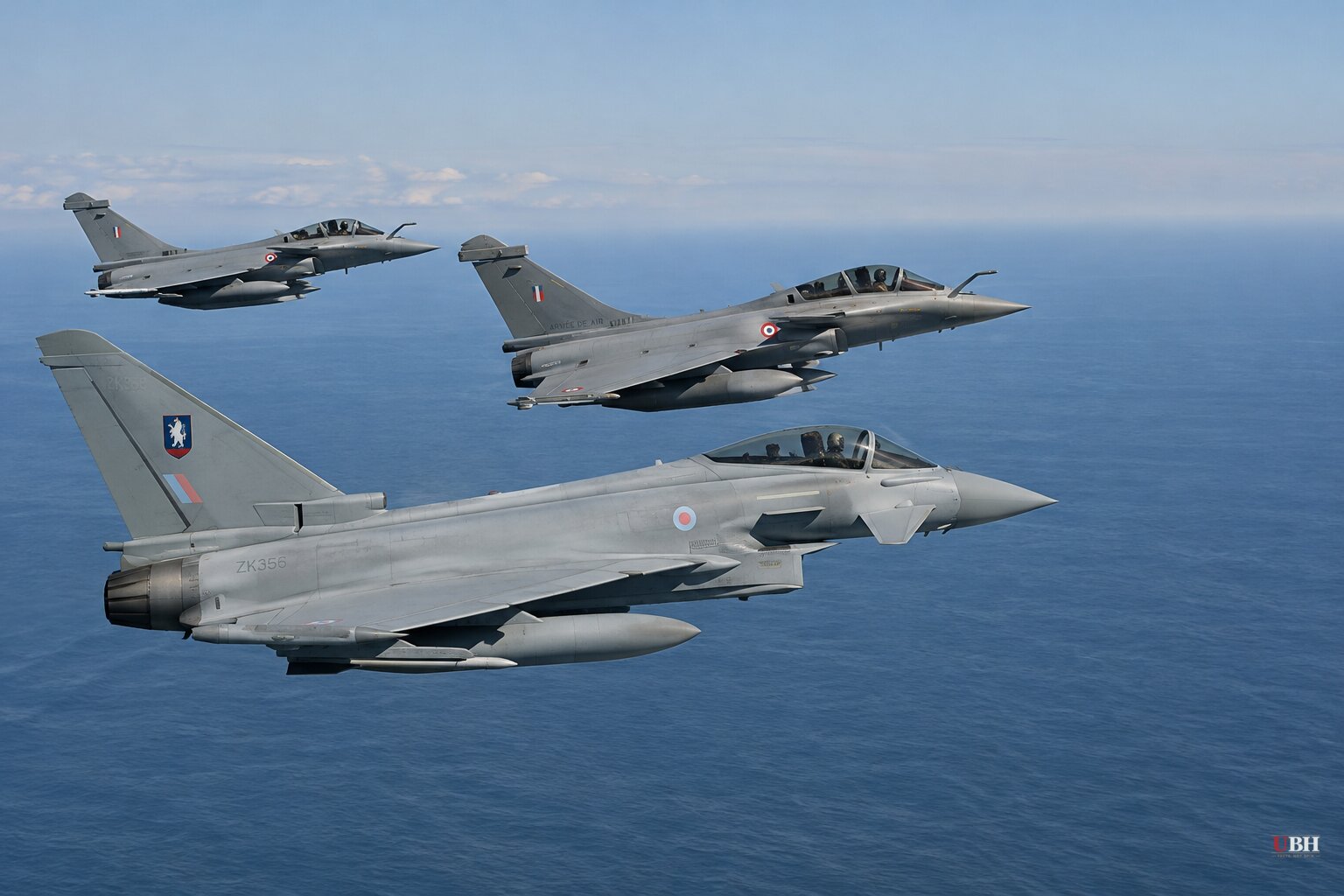
France and the United Kingdom flew a joint simulated nuclear-strike mission this week, the first time British aircraft have taken part in a French airborne nuclear exercise. The French Armed Forces Ministry announced it in a statement today, Friday, Oct. 23.
The exercise, code-named Rummy, ran Oct. 20 and 21, according to the ministry. The key flight took place Tuesday evening, Oct. 20, over the Mediterranean.
What flew
Royal Air Force Eurofighter Typhoons escorted French Rafale jets on the simulated strike. A330 MRTT tankers supported the mission, French Armed Forces Chief of Staff Gen. Fabien Mandon said in a post on X.
The French and British crews took off from Saint-Dizier air base in northeastern France. Mandon said they showed a "very high level of interoperability and a capability to coordinate."
The Rafales performed the simulated strike. The ministry said no actual nuclear weapons were involved.
Mandon's post included a photo of three taxiing Eurofighters, plus one under a hard cover bearing RAF 29 Squadron markings.
Why France's air leg matters
Both countries run ballistic-missile submarines as their strategic deterrent. Only France also has an airborne component: Rafales carrying nuclear-tipped cruise missiles. The U.K. has no equivalent.
That is what makes the British role notable. Etienne Marcuz, a senior analyst at the Fondation pour la Recherche Stratégique, called it "a revolution for the Strategic Air Forces, which have always operated in complete autonomy since their creation in the 1960s." He described the involvement of at least three British Eurofighters as "quite significant."
What officials said
French Armed Forces Minister Catherine Vautrin framed the drill around sovereignty and coordination together. "Having independent nuclear forces doesn't exclude coordination," she said. She added that coordination lets the two forces contribute "even more significantly to the overall security of the alliance."
British Defence Secretary Wes Streeting called it "a landmark step in UK-France defence co-operation." He said: "In an increasingly dangerous world, our adversaries should be in no doubt: the United Kingdom and France stand together in their commitment to European security and to maintaining the deterrence that has helped preserve peace for generations."
The ministry called the exercise an important step in implementing the Northwood Declaration. In that agreement, London and Paris committed to deeper nuclear coordination and said no extreme threat to Europe would go unanswered by both nations. Modern Diplomacy dates the agreement to July 2025.
The backdrop: Russia and doubts about Washington
France is working with several European allies on what it calls "forward deterrence." The push comes amid uncertainty over U.S. security guarantees for Europe and an aggressive Russia.
Washington has long provided Europe's primary nuclear deterrence, a decades-old symbol of trans-Atlantic solidarity. President Donald Trump's criticism of NATO and his overtures to Russia have fed concern in European capitals about whether Washington would help defend its allies.
Paris has been building its own case. In March, President Emmanuel Macron announced plans to expand France's nuclear arsenal. He also offered European allies joint exercises and the short-term deployment of French nuclear-capable assets on their territory.
Earlier this month, the French defence ministry carried out the first test launch of its latest M51.3 submarine-launched ballistic missile off the coast of Brittany. The missile carried no nuclear warhead. The shot certified the submarine Le Vigilant's ability to deploy the weapon after a major maintenance overhaul.
The numbers
France maintains 290 nuclear warheads on air- and sea-launched systems and spends roughly €5.6 billion a year doing it. Britain holds 225. Russia and the United States each hold more than 5,000.
Both European arsenals remain under separate national control. The ministry said the U.K. and France maintain sovereign and independent nuclear forces, and decision-making on their use is not shared. Vautrin's statement leans on that point: coordination, not merger.
What comes next
Macron's March offer of joint exercises and the temporary deployment of French nuclear-capable assets on allied soil is still on the table.
Sources used for this briefing
7 links from 6 independent newsrooms (syndicated copies of the same report count once)
These are the sources it draws on, linked so you can verify.


