
Unbiased headlines. Facts, not spin.
Unbiased Headlines is an independently owned news organization. We bring you the facts, not opinions, written fresh from 110+ named sources. Sources linked so you can verify it yourself.
 defense
Notable (6/10)
Hegseth memo bars Pentagon personnel from betting on Polymarket and Kalshi with nonpublic information
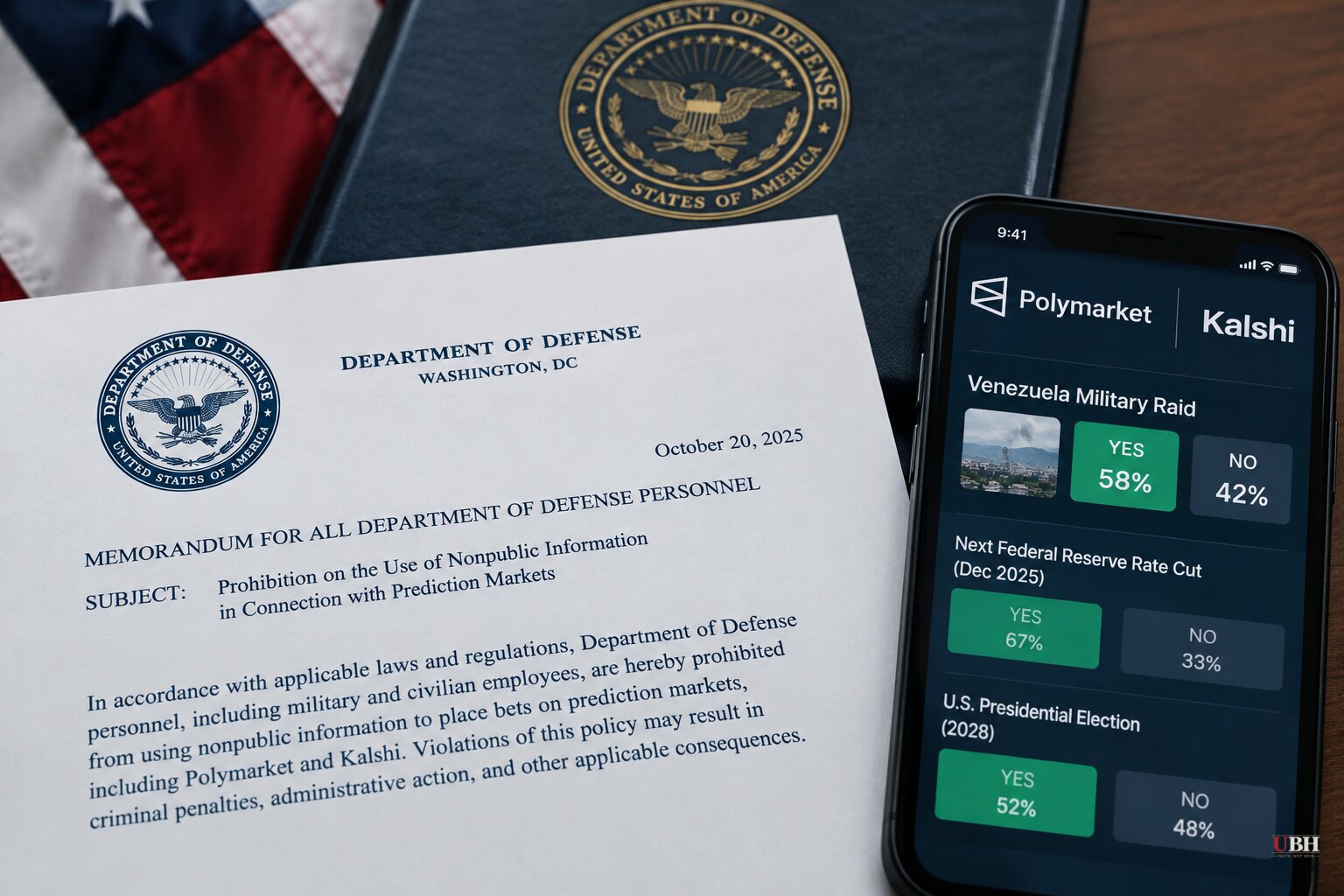
Pentagon personnel are barred from using nonpublic government information to place financial wagers, including on prediction markets, under a memorandum Defense Secretary Pete Hegseth signed on Oct. 20.
The memo names "traditional betting platforms and prediction markets such as 'Polymarket' or 'Kalshi.'" It was addressed to Pentagon leadership, combatant commanders, and the directors of Defense agencies and field activities. DefenseScoop obtained it Thursday, Oct. 22, and a source confirmed its authenticity.
What the memo says
The ban covers classified and unclassified information alike. "This prohibition applies whether the transaction is informed by classified or unclassified information," Hegseth wrote.
It also reaches transactions conducted indirectly through another party, not just personal accounts, according to Crypto Briefing's account of the memo, which was first reported by CBS News.
Violators face "administrative, disciplinary, and, where appropriate, criminal action under the Uniform Code of Military Justice and/or applicable federal law," the memo says.
Hegseth gave two reasons. The first is operational security. When service members, intelligence professionals and Defense civilians take part in financial transactions tied to operational outcomes, he wrote, they generate indicators adversaries can exploit against U.S. forces and assets. "Make no mistake why this matters. Our enemies watch movements in these markets," he wrote. The department's concern is that foreign intelligence services could aggregate and correlate market signals to infer the timing of operations, potential targets and troop movements.
The second is judgment. "A logistician with money riding on a strike date has an interest in that date. An analyst with a position on an outcome has an interest in that outcome," Hegseth wrote. The department says such financial interests can distort professional judgment and conflict with discipline, operational readiness and winning military engagements.
The case behind it
The memo lands against a specific prosecution. In April, the Justice Department charged Master Sgt. Gannon Ken Van Dyke, a senior enlisted soldier assigned to U.S. Army Special Operations Command, over bets on the capture of Venezuelan President Nicolás Maduro.
Prosecutors allege Van Dyke used information he obtained while taking part in the planning and execution of Operation Absolute Resolve, the operation to capture Maduro. They say he placed approximately 13 bets worth $33,034 on Polymarket covering potential U.S. military activity in Venezuela and Maduro's removal from power. The alleged profit was approximately $409,881 after January's capture.
Officials also allege he then sent money to a foreign cryptocurrency vault before moving the funds into a newly made brokerage account.
Van Dyke pleaded not guilty and was released on bond. He has not been convicted of anything.
A wider pattern
The Van Dyke case is not the only one. In February, Israeli authorities arrested and charged a reservist and a civilian on allegations they traded on Polymarket using information about an Israeli military strike on Iran.
In August, CNN reported that more than 150 Polymarket "wallets" may have traded on insider information from the military, citing research by the nonprofit Anti-Corruption Data Collective. That is a researcher's estimate, not a finding by a court or agency.
Also in August, Reuters reported that Polymarket had referred "dozens" of potential military insider trading cases to the Justice Department.
Congress is circling too. On Oct. 4, House Oversight Committee Chairman James Comer, R-Ky., discussed on Fox News Live legislation targeting government employees and politicians who use prediction platforms. No bill text or vote has been reported.
What the memo does not answer
Maduro was captured in January. Van Dyke was charged in April. The Pentagon's written ban is dated Oct. 20.
The Justice Department charged Van Dyke before this memo existed, so prosecutors were already pursuing alleged insider betting on military operations. What the memo adds is a department-wide written rule and an explicit path to administrative and disciplinary action, alongside criminal consequences where appropriate.
The memo's text, as reported, does not say how the Pentagon will detect violations. The alleged Van Dyke transfers ran through a foreign crypto vault. Hegseth's memo, as described in the coverage, does not describe monitoring, reporting requirements or an audit process.
Polymarket's own referrals to the Justice Department, as reported by Reuters, suggest the platform has acted on suspected military insider trading.
The next concrete marker is the Van Dyke case, where a trial or plea would show how prosecutors prove that a soldier's trade rested on nonpublic operational information. Whether Comer's legislation moves in Congress will show whether restrictions extend beyond the Pentagon to other government employees.
Sources used for this briefing
7 links from 7 independent newsrooms (syndicated copies of the same report count once)
These are the sources it draws on, linked so you can verify.


