
Unbiased headlines. Facts, not spin.
Unbiased Headlines is an independently owned news organization. We bring you the facts, not opinions, written fresh from 110+ named sources. Sources linked so you can verify it yourself.
 defense
Major Story (8/10)
Saudi Arabia Says Houthi Strikes Have Killed 24 This Month as Another Missile Is Shot Down Over Riyadh
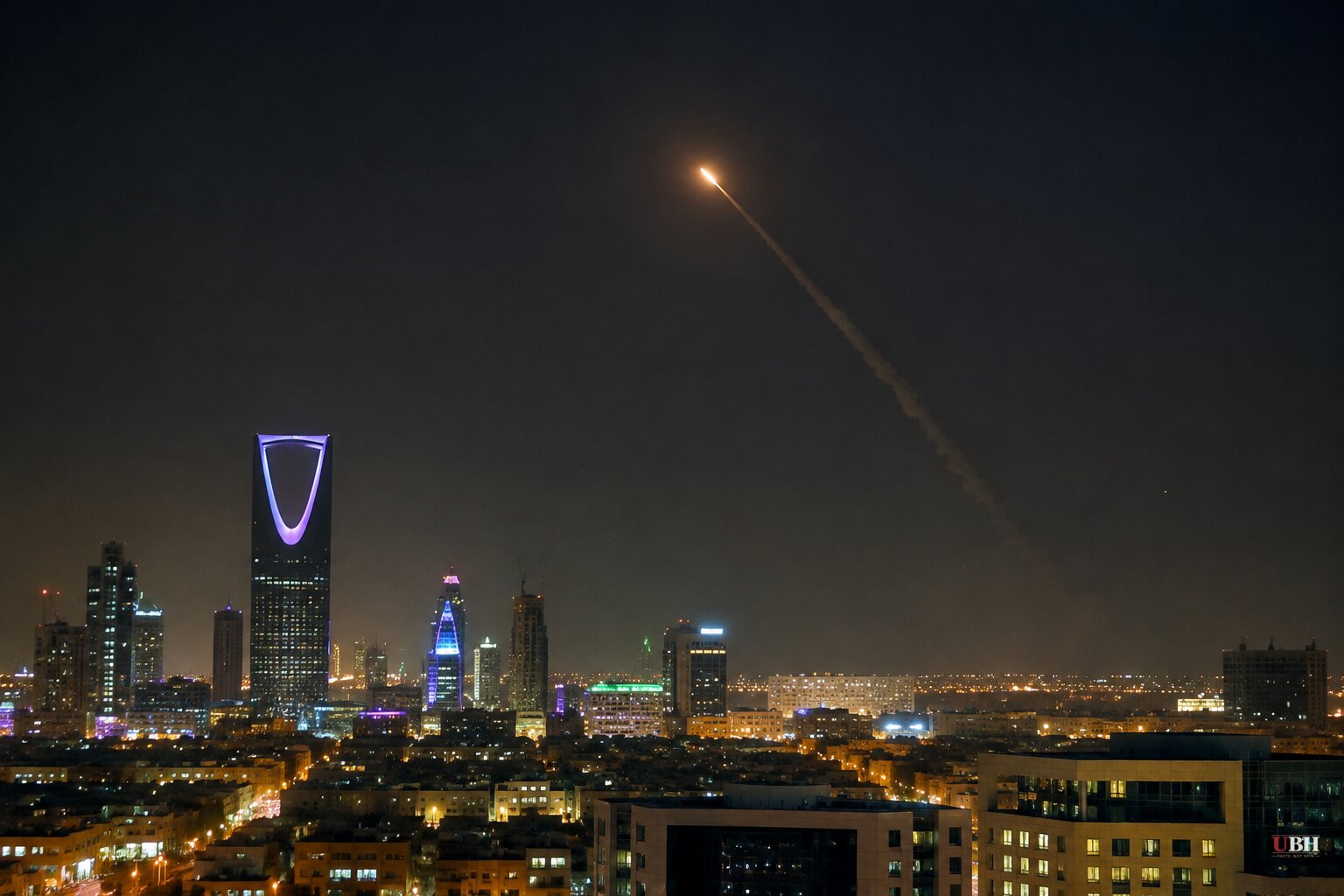
The Houthi campaign against Saudi Arabia has become the sharpest cross-border escalation of the Iran war's regional spillover, and it has not let up. Between Oct. 7 and Oct. 11, a series of missile and drone attacks hit King Khalid International Airport in Riyadh.
The Saudi-led Coalition to Restore Legitimacy in Yemen said its air defenses shot down a Houthi ballistic missile launched toward Riyadh shortly after 4 a.m. Friday. Coalition spokesman Maj. Gen. Turki Al-Maliki said two drones aimed at the southern region were destroyed around 1 a.m. The coalition also said a ballistic missile targeting Khamis Mushait was intercepted.
On Thursday, Oct. 22, the coalition said it destroyed a missile fired toward Najran, near the Yemeni border. No casualties or damage were immediately reported in that attack.
The October toll
Coalition figures show the Houthis have launched at least 14 ballistic missiles and more than 60 armed drones at the kingdom this month. Coalition and official government reports carried by the Saudi Press Agency put the death toll at 24 and the injured at no fewer than 374.
King Khalid International Airport took the worst of it: 18 dead and more than 333 injured between Oct. 7 and Oct. 11. The deadliest single strike came Oct. 10, when a ballistic missile hit the area between Terminals 3 and 4, killing 13 and wounding 309.
Abha International Airport lost two people, with 28 injured. At Dammam's King Fahd International Airport, two died and eight were hurt. Two more were killed and two wounded in attacks on Aramco's Shaybah oil facilities. Three people were also injured in strikes on King Abdullah Airport in Jazan.
The Houthis tell a different story about intent. Houthi military spokesman Yahya Saree claimed on Thursday that the group carried out four missile and drone attacks over the previous 48 hours against targets in Riyadh, Dammam, Yanbu and Abha. The coalition, for its part, rejected Houthi claims that Saudi Arabia is threatening tribal and civilian gatherings in Yemen, calling them baseless and fabricated.
Why $83 billion has not been enough
Saudi Arabia's 2026 budget listed $83 billion for the military. The kingdom received 12% of all U.S. arms exports from 2021 to 2025, according to the Stockholm International Peace Research Institute, and earlier this year it struck a $9 billion deal with Washington for 730 Patriot missiles. It operates Patriot and THAAD systems.
The geography works against it. The country is roughly three times the size of Texas, with a Yemen border stretching more than 1,300 kilometers. Iran fired about 1,000 missiles and drones at Saudi targets at the height of the conflict this year, and Iran-backed militias in Iraq have hit the East-West oil pipeline with drones. Satellite imagery showed pipeline damage after a Sept. 22 attack.
The Houthis now combine ballistic missiles, low-flying cruise missiles and long-range drones in the same salvos to overwhelm defenses. Saudi analyst Ali Shihabi put it plainly this week: "Expecting a country the size of Saudi Arabia to intercept every missile is simply unrealistic. No defense can guarantee complete protection."
Regional officials say the kingdom is running low on interceptors and has asked allies for help. A Saudi source told CNN the defense ministry faces hard choices in distributing the limited systems on hand. Saudi Arabia recently signed a defense pact with Pakistan and Turkey, but those two countries appear to be staying largely on the sidelines or limiting their support.
Iran's role and what comes next
Rayed Krimly, deputy minister for public diplomacy at the Saudi foreign ministry, told journalists in Cairo that Iran is encouraging the escalation and does not appear ready to make the concessions needed in the wider war with the United States.
Washington's next move is undecided. President Donald Trump said this week he is evaluating whether the U.S. should join Saudi strikes on the Houthis. He has not announced a decision.
The larger decision may come after the U.S. midterms. The New York Times reported Thursday that Washington and Israel have drawn up a short, intensive bombing campaign for after Nov. 3, and after Israel's Oct. 27 election. According to the report, exercises are already running, more U.S. forces are moving into the region, and the target list covers nuclear sites, missile and drone installations and energy infrastructure. Iran has explicitly listed Saudi refineries, data centers and undersea communications cables as the next targets should Washington strike again, according to OilPrice.com.
Egypt has a direct stake. A $5.3 billion Saudi deposit at its central bank falls due this month, and the war has already forced Cairo to buy replacement LNG after Israel cut gas exports. OilPrice.com describes Egypt's offer to help defend Saudi Arabia as a defensive move to protect that money and its Red Sea shipping revenue.
Saudi Arabia is also reportedly building its own firepower. Researchers Sam Lair and Michael Duitsman of the Foreign Policy Research Institute analyzed commercial satellite images from April 2025 to September 2026 and found a new building at the Al-Dawadmi missile complex, about 200 km west of Riyadh. It appears to contain casting pits for solid-fuel missile motors and is at least twice the size of an existing facility. They said the complex could begin producing missiles by the end of 2026, depending on equipment installation. The imagery does not establish the facility's intended role or confirm that production has begun, and the researchers assessed that Saudi Arabia may be producing Chinese-designed DF-15 ballistic missiles.
Saudi Arabia says it is investigating how its air defenses failed to stop the airport strikes. The coalition and the Houthis have been exchanging attacks since July, and the Nov. 3 date now hanging over the region leaves one open question: whether the kingdom can replenish its interceptors before any new U.S. and Israeli strikes on Iran invite the retaliation Tehran has threatened.
Sources used for this briefing
8 links from 7 independent newsrooms (syndicated copies of the same report count once)
These are the sources it draws on, linked so you can verify.


