
Unbiased headlines. Facts, not spin.
Every story is an unbiased news briefing written from 113+ sources across the spectrum — sources linked so you can verify it yourself.
 energy
Notable (6/10)
October 1, 2026 at 04:43 PM
energy
Notable (6/10)
October 1, 2026 at 04:43 PM
Uranium Hits All-Time High of $96 a Pound While Cameco and Nuclear Stocks Keep Falling
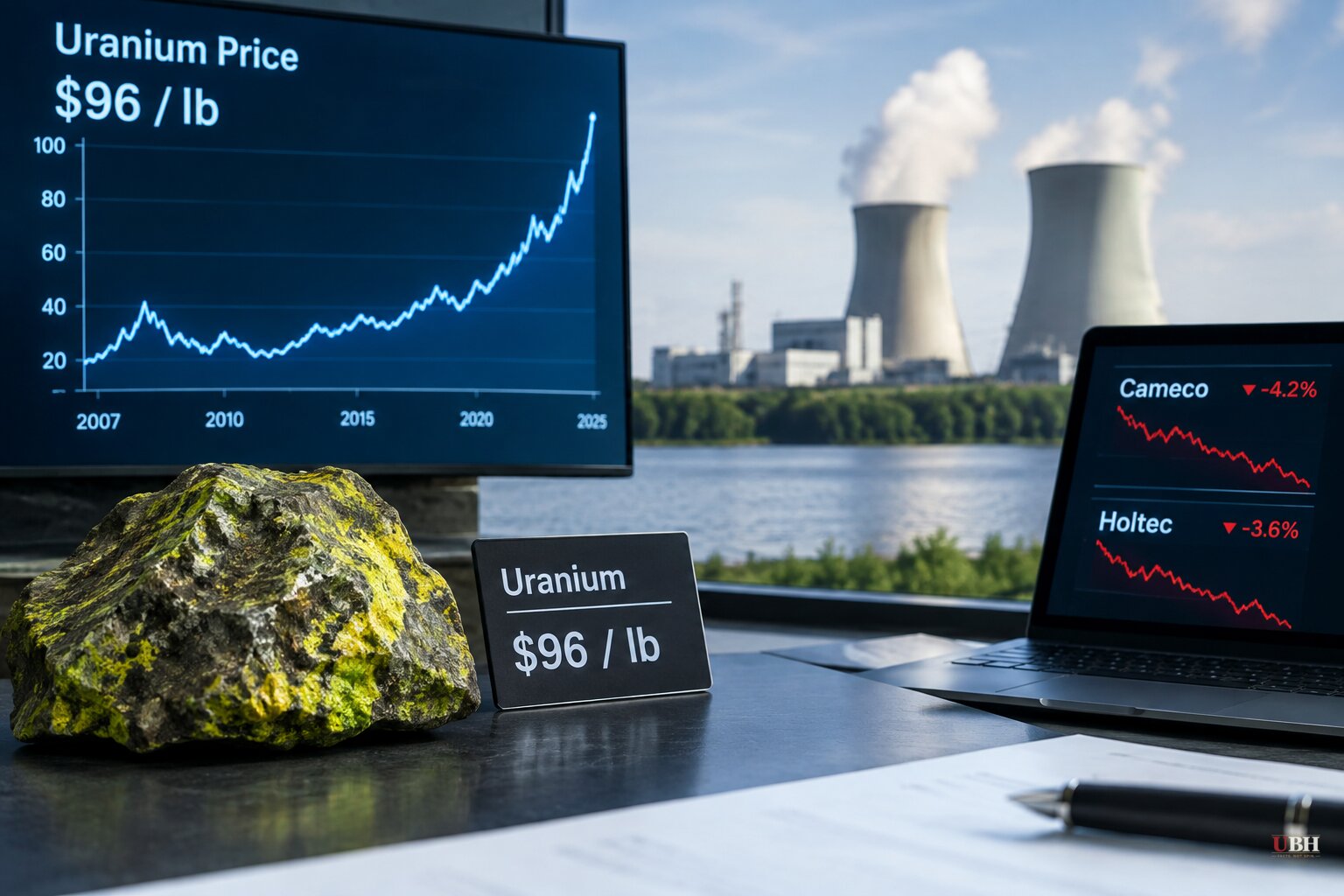
Uranium Hits Highest Level Since 2007 at $96 a Pound While Cameco and Nuclear Stocks Keep Falling
The price of uranium just did something it hasn't done since 2007. Long-term contract prices hit $96 a pound, the highest level since that year's historic spike, up roughly 12% year-to-date, according to UxC data compiled by TD Cowen analysts Craig Hutchison and David Liang. Spot prices followed, climbing to around $90 a pound, up about 11% on the year.
Normal market logic says the stocks tied to that commodity should be flying. They are not.
Cameco, one of the world's largest uranium producers, is down more than 4% this year and trading around $84.54, well off its 52-week high of $135.24, according to The Motley Fool. Analysts have an average price target of $127 on the stock, implying significant upside if the fundamentals actually catch up with the equity price. XTB reports the same pattern across Uranium Energy Corp, Oklo, Kazatomprom, Denison Mines, NuScale, Centrus Energy and BWX Technologies: the whole sector sliding while the raw material sets records.
Utilities Are Balking at the Price
TD Cowen's own conversations with companies in its coverage universe point to the simplest explanation: buyers don't want to pay up. "Term pricing remains at all-time high, and based on our conversations with the companies under coverage, utilities are feeling a sticker shock on pricing and seem reluctant to contract in any meaningful way," the firm wrote.
Term contracting volumes were down roughly 15% year-over-year as of late August, sitting at just over 38 million pounds. The World Nuclear Association Symposium in London, held September 9-11, narrowed that gap somewhat, pushing volumes to 42.2 million pounds by September 15, about 3% below last year's pace. TD Cowen argues it's "not a question of if term contract volumes pick up, it is a question of when," since utilities are contracting below the replacement rate their reactors actually require. Fuel doesn't fill itself. But 2026's cumulative term volumes are still tracking at the bottom of the past five years, nowhere near 2023's roughly 160 million pound blowout.
The IPO Pipeline Is Stalling Too
Holtec, an industrial nuclear energy company that had been preparing to go public, postponed its IPO and cited uncertainty around data center development as a factor, according to XTB. That's notable because the entire nuclear equity rally over the past two years has been built on the assumption that AI data centers need enormous, reliable power and nuclear is the answer.
XTB's analysis points to a more basic financial mechanism: higher interest rates raise the discount rate applied to projects that won't generate cash for years, which hits small modular reactor developers particularly hard since many are still burning cash. NuScale Power is a case in point. Its stock rose 4% recently even as the company launched a new $750 million share-sale program that dilutes existing shareholders, according to Pluang. NuScale remains pre-commercial despite sitting on a $1.9 billion cash position.
Meanwhile Uranium Energy Corp posted a genuinely strong fiscal 2026: production expanded from one mine in one state to two mines in two states, with a third under construction at Ludeman, drill rigs doubled to 40, and the company sold uranium at $93.13 a pound, the highest realized price among public producers, per Pluang. The stock jumped 6% on the news. That's the kind of concrete operating result the market is rewarding, in contrast to speculative SMR names still years from revenue.
One Possible Bright Spot: Westinghouse
There's at least one near-term catalyst that could reconnect commodity and equity. Westinghouse, the reactor maker Cameco co-owns, may go public at a valuation north of $50 billion, which would value Cameco's 49% stake at roughly $24.5 billion, according to The Motley Fool. Westinghouse's technology powers 57% of the world's existing nuclear reactors.
The broader market backdrop isn't helping nuclear's case either. The Epoch Times reported the S&P 500 pushing toward record highs in late September on falling oil prices and easing Middle East tensions, while CNN noted that bond market volatility surged roughly 47% that same month, its biggest one-month jump since February 2021, as yields hit multi-year highs. Higher yields raise the cost of capital across the board, and nuclear projects, with their years-long payback horizons, feel that pinch more than most.
A reasonable skeptic would say the uranium price itself could be fragile. Term volumes are being set by a shrinking pool of willing buyers, not broad utility demand, and a commodity rally built on "thin volume," in TD Cowen's own words, is not the same as a durable repricing. But the physical fundamentals matter. Reactors keep running on fuel they haven't yet bought, meaning utilities can delay contracting, not avoid it. Historically, November and December have brought utility buying surges of 26 to 30 million pounds in a single month. Whether that pattern repeats before year-end will say a lot about whether this is a temporary standoff or a genuine crack in the nuclear investment thesis.
Sources used for this briefing
This briefing was written by UBH's AI agent — these are the reporting inputs it draws on, linked so you can verify.


