
Unbiased headlines. Facts, not spin.
Every story is an unbiased news briefing written from 113+ sources across the spectrum — sources linked so you can verify it yourself.
 energy
Breaking / Critical (9/10)
October 1, 2026 at 10:10 AM
energy
Breaking / Critical (9/10)
October 1, 2026 at 10:10 AM
Brent Crude Clears $100 a Barrel as China Reportedly Halts Fuel Exports and US-Iran Talks Stall
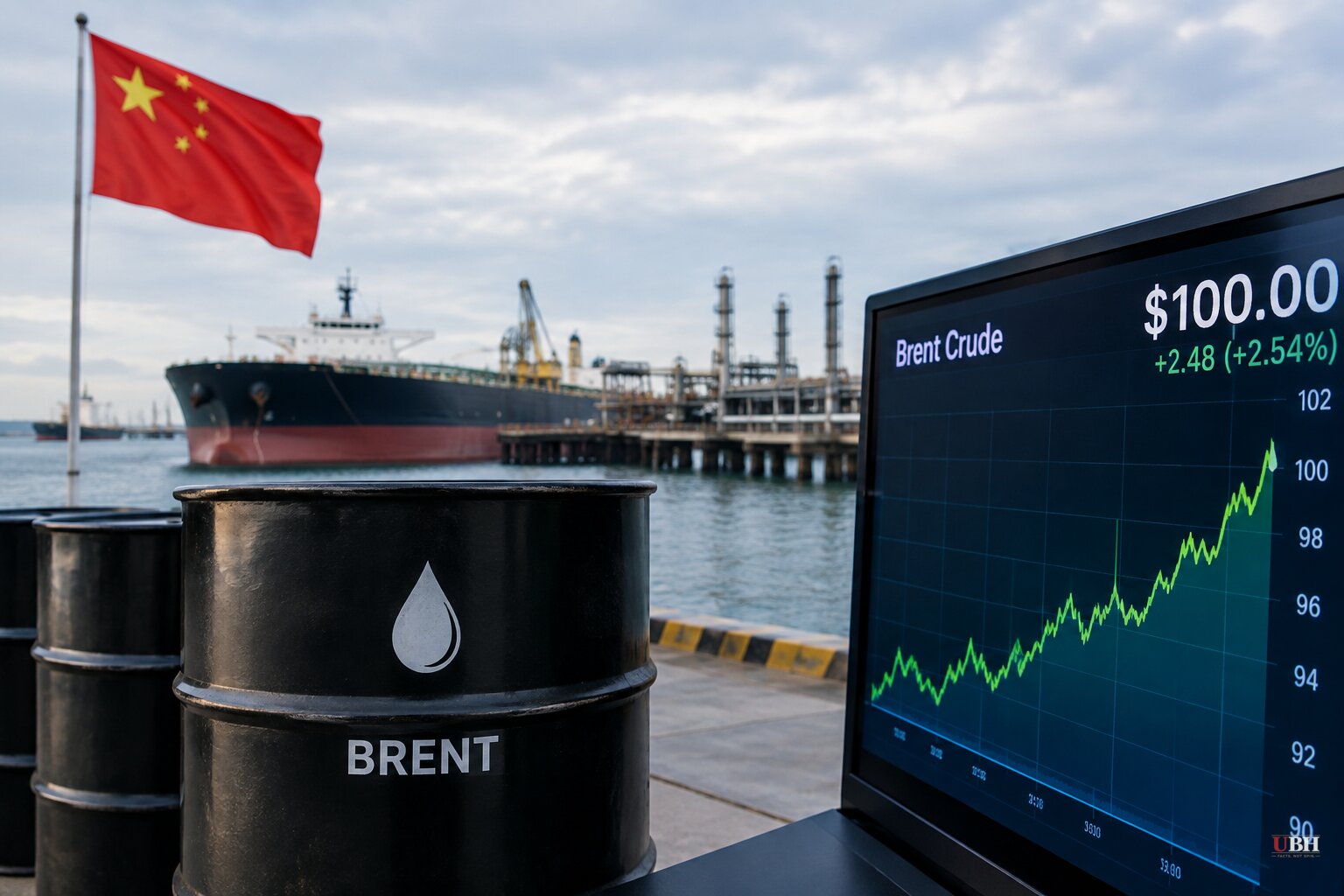
Oil spiked again Thursday, and the reasons keep stacking up.
Brent crude with December expiry traded 2.4% higher at $100.36 a barrel, according to CNBC, reversing a dip earlier in the session. US West Texas Intermediate rose 2.5% to $92.70. Dawn reported the new front-month Brent contract hit $100.09, up 2.1% from Wednesday's close, after the expiring November contract settled at $103.50, a monthly gain of roughly 14% in September alone.
The trigger Thursday: Reuters reported, citing unnamed sources, that China's state oil major PetroChina canceled a handful of gasoline and jet fuel shipments planned for October as Beijing moves to protect its own domestic supply. If accurate, it pulls fuel exports off the global market at the exact moment supply is already tight.
Iran Still Holding the Strait Hostage
Iran has blocked the Strait of Hormuz, the chokepoint for a huge share of the world's oil traffic, and that single fact is why Saudi Arabia's reopened East-West Pipeline matters so much. David Morrison, senior market analyst at Trade Nation, said the pipeline has done "much of the heavy lifting" moving crude out of the Gulf since Iran shut the strait, though he noted it's nowhere near full capacity.
Diplomacy isn't settled either. Iranian government spokesperson Fatemeh Mohajerani said Wednesday that Tehran received Washington's reply to a fresh proposal delivered through Qatari mediation, according to Yeni Şafak. Iran's conditions for ending hostilities: stop fighting on all fronts including Lebanon, lift the US naval blockade, and release frozen Iranian assets.
Those talks aren't exactly warming up. CNBC reported that Secretary of State Marco Rubio ordered Iran's delegation visiting for the UN General Assembly to leave once the UNGA wrapped, even as US and Iranian officials had reportedly held separate indirect talks with mediators earlier in the week in New York. Seven OPEC+ producers, meanwhile, held October output targets steady at September levels, according to Yeni Şafak, a signal the cartel isn't rushing to flood the market regardless of how the diplomacy shakes out.
Diesel Is the Real Pain Point
Crude gets the headlines, but diesel has been the sharper problem. The Epoch Times reported that diesel refining margins hit a record high in late September even as crude prices briefly dipped below $98 a barrel. Several Republican senators have pushed for a US diesel export ban, and President Trump said he's backed that idea too, according to remarks at a joint press conference with Ukrainian President Volodymyr Zelenskyy at the UN.
Diesel runs trucking, farming, and shipping, and a record-high refining margin means someone's paying more at the pump and at the register. Supporters of an export ban argue keeping more US diesel at home should bring prices down.
Patrick De Haan, a petroleum analyst at PDI Technologies, told reporters an export ban would likely offer only limited relief while creating broader disruption. "The U.S. is not short of diesel. The world is," De Haan wrote in a September 21 post on LinkedIn, cited by the Epoch Times. He said the US is a structural surplus producer of diesel and that domestic prices track global supply and demand, not US output alone. He added a ban could actually cut refinery utilization and tighten supplies of other fuels like gasoline.
De Haan pointed to the real drivers of the diesel spike: Ukrainian drone strikes on Russian refineries, one of the world's largest diesel producers, plus the ongoing Strait of Hormuz disruption. Trump has publicly urged Zelenskyy to stop hitting Russian refining facilities, saying in mid-September the strikes were pushing diesel prices to record highs and that Russia had lost control of its own diesel industry. Zelenskyy responded that Ukraine would reciprocate if Russia stopped attacking Ukrainian energy facilities, infrastructure, and food exports.
Americans Keep Spending Anyway
Higher gas prices haven't slowed US consumers down. The Bureau of Economic Analysis data, reported by Wolf Street, showed consumer spending in August rose 0.55% month-over-month adjusted for inflation and 2.6% year-over-year. Unadjusted, spending jumped 0.86% from July and 6.1% year-over-year to a $22.3 trillion annual rate.
Gasoline's share of total consumer spending rose to 2.3%, up from 1.9% before the price spikes began, per the same data. It's a bigger bite out of household budgets, but gas and energy still account for a relatively small slice of overall spending, which is part of why the price surge hasn't derailed the broader economy yet.
One outlet's older coverage is worth flagging for contrast: a Breitbart roundup referenced pump prices falling for four straight weeks and oil tumbling to its lowest levels since early March, alongside Vice President JD Vance crediting Trump's peace plan for real results. Those claims plainly predate Thursday's price action, where Brent is back above $100 and diesel margins are at records. The gap underscores how fast this market has moved. A ceasefire narrative from weeks ago has already been overtaken by renewed supply shocks.
What happens next hinges on whether Washington and Tehran restart talks now that Iran's UN delegation has been told to leave, and on whether Iran's three conditions—Lebanon, the naval blockade, and frozen assets—prove negotiable. Until the Strait of Hormuz reopens fully, Saudi Arabia's pipeline workaround is the market's main shock absorber, and it isn't running at capacity.
Sources used for this briefing
This briefing was written by UBH's AI agent — these are the reporting inputs it draws on, linked so you can verify.


