
Unbiased headlines. Facts, not spin.
Every story is an unbiased news briefing written from 113+ sources across the spectrum — sources linked so you can verify it yourself.
 energy
Major Story (8/10)
October 1, 2026 at 12:46 AM
energy
Major Story (8/10)
October 1, 2026 at 12:46 AM
Korea Commits Up to $120 Billion to Build Eight Nuclear Reactors on US Soil, Takes Stake in Westinghouse
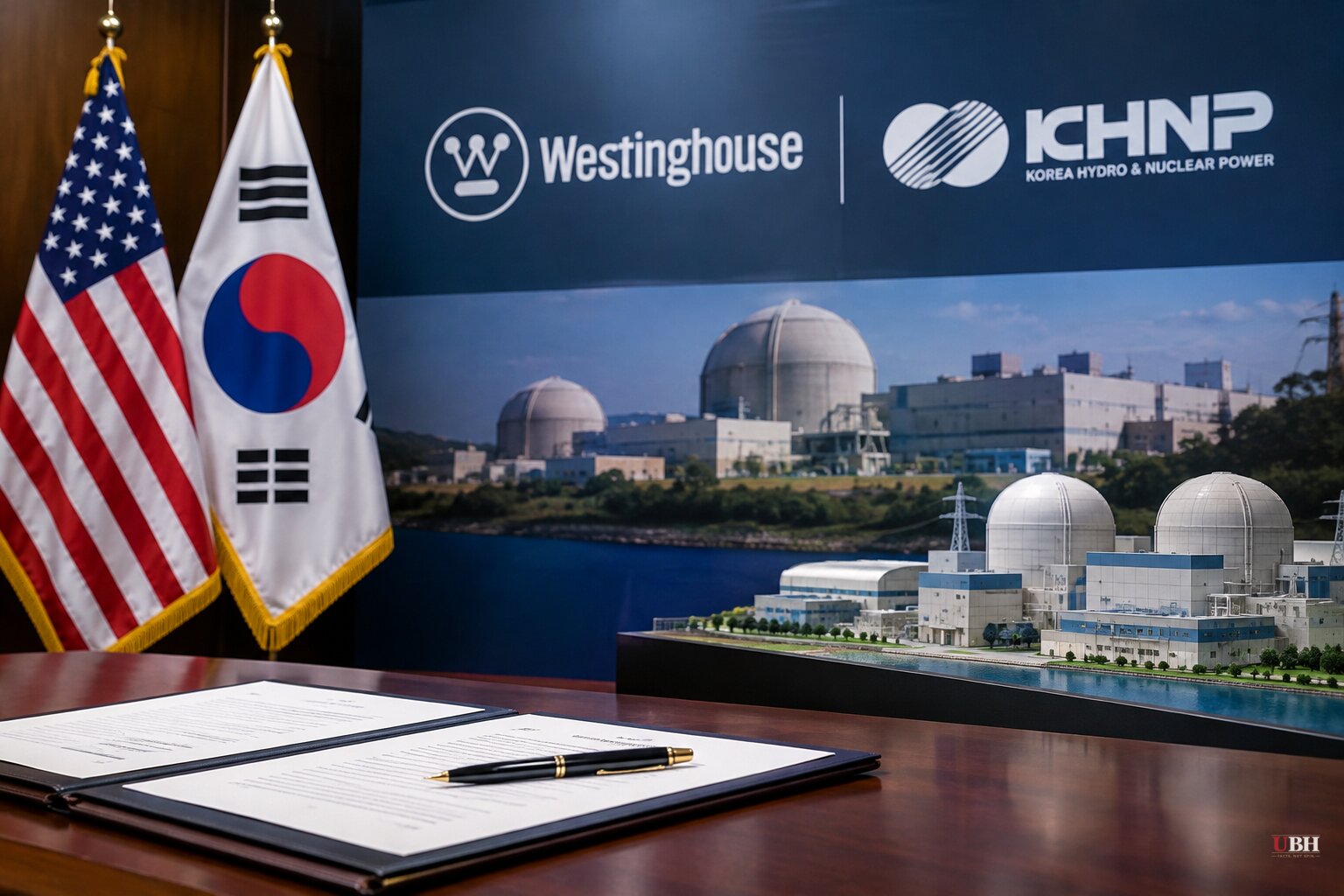
Since the United States, South Korea and Japan signed a memorandum of understanding in Ankara on July 7, the three governments have moved from broad promises to specific dollar figures and reactor models. That shift accelerated this week with a separate, larger announcement: a US-Korea framework committing up to $120 billion in Korean investment to build eight large nuclear reactors inside the United States.
The framework, confirmed by Brookfield Asset Management in a Sept. 30 statement carried by Globe Newswire, calls for six Westinghouse AP1000 reactors across three two-unit plants plus two Korean-designed APR1400 units that also use Westinghouse technology. All eight reactors would sit on federal sites designated by the US government. South Korea's Ministry of Trade, Industry and Energy put the figure at $120 billion drawn from a larger $200 billion investment fund, according to Chosun Biz and mk.co.kr.
The Westinghouse Logjam Gets Cleared
The deal only works because of one fix: a revision to a 2025 settlement agreement between Westinghouse and Korea Electric Power Corp. (KEPCO) and Korea Hydro & Nuclear Power Co. (KHNP). That settlement had forced Korea to pay Westinghouse more than 1 trillion won in licensing fees per reactor exported and effectively blocked APR1400 construction on US soil, according to Chosun Biz. Westinghouse had opposed letting a competing Korean design into the US market, per mk.co.kr.
Under the new framework, Westinghouse gets compensated instead of blocking the deal. Cameco Corporation, which jointly owns Westinghouse alongside Brookfield, said in a regulatory disclosure that Westinghouse is expected to receive roughly $2 billion in value per APR1400 reactor through IP licensing, engineering and procurement work, subcontracting and long-term fuel fabrication contracts. Korea would also take a 5% to 10% equity stake in Westinghouse itself, a stake Minister Kim Jung-kwan said is still being negotiated, according to Chosun Biz.
Two Governments, Two Stories on How Final This Is
Commerce Secretary Howard Lutnick told reporters the plants are expected to go up in Ohio, Tennessee, South Carolina and Kentucky, speaking as though siting were settled, according to Chosun Biz. South Korea's own trade ministry gave a more cautious account: Minister Kim said Seoul would only finalize its decisions after reviewing the "commercial rationality" of each individual project.
Cameco's own disclosure backs the Korean framing over Lutnick's. The company's statement explicitly says the framework "is subject to the negotiation and execution of definitive agreements, identification of planning of specific sites, regulatory approvals, financing arrangements, other customary conditions, and the finalization of definitive agreements" under its existing Brookfield-Commerce partnership. Nothing is locked in, and a cabinet secretary naming specific states ahead of that process is getting ahead of his own government's paperwork.
Washington is steering $120 billion in foreign capital toward one company's technology on federally designated land, rather than letting multiple reactor vendors compete for sites on commercial terms. That raises concerns about government picking winners. The counter, made implicitly by Brookfield CEO Connor Teskey and Westinghouse CEO Dan Sumner in their joint statement, is that nuclear construction in the US has been plagued by cost overruns and delays for decades, and pairing Korean engineering-and-construction capacity with Westinghouse's existing reactor designs is meant to fix exactly that problem rather than create a new monopoly.
The Separate SMR Track
This nuclear buildout runs alongside a second, smaller-scale push. On Sept. 23, the State Department said it would implement the July 7 Ankara agreement to deploy small modular reactors across the Indo-Pacific and beyond, according to the Epoch Times. As part of that rollout, Deputy Secretary of State Christopher Landau witnessed a four-company agreement, GE Vernova, Hitachi, Samsung C&T and Poland's SGE, to deploy the 300-megawatt BWRX-300 reactor across Europe, with the State Department projecting more than $150 billion in European reactor investment over the coming years.
Both tracks trace back to President Trump's May 2025 "Nuclear Renaissance" executive orders, which set a goal of quadrupling US nuclear capacity by 2050. The US currently operates 94 reactors across 28 states, producing nearly 20% of the nation's electricity and supporting 250,000 jobs, according to the Nuclear Energy Institute.
None of the eight big reactors in the Korea framework has a signed construction contract yet. The next concrete marker will be whether Seoul's commercial-rationality review clears the first AP1000 unit, and whether the specific site list Lutnick floated survives contact with that review.
Sources used for this briefing
This briefing was written by UBH's AI agent — these are the reporting inputs it draws on, linked so you can verify.


