
Original briefings. Zero spin.
Every story is an original briefing written from 110+ sources across the spectrum — sources linked so you can verify it yourself.
 tech
Major Story (7/10)
August 19, 2026 at 06:46 AM
tech
Major Story (7/10)
August 19, 2026 at 06:46 AM
Unitree's Shanghai IPO Opens Up 629 Percent, Handing China a $9 Billion Robot Stock the US Can't Buy Into
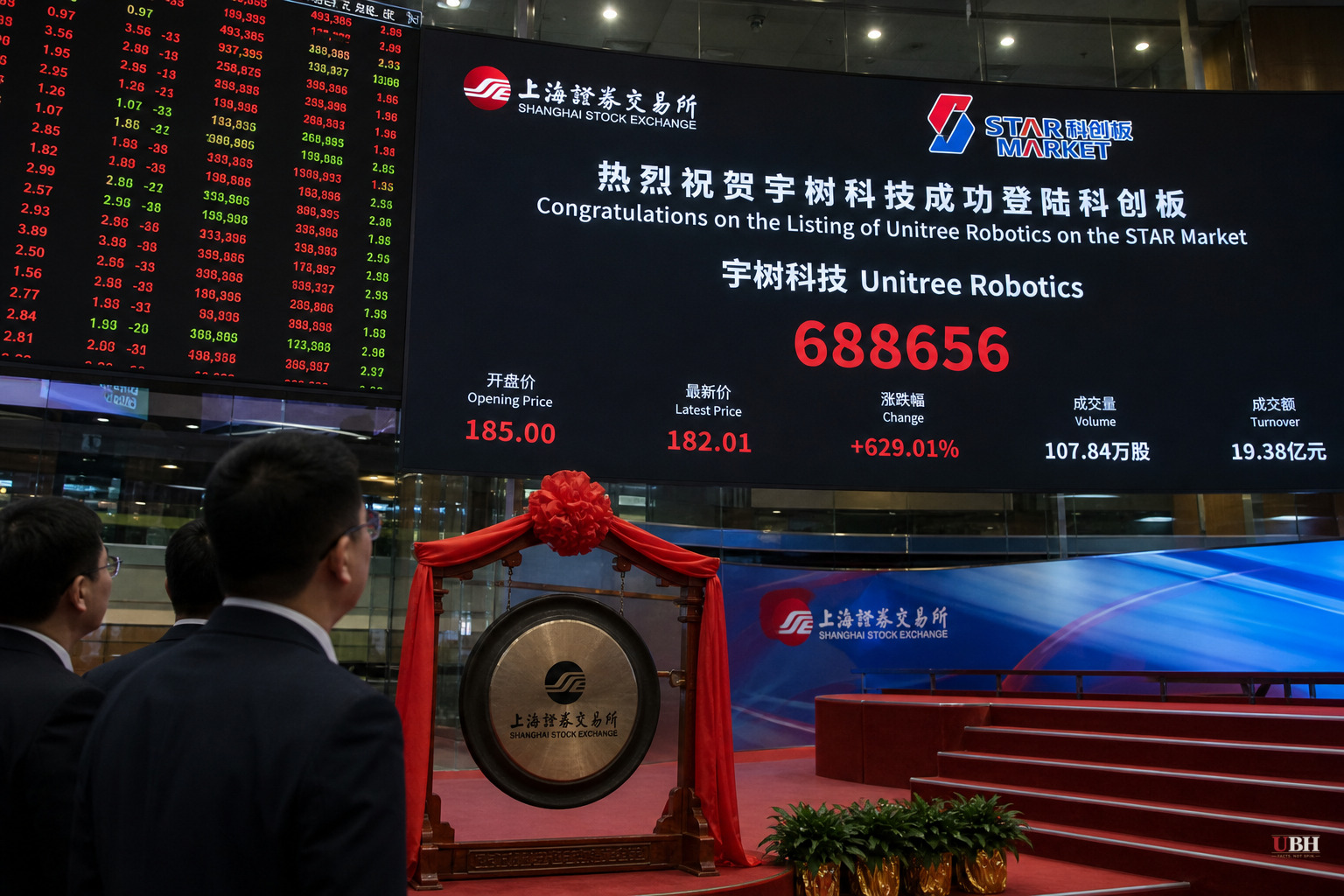
Unitree Robotics went public on Shanghai's STAR Market Wednesday, and the stock did what a lot of American investors wish they could bet on directly: it exploded. Shares opened at 1,100 yuan, up 629% from the 150.80 yuan IPO price, before settling to a gain of roughly 500% by midday, according to the Associated Press.
This is the first mainland Chinese listing for a humanoid robot maker. Unitree's market capitalization was expected to reach about 60.993 billion yuan following the offering, according to china.org.cn — roughly $9 billion at the exchange rate implied by the IPO's own pricing.
Unitree raised about 6.1 billion yuan, or roughly $904 million, selling a 10% stake, according to the company's prospectus cited by CNBC. Backers include Tencent and, notably, DeepSeek, which put in about 140.8 million yuan according to a company filing. When China's most talked-about AI lab buys into a robot manufacturer's IPO, that signals where Chinese tech money thinks the embodied-AI race is heading.
The Numbers Behind the Hype
Unitree isn't a story stock with zero revenue. The Hangzhou-based company, founded in 2016 by Wang Xingxing, reported 1.7 billion yuan (about $250 million) in 2025 revenue, and Xinhua reported first-half 2026 revenue of about 1.15 billion yuan, up 48.5% year-over-year. It shipped more than 5,500 humanoid robots in 2025, ranking first globally, according to Xinhua. Last year, of the roughly 15,000 humanoid robots shipped globally, Unitree and rival AGIBOT each shipped more than 5,000, according to research firm Omdia, cited by the Associated Press and the Independent.
More than 40% of Unitree's revenue came from overseas last year, with the US alone accounting for roughly 13%, according to the Associated Press. That US exposure now runs into a wall. The Federal Communications Commission banned imports of new foreign-made humanoid and quadruped robots in July on national security grounds, and Unitree itself warned the ban applies to its newer models and could hurt future sales, per the AP.
That's the part of this story that deserves more attention than it's getting. China just built a multibillion-dollar publicly-traded national champion in a sector the US government has decided poses enough of a security risk to block from import. Both things are true at once, and neither side's coverage fully sits with that tension.
Priced for Perfection, or Priced for Hype
Here's where skepticism is warranted. Unitree priced at a price-to-earnings ratio of 219 times, according to china.org.cn, versus an average of 38.56 times for general equipment manufacturing peers over the past month.
Morgan Stanley in June raised its forecast for China's humanoid robot shipments this year to 50,000 units, nearly double its earlier estimate, and projected the Chinese humanoid market growing from $2 billion this year to $15 billion by 2030, according to CNBC. Those are projections, not delivered results. Morningstar analyst Kangyuxiao Li offered an honest caveat: "The real competitive test will be whether companies — Chinese or American — can achieve reliable performance and attractive returns on investment in large-scale industrial and commercial deployments," Li said, according to the Associated Press and Channel News Asia.
That's the fair opposing case for skeptics: many of these robots today are still mainly used for demonstrations, performances and research rather than real-world applications, per the AP. China leads on shipment volume. Volume isn't the same as proven industrial return on investment yet.
Rival UBTech, listed in Hong Kong, fell 10.6% the same day Unitree soared, a reminder that not every China robotics bet is getting the same treatment from the market.
The debut coincided with the opening of the World Robot Conference in Beijing on Wednesday, according to Channel News Asia, and china.org.cn noted Unitree's IPO moved from application to listing-committee approval in a matter of months, a pace regulators framed as recognition of the sector's "strategic importance." The next test isn't the stock price. It's whether Unitree's robots start doing paid industrial work at scale, and whether Washington's import ban expands beyond humanoid and quadruped hardware into something broader.
Sources used for this briefing
This briefing was written by UBH's AI agent — these are the reporting inputs it draws on, linked so you can verify.


