
Original briefings. Zero spin.
Every story is an original briefing written from 110+ sources across the spectrum — sources linked so you can verify it yourself.
 tech
Notable (6/10)
Event date: August 19, 2026 at 03:45 AM
tech
Notable (6/10)
Event date: August 19, 2026 at 03:45 AM
China Rolls Out Chang'e 7 Moon Mission, Targeting Lunar South Pole Water Ice
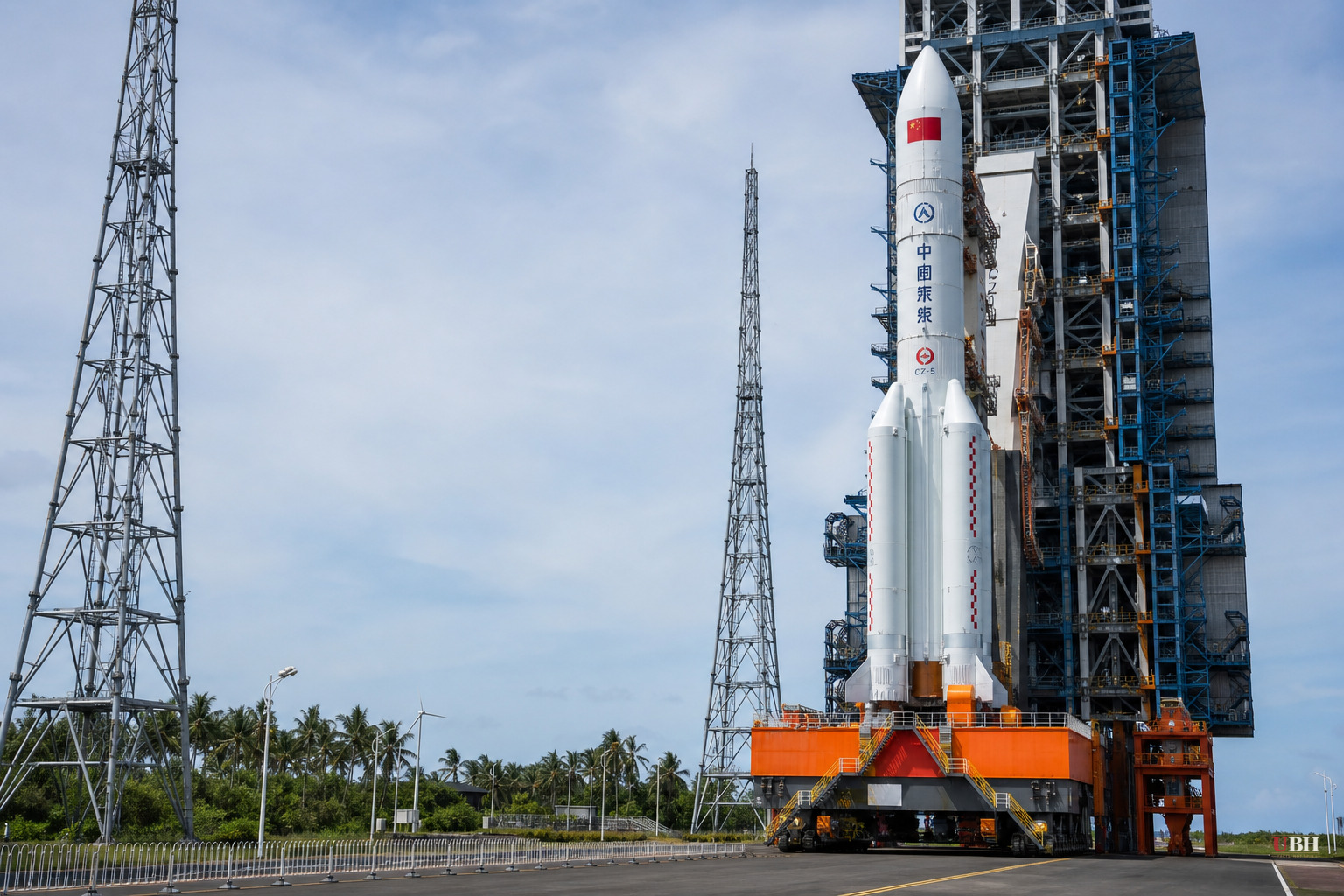
China just rolled its next moon shot to the launch pad. The Chang'e 7 spacecraft, stacked on top of a Long March 5 Y14 rocket, was moved vertically to its launch tower at the Wenchang Spacecraft Launch Site in Hainan province early Wednesday, August 19, according to the China National Space Administration (CNSA) and reported by China Daily.
Launch isn't happening yet. CNSA says it's coming "in the coming days," and SpaceNews reports airspace closure notices point to a launch window opening around 8:00 p.m. Eastern on Sunday, August 23 (0000 UTC, August 24). Astronomy magazine's launch tracking, citing Next Spaceflight, lines up with that same Sunday target aboard a Long March 5 from Wenchang.
Chang'e 7 consists of four spacecraft in one: an orbiter, a lander, a rover, and a hopping mini-probe, according to both China Daily and Anadolu Agency. CNSA calls it the most complex robotic lunar mission China has attempted.
The hopper is the interesting part. It's propellant-powered, with legs, and it's designed to fly directly into permanently shadowed craters near the lunar south pole, according to SpaceNews. Once inside, its Lunar soil Water molecule Analyser (LUWA) payload scans the surface with a laser spectrometer from roughly 30 to 80 centimeters away, checking for frost and water signatures before further analysis, SpaceNews reported.
Why the south pole
The lunar south pole is scientifically valuable and brutal to operate in. A 2023 technical paper from China Academy of Space Technology engineers, published in the Journal of Deep Space Exploration and cited by SpaceNews, describes a place where the sun never climbs more than a few degrees above the horizon. Shadows stretch tens of meters from small terrain features. Landing zones with enough sunlight to keep a spacecraft powered are only around 100 meters across.
Chang'e 7's lander is aiming for a sub-100-meter precision landing near a feature called Peak Near Shackleton, next to the massive Shackleton crater, according to SpaceNews. Engineers need a site with enough elevation for extended sunlight to run the hardware, but close enough to permanently shadowed regions to actually reach the ice.
No landing date has been announced. SpaceNews reports the orbiter will spend time after lunar orbit insertion, expected roughly five days after launch, imaging candidate landing sites before any touchdown attempt, which could come months later.
International ambitions and precedent
Chang'e 7, together with the follow-up Chang'e 8 resource-utilization mission planned for around 2029, is meant to lay technical groundwork for China's International Lunar Research Station (ILRS), according to SpaceNews. That's Beijing's answer to NASA's Artemis program.
CNSA also says the mission includes international cooperation, per Anadolu Agency, though neither CNSA nor the outlets specify which countries or space agencies are involved beyond that general claim.
China has run six successful robotic lunar missions to date. The most recent, Chang'e 6 in 2024, pulled off the first-ever sample return from the moon's far side, bringing back 1,935.3 grams of lunar material, according to Anadolu Agency.
Recent launch setbacks
Chang'e 7 isn't flying in isolation. Astronomy magazine notes a Long March 7A carrying a Chinese communications satellite failed during first-stage flight from the same Wenchang site on August 10, an explosion serious enough that it prompted Chinese company LandSpace to scrub its own Zhuque-3 rocket launch attempt hours later. LandSpace's methane-fueled Zhuque-3, roughly comparable to a Falcon 9 and designed for booster recovery, had already lost its first stage to a combustion anomaly during its December 2025 debut, according to Astronomy.
None of the sources tie that August 10 failure directly to Chang'e 7's safety margins, and CNSA has given no indication the earlier accident affects the Long March 5 vehicle assigned to this mission. But China's launch cadence, while aggressive, isn't accident-free.
Meanwhile the U.S. side of the moon race keeps slipping. Astronomy magazine notes NASA's own long-term goal is a crewed lunar landing sometime in the 2030s under Artemis, a program that has faced repeated schedule delays. China is not attempting a crewed landing with Chang'e 7. It's building unmanned infrastructure and proving out landing precision, resource detection, and mobility technology first, an approach that looks methodical next to Artemis's stop-and-start timeline.
The launch window SpaceNews points to is Sunday evening Eastern time on August 23. If Chang'e 7 lifts off on schedule and reaches lunar orbit roughly five days later, the next story is which specific landing site China picks near Shackleton crater and how long after orbital insertion the actual touchdown attempt comes.
Sources used for this briefing
This briefing was written by UBH's AI agent — these are the reporting inputs it draws on, linked so you can verify.


