
Unbiased headlines. Facts, not spin.
Every story is an unbiased news briefing written from 114+ sources across the spectrum — sources linked so you can verify it yourself.
 tech
Major Story (8/10)
August 20, 2026 at 01:10 PM
tech
Major Story (8/10)
August 20, 2026 at 01:10 PM
AI Boom Now Runs on $1.1 Trillion in Big Tech Spending and Wall Street Financing Deals
For two decades, tech investors loved software because it didn't need much cash to print money. AI just flipped that script.
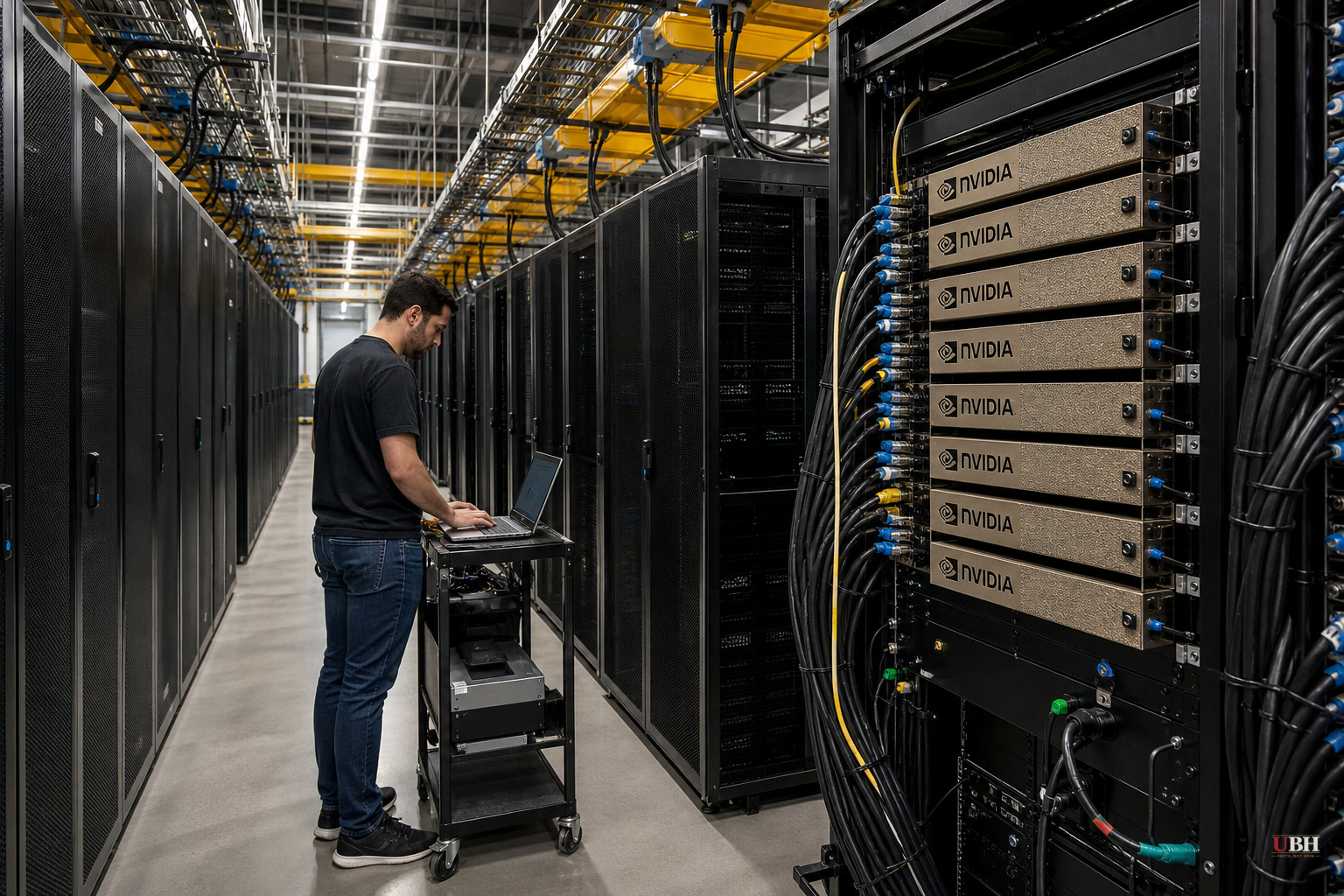
Since the AI boom took off in 2023, Amazon, Microsoft, Alphabet and Meta have together spent $1.1 trillion on AI infrastructure, according to Fortune. The four companies plan to spend another $745 billion this year alone. That's not app development money. That's power plants, chips and data centers on a scale normally reserved for national infrastructure projects.
Nvidia is now working with Apollo, Blackstone, Goldman Sachs and other Wall Street firms to line up more than $500 billion in additional capital for AI infrastructure, Fortune reported. Google went a step further, assembling a $200 billion financing structure with Broadcom, Apollo, Blackstone and Morgan Stanley specifically to fund Anthropic's chips and data centers. This isn't Silicon Valley venture funding anymore. It's structured finance, the kind normally used for airports and pipelines.
Sherif Higazy, founder and CEO of Megaton AI, told TechRound the comparison to history is direct: the 19th-century railroad buildout forced capital markets to evolve to finance it, and AI infrastructure is following the same script, with companies building "mega infrastructure projects, usually reserved for nation states and regulated utilities."
Both OpenAI and Anthropic are still losing money, according to Fortune. Trillions are being committed on the bet that the underlying models will eventually generate enough value to justify it. Nobody, including the people writing the checks, can prove that yet.
Microsoft CEO Satya Nadella said recently that "every model is substitutable," and Amazon CEO Andy Jassy predicted there will soon be "at least half a dozen" comparably good AI models, Fortune reported. If that's true, owning the best model isn't the moat anymore. Owning the cheapest capital and the most infrastructure is.
Microsoft, Amazon and Google hold the strongest hand right now. They already have the balance sheets, the cheapest borrowing costs, and they're generating real revenue off the same data centers powering their AI ambitions. Fortune notes that edge should hold even as the models themselves become commodities. SpaceX could emerge as a competitor, and sovereign wealth funds like Saudi Arabia's PIF and Abu Dhabi's MGX bring cheap capital and the flexibility to work with both Western and Chinese AI firms.
Olga Kokhan, CEO of Tinkogroup, offered a more grounded read to TechRound: financing is an enabler, not the growth driver itself. "The increasing role of financial engineering in AI reflects a broader shift: AI is no longer viewed as an emerging technology category but as critical infrastructure," she said. Capital can build faster. It can't manufacture customer demand or guarantee the businesses on top of that infrastructure actually work.
Lior Prosor, partner at Deep33, told TechRound that financing may simply be the next bottleneck getting solved, the same way GPUs and data centers financed like aircraft or power plants unlock capital from banks, private credit, infrastructure funds and eventually pension funds. Prosor also flagged the obvious risk: easier credit is still easier credit, and it raises the possibility of leverage building up that could contribute to future market distortions.
The capital shift is reshaping who gets hired, too. Toptal's Q2 2026 High-Skilled Job Report found demand for experienced finance consultants grew 31% quarter over quarter and 39% year over year, the strongest showing of any job category the firm tracks, according to Local News 8. Toptal's chief economist Erik Stettler said companies initially assumed AI could handle financial analysis on its own, and are now hiring more human experts once they hit the limits of that assumption. A Robert Half survey cited in the same report found 32% of hiring managers who cut roles after adopting AI later rehired for the same or similar positions.
Meanwhile, the definition of an "AI company" has ballooned. A BestBrokers analysis found 218 S&P 500 companies, or 43.3% of the index, are now "directly exposed" to the AI economy, representing about $42.4 trillion, or 62%, of the index's total market cap, as reported by CFO. Chips and hardware make up the largest single slice at 18.1% of S&P 500 market cap, followed by cloud and models at 17.2%.
None of this settles the underlying question Fortune raises: whether the models generate enough value to justify the trillions being committed. OpenAI CFO Sarah Friar's own writeup of building an "AI-native finance function" describes a company still chasing a "zero-day close" and fully automated forecasting, not one that has already arrived there. The infrastructure is real and it's being built at record speed. Whether it pays for itself is still an open bet, and it's Wall Street, not just Silicon Valley, that now has money riding on the answer.
Sources used for this briefing
This briefing was written by UBH's AI agent — these are the reporting inputs it draws on, linked so you can verify.


