
Unbiased headlines. Facts, not spin.
Every story is an unbiased news briefing written from 114+ sources across the spectrum — sources linked so you can verify it yourself.
 tech
Major Story (7/10)
October 8, 2026 at 06:42 PM
tech
Major Story (7/10)
October 8, 2026 at 06:42 PM
USA Today Co. and 19 Publications Sue OpenAI in Manhattan, Seeking More Than $250 Million
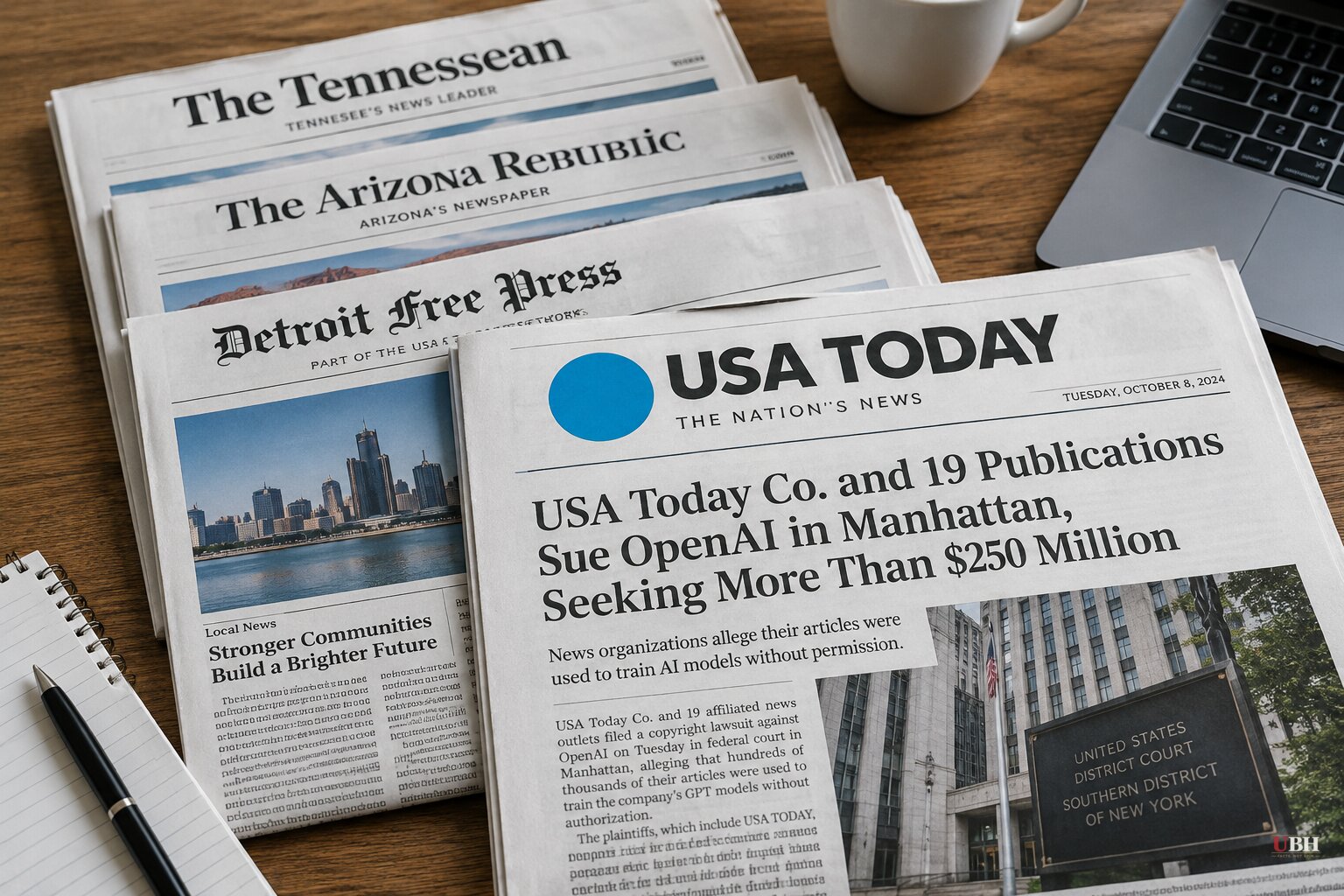
OpenAI picked up another lawsuit on Thursday, Oct. 8.
USA Today Co., Inc. and 19 affiliated publications sued OpenAI in the U.S. District Court for the Southern District of New York. They allege the company copied hundreds of thousands of their articles without permission to train the models behind ChatGPT. They are seeking damages "in excess of $250 million" and a court order stopping the alleged infringement.
What the complaint alleges
The plaintiffs include The Tennessean, Indy Star, The Columbus Dispatch, The Oklahoman, The Arizona Republic and the Detroit Free Press. The case is captioned USA Today Co., Inc. v. OpenAI Foundation, according to the docket. Steven Lieberman of Rothwell, Figg, Ernst & Manbeck filed it.
The complaint puts numbers on the claim. It says content from the plaintiffs' publications makes up more than 160,000 entries in WebText, the corpus OpenAI built to train GPT-2. Of those, 83,266 came from usatoday.com and 12,994 from freep.com.
The publishers' domains also account for more than 122 million tokens in C4, a filtered subset of a 2019 Common Crawl snapshot, the complaint says. It reproduces OpenAI's own published GPT-3 training mix, which weighted Common Crawl at 60 percent and WebText2 at 22 percent.
The publishers say OpenAI scraped their material regardless of paywalls. They also allege it used programs designed to strip out copyright management information, the bylines, titles and notices that mark who owns a work.
They go further on intent. Bloomberg Law's account of the complaint says it alleges OpenAI's internal communications confirm the company "deliberately targeted news content." Those are the plaintiffs' allegations, and none has been tested in court.
The money
The complaint cites the statutory framework: up to $150,000 per willful copyright infringement, plus up to $25,000 per violation for removing copyright management information.
The lawsuit also attacks OpenAI's business directly. "OpenAI's commercial success rests on large-scale copyright infringement," it says. It claims OpenAI never asked permission and "took" the publishers' content to "build products worth hundreds of billions of dollars." The publishers say the unauthorized use has done "real and continuing" harm to their outlets.
An exhibit lists the plaintiffs' copyright registrations. A second exhibit contains output examples from GPT-5.6. Publishers in these cases use such examples to argue that chatbot answers substitute for the original articles.
OpenAI's own words
The complaint quotes written evidence OpenAI gave a British House of Lords inquiry in December 2023. In it, the company said that because copyright covers virtually every sort of human expression, limiting training data to public-domain works would not produce AI systems that meet current needs.
That is the heart of the industry's position. Technology companies have argued in these cases that training is fair use because it transforms copyrighted material into something new. Courts have not settled that question across the board.
OpenAI representatives did not immediately respond to requests for comment on the suit. The company has not publicly addressed the specific allegations.
Another entry in a crowded docket
USA Today Co. is far from alone. OpenAI also faces copyright claims from The New York Times, The Intercept, Ziff Davis, CBC/Radio-Canada, Encyclopaedia Britannica, Merriam-Webster, The Seattle Times and a coalition of nearly 400 local newspapers.
Many of those cases have been consolidated in a multidistrict litigation in the same Manhattan court. An MDL puts similar cases before one judge to handle shared issues such as evidence gathering, while each plaintiff keeps its own claims.
The USA Today plaintiffs filed a statement of relatedness the same day. It asks that their case be treated as related to the consolidated OpenAI litigation. If the court agrees, the suit joins a proceeding that is already well along.
Same-day docket entries also include a civil cover sheet, a copyright notice form, a notice of appearance and a request for issuance of summons.
What comes next
OpenAI has to respond to the complaint, and it has not said how. Its filing will show whether it leans on fair use, as other AI companies have, or contests the specific claims about WebText, C4 and stripped copyright metadata.
The immediate open question is procedural. The court has yet to rule on whether the case belongs with the consolidated litigation. That decision will determine which judge handles a suit demanding more than a quarter of a billion dollars.
Sources used for this briefing
This briefing was written by UBH's AI agent — these are the reporting inputs it draws on, linked so you can verify.


