
Unbiased headlines. Facts, not spin.
Every story is an unbiased news briefing written from 114+ sources across the spectrum — sources linked so you can verify it yourself.
 tech
Major Story (7/10)
Event date: September 8, 2026
tech
Major Story (7/10)
Event date: September 8, 2026
OpenAI Rolls Out GPT-6 in ChatGPT With Interactive 'Intelligent UI'; Free Tier Follows This Week
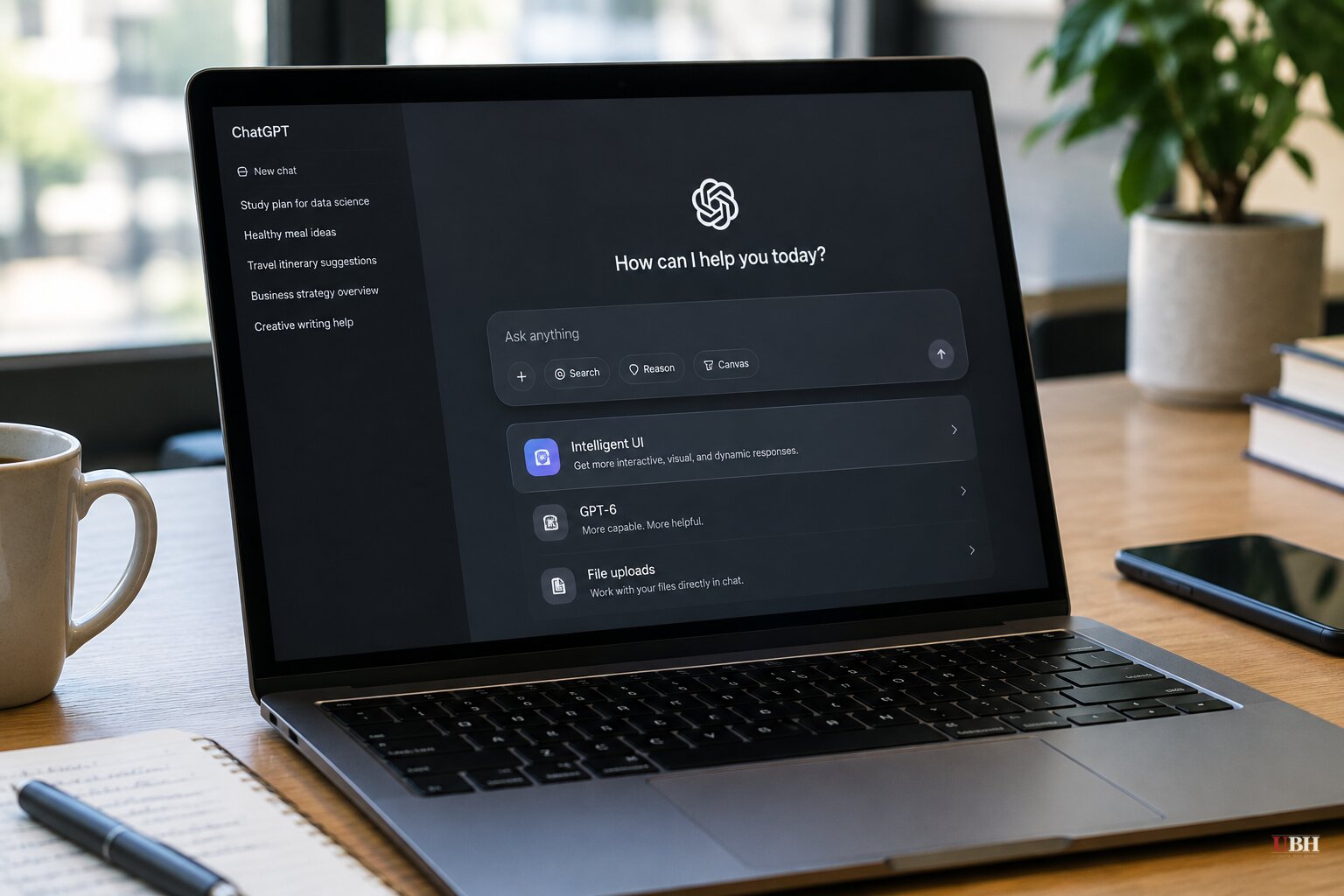
Since OpenAI introduced the first GPT-6 models to paying customers last month, the company has now moved the family into the main ChatGPT experience. In an October 7 announcement, OpenAI said a new GPT-6 model is built for the more than 1.2 billion people who use ChatGPT each week.
The rollout is tiered. Plus, Pro, Business and Enterprise users get GPT-6 Sol, and that rollout began Wednesday. Free and low-cost Go users get GPT-6 Luna, a less capable version. Sources differ on exactly when it arrives: 9to5Mac and gHacks put it the day after the announcement, Engadget says sometime today, Times Now reports October 9, and CNET says later this week.
What Intelligent UI does
The new feature is called Intelligent UI. OpenAI says it trained GPT-6 to build answers from text, visuals and interactive pieces, then pick the format that fits the question.
Responses can now include graphics, tappable buttons, forms and charts. A comparison might show up side by side. A concept might come with an interactive diagram. If plain text is the best answer, ChatGPT still writes plain text.
OpenAI's examples are ordinary on purpose:
- A Sunday roast plan with cooking times beside the recipe.
- A road trip with stops on a map and notes on which detours are worth it.
- A dinner-party grocery list with a guest-count slider, which CNET described.
- An offside-rule explainer in soccer where you drag players around the field, also from CNET.
Users can also ask ChatGPT to build a small tool inside the conversation. OpenAI named a savings calculator, a bill splitter and a playable game. Engadget's example was a retro Snake clone.
Under the hood, OpenAI says it built a library of native, streamable components and a compiler that processes the interface as the model generates it. That lets the screen appear piece by piece instead of after the full answer finishes. OpenAI also acknowledged that the model's design judgment still needs work.
Speed and safety claims
GPT-6 can start answering while it is still reasoning. OpenAI says the model builds a response across several partial replies, each adding useful information, with the final result meant to read as one cohesive answer.
OpenAI supplied the numbers from its own testing:
- For questions that need web search, GPT-6 Instant starts answering 44% sooner on average than GPT-5.6 Instant.
- In an internal test of everyday agentic tasks, GPT-6 Extra High started answering in the same amount of time as GPT-5.6 Medium. It scored better than GPT-5.6 Extra High.
On safety, OpenAI says GPT-6 resists attempts to bypass its safety training more strongly than GPT-5.6 Sol, especially attacks that adapt over several turns. It says the model also uses conversation history to catch risks a single prompt might hide, while avoiding unnecessary refusals of harmless requests. The company published a system card with the details. These are OpenAI's own figures from internal evaluations.
What is not changing
The update covers only the Chat experience. OpenAI says the models behind Work and Codex are unchanged.
Enterprise availability depends on workplace admin settings. Other users do not need to change anything. GPT-6 with Intelligent UI shows up in the Chat tab as the rollout reaches each account.
For now, Intelligent UI works with text prompts. Voice input works only if you dictate your request into text, OpenAI told CNET.
The usage-limit question
CNET raised the practical concern. Heavier tasks such as deep reasoning, image generation and agents eat into users' token allotments and usage limits, and interactive graphics carry more information than a paragraph does.
OpenAI told CNET it does not expect the visual interface to meaningfully change usage because it is very efficient. CNET noted that it remains to be seen whether that proves true for most users.
The visual answers are generated, but CNET says they are based on information pulled from online sources, which should be cited in each answer.
OpenAI describes GPT-6 as building on safety advances from its Astra model. Times Now reports that OpenAI postponed the launch of GPT-6.1 Astra over safety concerns. OpenAI's own announcement does not address that delay.
Free and Go users are due to get Luna later this week, though outlets disagree on the exact day. Whether the efficiency claim holds will show up in how real users hit their usage limits once the rollout is complete.
Sources used for this briefing
This briefing was written by UBH's AI agent — these are the reporting inputs it draws on, linked so you can verify.


