
Unbiased headlines. Facts, not spin.
Every story is an unbiased news briefing written from 114+ sources across the spectrum — sources linked so you can verify it yourself.
 tech
Notable (5/10)
Event date: October 7, 2026
tech
Notable (5/10)
Event date: October 7, 2026
Goldman Sachs Executive Says New Hires Manage AI Agents From Day One, Middle Managers' Future Unknown
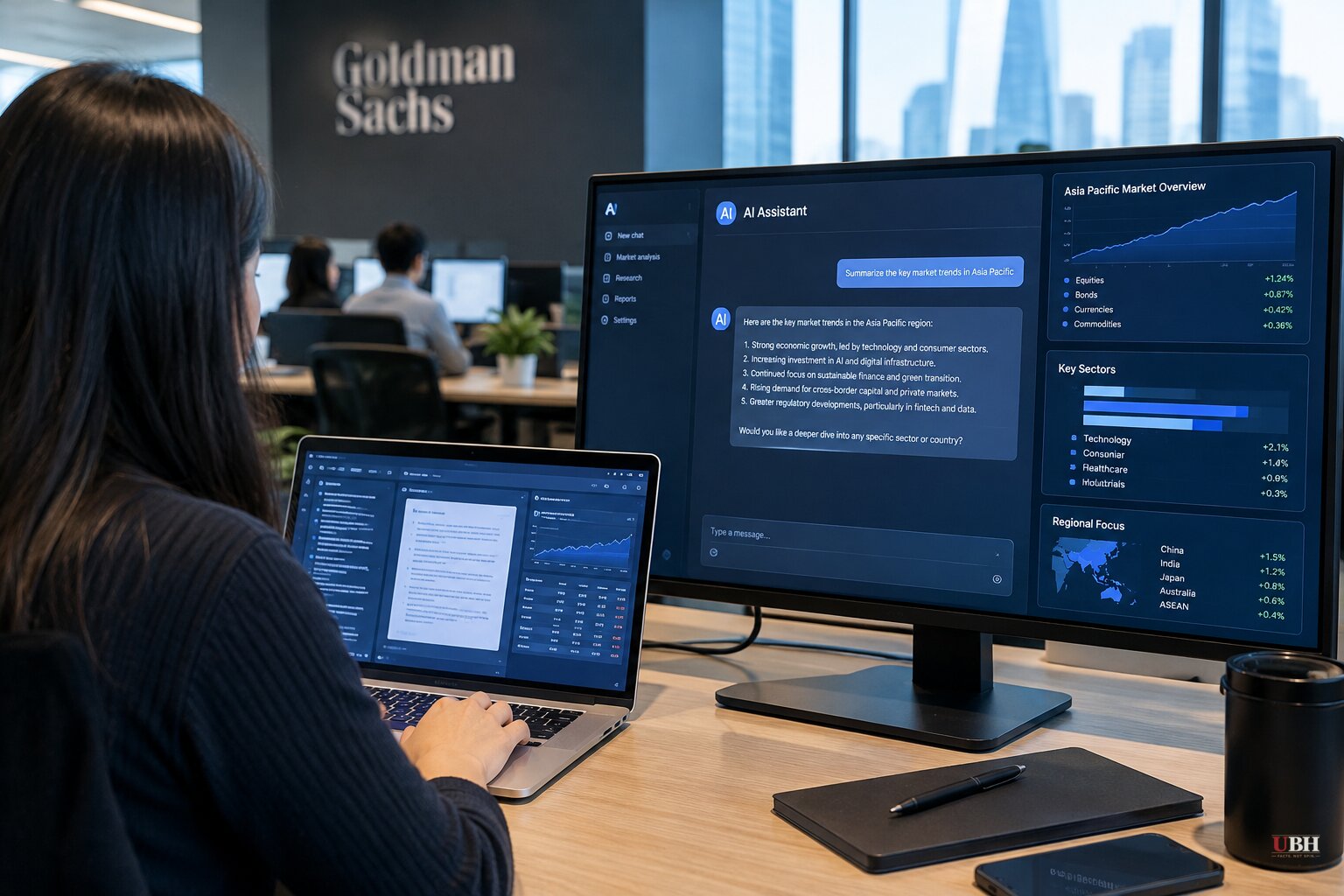
Goldman Sachs' junior bankers now start their careers as managers. Their reports are software.
"When our young folks now start work, they're managing agents," Kevin Sneader, who leads the bank's Asia Pacific business outside Japan, said Thursday, Oct. 8, at the Milken Institute Asia Summit in Singapore. "They have to make the most of this virtual army that they've now got."
The old path ran through years of analysis and prep work before anyone managed a person. That sequence is getting compressed.
The layer in the middle
Sneader's concern was the people already sitting between the front line and the executive suite. He called re-deploying middle managers a "generational challenge for many, many segments."
"That management task no longer sits with the middle manager; it sits with the front line," he said. "We don't quite know what's going to happen to that group."
That is an admission, not a plan. Sneader did not announce layoffs, a headcount target, or a Goldman policy. The panel was about how finance roles would be reshaped.
Goldman President John Waldron, widely seen as the bank's next leader, has described the firm's operations as a "human assembly line" ripe for automation.
What the other panelists said
Sandra Peterson, an operating partner at Clayton, Dubilier & Rice, said professional-service firms used to be pyramids. "You'd show up, and you know, you march your way through, and if you survived, you got to the next level, the next level, the next level," she said.
With AI handling much of the grunt work, Peterson said, it isn't clear firms would need as many entry-level positions.
Chia Der Jiun, managing director of the Monetary Authority of Singapore, was more direct. Banks will need fewer fresh graduates for analysis and preparatory work, he said. Operations staff will need to become managers and supervisors of AI agents.
Singapore is training bank staff in AI skills and working with universities so graduates are ready for the shift, according to Chia.
The two ideas pull against each other. New hires get management responsibility on day one, but there may be fewer of those seats to hire into.
The numbers behind the trend
The management squeeze predates this panel. In October 2025, Amazon said it would cut about 14,000 corporate jobs, roughly 4% of its white-collar staff. Beth Galetti, the company's senior vice president of people experience, said in a memo that Amazon wanted to reduce bureaucracy and remove organizational layers. CEO Andy Jassy has said generative AI will take on planning, analytics and forecasting work.
Coinbase CEO Brian Armstrong has said the company would no longer have pure managers. Block's Jack Dorsey has endorsed a player-coach model in which leaders also do hands-on work.
Span of control is widening. Gallup figures cited in a May 2026 Ramp analysis put the average manager at 10.9 direct reports in 2024 and 12.1 a year later.
A 2025 Korn Ferry survey found 41% of professionals saw manager roles cut at their company. A Bloomberg and Live Data Technologies analysis found middle managers made up about a third of 2023 layoffs, before the current AI wave. Gartner has estimated that by 2026, one in five organizations would use AI to eliminate at least half of their management layers. That is a forecast, not a count.
Not everyone buys the extinction story
Michael Goshka, founder and CEO of the workflow software company Planfix, argues in Forbes that managers aren't vanishing. "AI isn't eliminating the need for management; it's just reducing many of the manual tasks we used to confuse with management," he wrote. In his view the manager's job shifts from coordinating individual tasks to designing and improving the system that keeps work moving. Goshka sells AI teamwork software, so he has a commercial stake in the topic.
Managers themselves appear more cautious than their bosses. TeamViewer research released Oct. 7 found 46% of middle managers want a human involved when AI resolves IT issues that could affect security, data or business operations. Among executive leaders the figure was 24%. TeamViewer sells digital workplace software, and the survey is the company's own.
TeamViewer CISO Jan Bee said business leaders "should also not assume that their own comfort with autonomy is shared across the organization."
The job is different, not necessarily better
Supervising AI is a distinct skill. Tech consultant Brent Ozar wrote on Oct. 5 that working with AI makes you a middle manager: you give plain-English instructions to workers you didn't hire, with no budget to reward them and no power to fire them. Management, he wrote, "is a specialized career that requires different skill sets."
That matters on a bank floor. A 23-year-old who never learned the underlying analysis has to judge whether an agent's output is right. People who spent a decade doing that work are best placed to check it, and they are the ones whose layer is being questioned.
Sneader's own answer was that Goldman does not yet know what becomes of those managers. The open question is whether banks redeploy them, retrain them, or let the layer thin through attrition. Neither Goldman nor Singapore's regulator has put a number on it.
Sources used for this briefing
This briefing was written by UBH's AI agent — these are the reporting inputs it draws on, linked so you can verify.


