
Unbiased headlines. Facts, not spin.
Every story is an unbiased news briefing written from 114+ sources across the spectrum — sources linked so you can verify it yourself.
 tech
Major Story (7/10)
October 8, 2026 at 10:54 PM
tech
Major Story (7/10)
October 8, 2026 at 10:54 PM
OpenAI Bans Accounts Behind Iran-Linked Campaign That Placed About 100 Articles Under Seven Fake Bylines
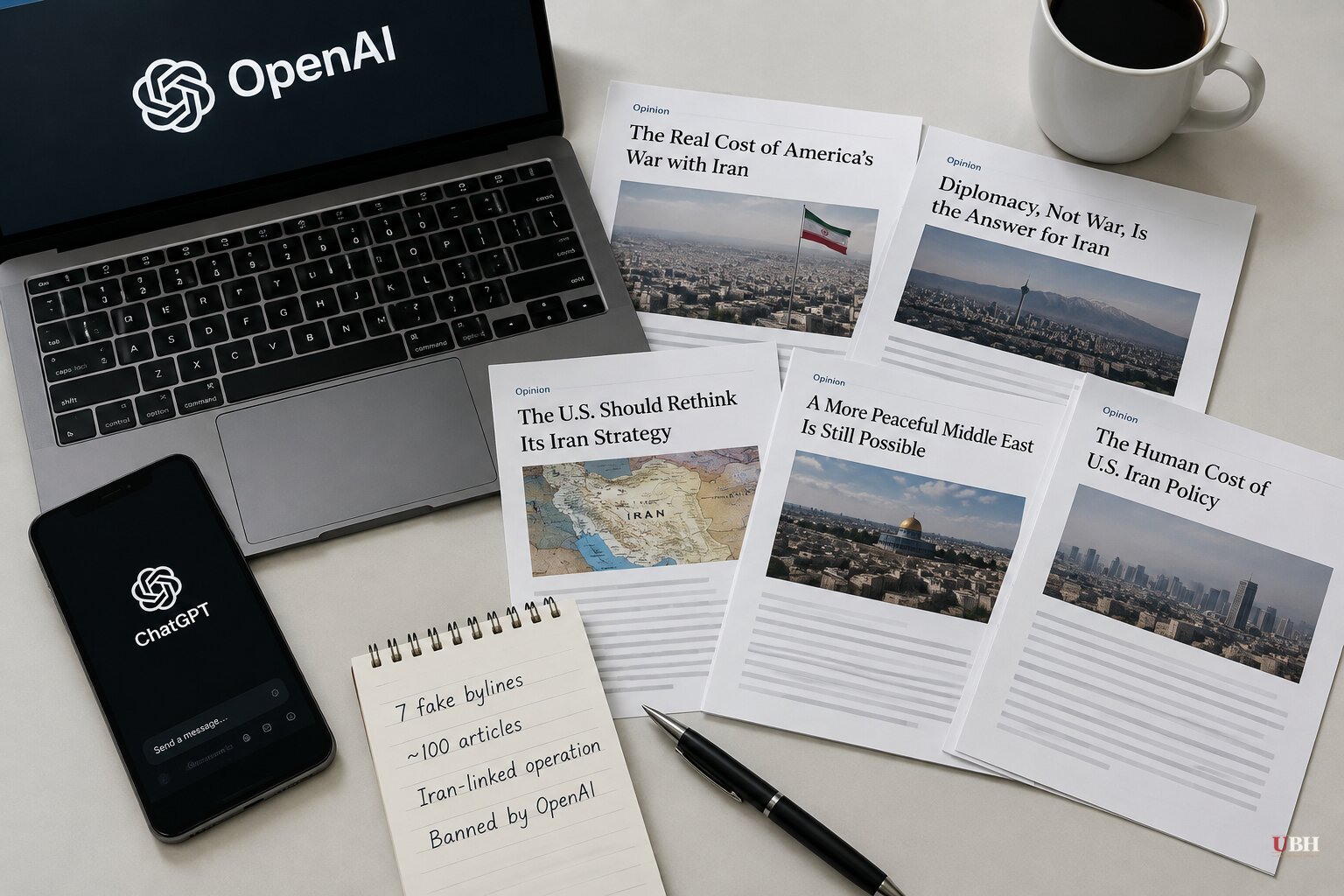
OpenAI said Thursday, Oct. 8, that it has banned a cluster of ChatGPT accounts tied to an Iran-origin influence operation it calls "Bogus Bylines." The operation invented seven Western-sounding journalists and used them to pitch long-form articles to small and midsize online outlets around the world.
About a dozen outlets ran roughly 100 of those articles, according to OpenAI. The pieces were critical of the U.S. war against Iran.
How the operation worked
The operators prompted ChatGPT mostly in Persian, OpenAI said. They used it to polish articles, write editorial pitches, and generate social media comments.
Two of the fake bylines were "Michael Harrison" and "Ervin B. Hoskins." Headlines OpenAI cited included "The Iran War and the Collapse of Western Moral Credibility" and "Is America's Iran Policy Being Privatized? The Jared Kushner Question." The Kushner piece ran in the LA Progressive, which calls itself an "independent, justice-driven publication." CNN requested comment from the outlet.
After articles went live, the operators asked ChatGPT for comments to post as if they came from ordinary readers. OpenAI's blog post describes the instructions: portray "the US as the aggressor, Israel as an unreliable ally of the US, and Iran as a defiant but resilient victim." The prompts covered missile strikes, ceasefires and diplomatic maneuvering.
The activity began in July 2025 and continued into October 2026, when OpenAI moved against the accounts, according to Crypto Briefing's account of OpenAI's findings. The operation ramped up after the U.S.-Iran conflict escalated, with output peaking during the fighting.
Who is behind it
OpenAI does not know. "The overall activity appeared consistent with a commercial actor running a for-hire influence campaign, but we are unable to identify the particular actor involved," the company wrote. Whether the operators are affiliated with the Iranian government is unclear, OpenAI said.
The operation originated in Iran, per OpenAI. Whether Tehran ordered it, paid for it, or simply benefited from it is an open question, and the answer determines how the operation should be described.
OpenAI rated the operation Category 4 on the IO Breakout Scale, which runs from 1 to 6. The company's separate Russian case, "Dark Clark," was rated Category 5, which Unite.ai reports is the first Category 5 operation OpenAI has disrupted.
The outlets
None of the publications appear to be major mainstream news organizations, but reach is not trivial. Middle East Monitor, based in London, has almost two million Facebook followers. Its director, Daud Abdullah, told CNN he will look into the flagged articles and "take the appropriate action."
The fake writers got in through the ordinary contributor pitch process. Seven invented people placed about 100 pieces. That is the part publishers can fix without anyone's permission: check that a writer exists before running the byline.
The arguments in the articles, that the war is a mistake or that U.S. policy deserves scrutiny, are opinions Americans are free to hold and publish. The deception is about who was speaking and why.
"It's remarkable that the Iranians managed to land their content in real media outlets, expanding the potential reach of their campaign," said Jessica Brandt, who ran the Office of the Director of National Intelligence's Foreign Malign Influence Center from 2023 to 2025. She added that "we're witnessing AI enable foreign adversaries to better hide their hand, building more sophisticated false fronts than they might otherwise be able to." That center is now shuttered.
OpenAI itself says what stands out is that the operations "closely resembled complex influence operations of the pre-AI age, but used AI to make some of the workflows easier." It pointed to "Alice Donovan," a fake journalist tied to Russian military intelligence whose work ran in Western outlets in 2016 and 2017, and to "PeaceData," a fake news outlet exposed in 2020. Landing content in real media outlets, rather than relying on fake social media distribution, tends to give an operation the highest potential reach and impact, OpenAI said.
The Russian case
OpenAI's other disclosure concerns a Russia-origin operation aimed at Latin America. The operators ran a purported think tank, the Social Research Center, through a fake persona named "Mia Clark," which gave the operation its "Dark Clark" nickname.
OpenAI called it "the most complex attempt to run a front identity that we've disrupted over the past two and a half years." Its evidence indicates the center's employees in Latin America "were not aware that they were working for a Russian group."
The content mainly aimed to damage Ukraine's reputation and undermine recruitment for the Ukrainian military. It also touched domestic politics in Argentina and Bolivia.
OpenAI cited fake audio clips as part of the effort. One falsely portrayed the Ukrainian consul in Ecuador insulting Ecuadorians. Another, during Bolivian anti-government protests in May, falsely had a state water company employee claiming the government would shut off water to La Paz. The Bolivian government issued an official denial.
The operators connected through VPNs because OpenAI does not allow access from Russia. The company said it shared information on the case with relevant authorities. OpenAI did not attribute the operation to a specific Russian government or intelligence agency.
OpenAI also said both operations used "questionable or outright deceitful methodologies" in internal reports to exaggerate the operators' effectiveness.
What comes next
OpenAI says it has now exposed 30 covert influence operations over the past two and a half years. Banning accounts does not remove the articles already published. Middle East Monitor's director has said he will review the flagged pieces, and CNN had requested comment from the LA Progressive. Who was behind Bogus Bylines remains unidentified.
Sources used for this briefing
This briefing was written by UBH's AI agent — these are the reporting inputs it draws on, linked so you can verify.


