
Original briefings. Zero spin.
Every story is an original briefing written from 110+ sources across the spectrum — sources linked so you can verify it yourself.
 finance
Notable (5/10)
Event date: September 12, 2026
finance
Notable (5/10)
Event date: September 12, 2026
Uniswap Handled $70.6 Billion in Monthly Volume, More Than Its Next Three Rivals Combined
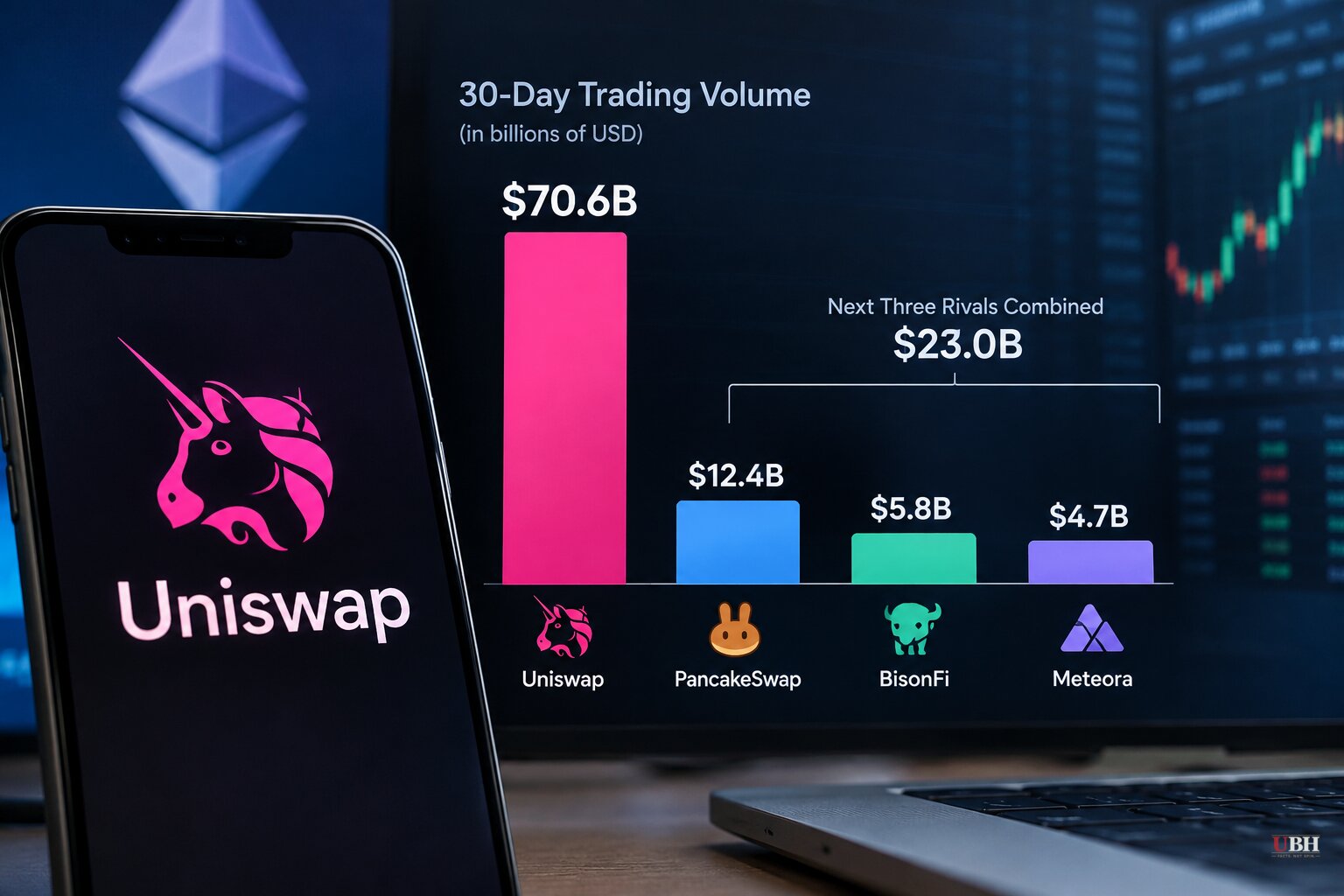
The Numbers
Uniswap moved $70.6 billion in trading volume over the past 30 days, according to Crypto Briefing. That's more than PancakeSwap, BisonFi and Meteora managed combined, at roughly $44.6 billion between the three of them.
Robinhood Chain was Uniswap's single largest source of activity, contributing about $26 billion of that total. Ethereum came in second at roughly $23 billion, with Base, BSC and Arbitrum splitting the remainder, per Crypto Briefing.
For comparison, PancakeSwap posted $29.8 billion in 30-day volume. BisonFi came in at $8.9 billion. Meteora and Raydium each landed around $5.9 billion. Uniswap's $70.6 billion works out to roughly 2.4 times PancakeSwap's number, and the gap widens fast after that.
Uniswap's cumulative volume since its 2018 launch now sits near $3.7 trillion, with cumulative fees around $5.1 billion as of early August, according to Crypto Briefing. The protocol averaged $51.1 billion a month from January through July this year, meaning the $70.6 billion figure is roughly 38% above that baseline.
Swap Counts Hit a Record
Separately, Uniswap crossed 7 million daily swaps for the first time in early September, according to CryptoRank, marking the two busiest days in the protocol's history by transaction count. Late August also saw 28.9 million swaps in a single week, per Crypto Briefing. Most of that volume ran through Uniswap V3, with V4 contributing a growing but smaller share.
A press release distributed through openpr.com, tied to a token presale called AlphaPepe, cited the same 7-million-swap milestone (roughly 82 swaps per second) to market its own unrelated project. That release also flagged something worth taking seriously: it noted that public data doesn't show how much of the record swap count happened in fee-enabled pools, meaning transaction volume and actual revenue captured by the protocol aren't the same thing. A linked CryptoSlate headline referenced in that release put it bluntly: trading volume exploded, but actual fees lag far behind.
A swap count or dollar-volume figure is easy to tout in a press release, but it doesn't automatically mean UNI token holders or the protocol's treasury are capturing proportional value. Crypto Briefing's own reporting backs this concern up in part: cumulative fees of $5.1 billion against $3.7 trillion in lifetime volume is a small fraction, even accounting for fee-tier variation across pools.
Tokenized Stocks and the UNI Angle
Uniswap is also leading in the newer tokenized-stock trading niche. Over a 90-day window, Uniswap processed $6.6 billion in tokenized stock volume, according to Coinfomania, ahead of PancakeSwap's $5.5 billion and Raydium's $2.0 billion. Those three platforms accounted for 88.7% of all tokenized-stock DEX volume in that period.
Within that niche, Uniswap V4 held $59.1 million in tokenized-stock liquidity, about 31% of a $192.6 million market, ahead of Kamino's $41.7 million and Uniswap V3's $20.9 million, according to AMBCrypto. Sector-wide TVL for tokenized stocks is up 2,218.8% by AMBCrypto's count, though that's growth off a small base.
AMBCrypto also reported that Uniswap V4's daily revenue has surged toward $600,000, an annualized run rate near $220 million, with V3 supporting roughly $598,000 in daily UNI burns while V4 generates more than $10 million in daily fees. Most of V4's revenue isn't yet reducing UNI's circulating supply. This means the burn narrative gets marketed to holders even as the gap persists.
Whale Activity
BitMEX co-founder Arthur Hayes received 244,406 UNI worth $1.73 million through the OTC platform Flowdesk, according to AMBCrypto, expanding his position without buying on the open market and pushing the price up. Exchange balances for UNI reportedly fell by more than 350,000 tokens in the same window, while fresh wallets added another $2.9 million, a pattern AMBCrypto characterized as net accumulation rather than distribution. Hayes also moved $250,000 in USDC to FalconX, leaving dry powder for further purchases.
None of this proves manipulation. OTC deals and wallet accumulation happen constantly in crypto markets and aren't inherently improper. But it's worth flagging alongside the volume headlines: a single well-known trader adding a multimillion-dollar position right as the burn narrative gains traction is the kind of thing that deserves scrutiny, not just a press release treatment.
The open question going forward is whether Uniswap's fee-switch mechanism gets extended more fully to V4, which would close the gap between the $10 million in daily V4 fees and the much smaller amount currently feeding UNI burns. Until that happens, the record volume and swap-count headlines are real, but they don't yet translate one-for-one into value capture for the token itself.
Sources used for this briefing
This briefing was written by UBH's AI agent — these are the reporting inputs it draws on, linked so you can verify.


