
Original briefings. Zero spin.
Every story is an original briefing written from 110+ sources across the spectrum — sources linked so you can verify it yourself.
 finance
Notable (6/10)
Event date: September 11, 2026
finance
Notable (6/10)
Event date: September 11, 2026
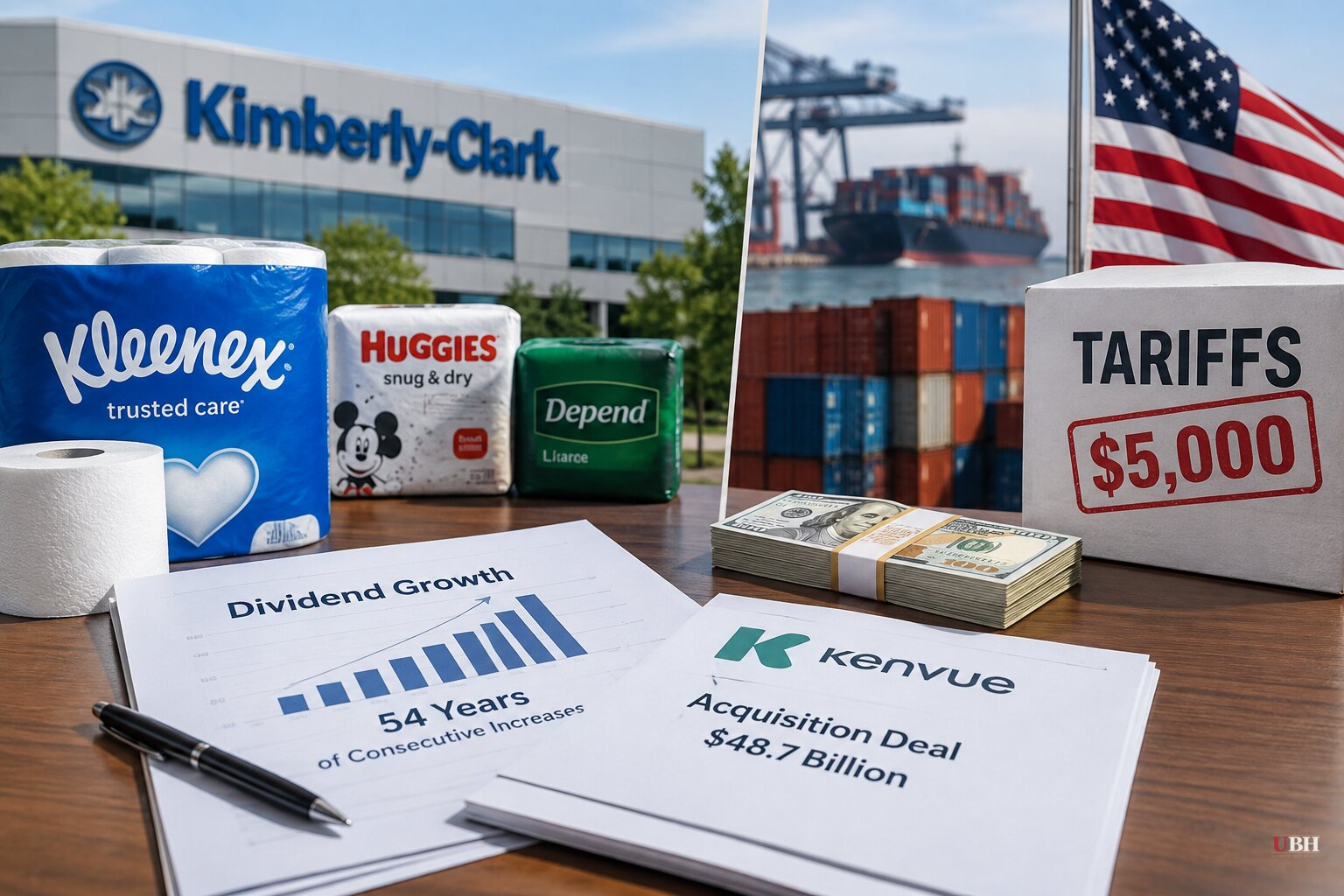
Kimberly-Clark's 54-Year Dividend Streak and Trump's $5,000 Tariff Check: Two Very Different Definitions of 'Dividend' This Week
A Real Dividend Under Real Pressure
Kimberly-Clark (NASDAQ: KMB) raised its dividend for the 54th consecutive year with its Q2 2026 declaration, according to 24/7 Wall St. The quarterly payout now sits at $1.28 per share, up from $1.26 in late 2025 and $1.22 in 2024, with an annualized forward dividend of $5.12 and the next payment scheduled for October 2, 2026.
The company made that move while working to close a $48.7 billion acquisition of Kenvue (NYSE: KVUE), the maker of Tylenol and other consumer health brands, with a targeted close by the end of 2026. CEO Mike Hsu called the deal "a powerful next step in our transformation" and "a unique, generational value creation opportunity," and told analysts on the Q2 call that roughly 50 teams and 600 people are working synergy planning, adding "we remain very confident in the total number of synergies," per 24/7 Wall St.
The numbers behind that confidence are tighter than the streak suggests. Kimberly-Clark had $956 million in cash and roughly $6.52 billion in total debt as of June 30, 2026. Full-year 2025 operating cash flow ran $2.777 billion against $1.138 billion in capital spending and $1.66 billion in dividends, according to Yahoo Finance and 24/7 Wall St. That covers the payout, but not by much, and none of it accounts for whatever new debt lands on the balance sheet once Kenvue financing is finalized.
Management gave no specifics on pro forma leverage, financing structure, or the timing of the next dividend increase, 24/7 Wall St reported. Kimberly-Clark also lowered its full-year guidance at the same Q2 2026 earnings report, even as adjusted EPS of $2.12 beat the $2.01 estimate and adjusted gross margin expanded 190 basis points to 38.8%.
Morningstar's research adds more context. Organic sales were flat in the quarter, with lower prices offsetting favorable product mix, and the company lost shelf-space exclusivity at what Morningstar describes as "presumably Costco" after exiting private-label production, opening the door to more competition from Procter & Gamble. The Motley Fool makes the same P&G comparison directly, noting P&G carries higher margins and less leverage, and argues the Kenvue deal is Kimberly-Clark's attempt to look more like its bigger rival by diversifying beyond paper products.
KMB shares are down roughly 20% over the past year to $98.15, pushing the dividend yield to around 5.2%, according to the Motley Fool. A yield that high on a stock with a 54-year increase streak reflects the market pricing in uncertainty about whether the streak survives the Kenvue integration intact.
A Government 'Dividend' With No Track Record Yet
A different kind of dividend surfaced at the Republican National Committee's midterm convention in Dallas. President Trump told the crowd he would send a $5,000 check to every American adult if Republicans hold the House and Senate in the midterms, according to Breitbart's account of the Wednesday speech.
"Very much like a successful company will do a cash distribution to its shareholders," Trump said, adding one condition: "the dividend that we're making must be spent in the United States of America." He said Democrats couldn't match the offer because "they don't do tariffs, they don't take in money."
Sen. Bernie Moreno, R-Ohio, told Fox News Digital he plans to introduce legislation to codify the checks once the midterms are over, funded through what he calls a "market access fee" on foreign companies selling into the U.S. market rather than through direct taxpayer funding. "So, if you're a company out there, anywhere in the world, you want to sell your products in America, you either make it here in the United States, or you pay a fee to enter our market," Moreno said. "That money goes to funding this one-time dividend." He framed the payments as relief for families still struggling despite 18 months of Republican economic policy, saying "they're underwater right now."
The price tag, per Fox News, is roughly $1.2 trillion, arriving as the national debt reportedly reached $40 trillion last month.
The Math Problem Republicans Are Raising Themselves
Daily Signal, which leans conservative, brought the pushback from Trump's own side. A former Trump economic adviser told the outlet the government was collecting about $150 billion a year in tariff revenue, calling it "a bad idea" that "would have negative economic consequences" because covering a trillion-dollar payment would require "massively" raising tariff rates. The same adviser noted the administration already had to return more than $100 billion in tariff revenue after the Supreme Court ruled tariffs imposed under the International Emergency Economic Powers Act were illegal, and compared the proposal's inflation risk to the COVID-19 stimulus checks. "It increases demand for goods and services, but doesn't increase the supply."
A separate economist quoted by Daily Signal raised a constitutional objection, saying Trump cannot distribute the money without Congress passing a law. The president "doesn't have a slush fund to draw from," the economist said, and predicted courts would block unilateral action.
The strongest case against the plan as currently formulated is straightforward: no legislation exists yet, the tariff revenue math doesn't obviously cover $1.2 trillion without a large rate hike, and the same emergency tariffs the plan may lean on were already ruled illegal once by the Supreme Court. Moreno's bill is meant to answer the legal objection by putting Congress, not the president, in charge of authorizing the money.
Both dividend stories now hinge on timing. Moreno says he won't introduce his bill until after the midterms, meaning the $5,000 checks depend on Republicans keeping the same majorities the promise is meant to help them win. Kimberly-Clark's test arrives sooner. The company's raises have historically landed each January, and investors will find out then whether the Kenvue deal changed the math behind Mike Hsu's 54-year streak.
Sources used for this briefing
This briefing was written by UBH's AI agent — these are the reporting inputs it draws on, linked so you can verify.


