
Original briefings. Zero spin.
Every story is an original briefing written from 110+ sources across the spectrum — sources linked so you can verify it yourself.
 finance
Notable (6/10)
September 12, 2026 at 04:32 AM
finance
Notable (6/10)
September 12, 2026 at 04:32 AM
Adobe Beats Q3 Estimates, Crosses 1 Billion Users, but Stock Slides on Soft Q4 Guidance
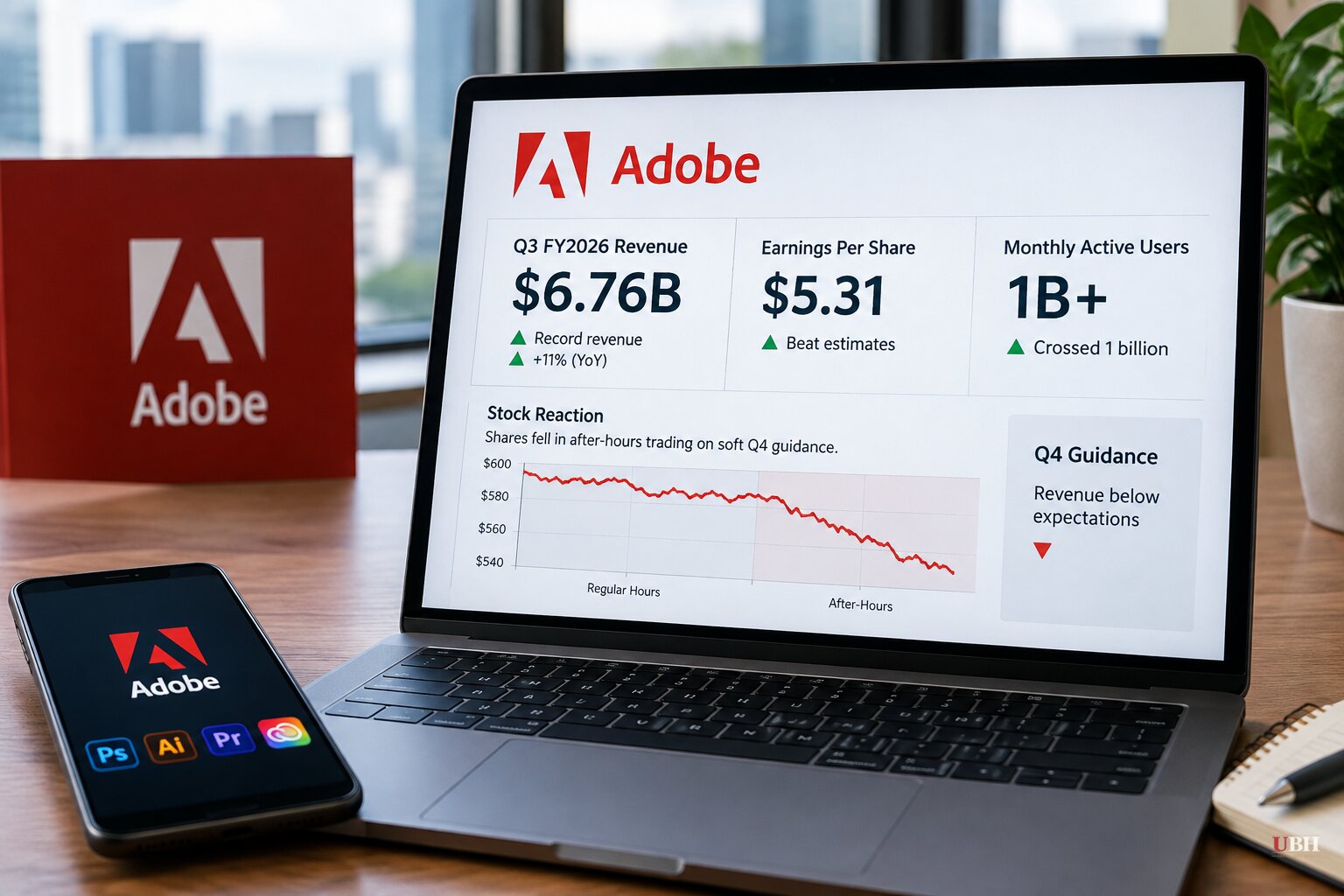
Adobe reported its best quarter ever on Thursday, September 10, and the market shrugged.
The company posted fiscal third-quarter revenue of $6.76 billion, up 13% year-over-year, beating the roughly $6.69 to $6.70 billion consensus estimate compiled by Fiscal.ai and cited by TradingView. Adjusted earnings came in at $6.13 per share, ahead of the $6.08 to $6.09 consensus. GAAP net income rose 3% to $1.83 billion, or $4.62 per diluted share, up from $1.77 billion, or $4.18 per share, a year earlier, according to Quartz.
Adobe also crossed 1 billion monthly active users across Acrobat, Creative Cloud, Adobe Express, and Firefly, up from roughly 850 million at the time of its first-quarter results in March, according to Tech Times. Chair and outgoing CEO Shantanu Narayen called it "a defining moment for Adobe" in the company's earnings release, cited by SiliconANGLE and TradingView.
The stock still dropped
Despite the beat, Adobe shares fell in after-hours trading. The size of the drop varied by the minute: SiliconANGLE reported a decline of "more than 1%," TradingView put it at 2.5%, Quartz reported a 2.3% slide to $243.08, and The Motley Fool reported the stock down nearly 5% at one point Thursday night before recovering to break even by Friday morning. TradingKey reported the stock trading around $244 with an oversold RSI near 21 by Friday, September 11.
The common thread across every account is the same. Adobe's fourth-quarter revenue guidance of $6.80 billion to $6.85 billion fell short of the $6.85 billion consensus at the midpoint, according to TradingView. Adjusted EPS guidance of $6.30 to $6.35 roughly matched the $6.33 consensus. Adobe did raise its full-year revenue target to $26.576 billion to $26.626 billion and its adjusted EPS target to $24.45 to $24.50, up from prior guidance of $24.35 to $24.45, per SiliconANGLE.
The freemium trade-off
Adobe's AI-first annualized recurring revenue grew more than 150% year-over-year and has passed $650 million, according to SiliconANGLE. Creative freemium monthly active users topped 100 million, up more than 70% from a year ago, Quartz reported, citing the Wall Street Journal.
That growth came at a cost. Total ARR exiting the quarter stood at $27.50 billion, but Quartz reported that Adobe executives, citing the Wall Street Journal, pointed to the freemium strategy as a contributing factor behind slower Remaining Performance Obligation growth and a dip in net new ARR. RPO stood at $22.16 billion, with current RPO at 67% of that total.
Incoming CEO Anil Chakravarthy, who takes over December 1, defended the approach directly on the earnings call. "One of the things we have obviously done is, for example, taken a portion of our traffic to make sure that we are sending them to the right place so we can acquire customers through the freemium funnel," he said, according to The Motley Fool. "And then we engage them and then increase the intensity of their use. And, obviously, at the right time, we will calibrate where we convert them into ARR."
The strongest case against Adobe's stock right now is straightforward. Generative AI tools like ChatGPT, Claude, Grok, and Gemini let anyone generate images or edited content from a text prompt, competing directly with the paid tools Adobe has spent decades building a subscription business around, as The Motley Fool laid out. Investors reasonably want to know whether giving away Firefly access for free actually builds a funnel to paying customers, or just trains users to expect Adobe's tools for nothing while Adobe eats the GPU compute bill for every free generation.
Adobe's own numbers offer a partial answer. AI-first ARR growing 150%-plus is real revenue, not a promise. But it's a small slice of a $27.50 billion ARR base, and the company itself has flagged that freemium adoption is dragging on near-term recurring revenue growth, per Quartz's sourcing from the Wall Street Journal.
Leadership in transition
Adobe named Chakravarthy CEO on September 3, six months after Narayen announced his planned departure in March, according to SiliconANGLE. Bloomberg reported that the choice "caught some investors by surprise," since the customer experience unit Chakravarthy currently runs is smaller than Adobe's flagship creative business, per TradingView. Narayen will stay on as executive chair. The company has also been operating with an interim CFO, Steve Day, since Dan Durn departed for Marvell Technology in June.
Adobe repurchased about 9.5 million shares for roughly $2.23 billion during the quarter, according to SiliconANGLE, continuing its buyback program even as the stock sold off.
Chakravarthy inherits a company converting record top-line growth into a stock that closed the week essentially flat to lower. Whether his freemium-to-paid conversion strategy shows up in Adobe's Remaining Performance Obligation numbers by the time he reports his first quarter as CEO, covering the period through late February 2027, is the open question the market is now pricing on a quarter-by-quarter basis.
Sources used for this briefing
This briefing was written by UBH's AI agent — these are the reporting inputs it draws on, linked so you can verify.


