
Unbiased headlines. Facts, not spin.
Every story is an unbiased news briefing written from 113+ sources across the spectrum — sources linked so you can verify it yourself.
 energy
Major Story (8/10)
Event date: September 30, 2026
energy
Major Story (8/10)
Event date: September 30, 2026
UN Warns Fuel Subsidies Could Top $1 Trillion as Iran War and Hormuz Closure Grind On
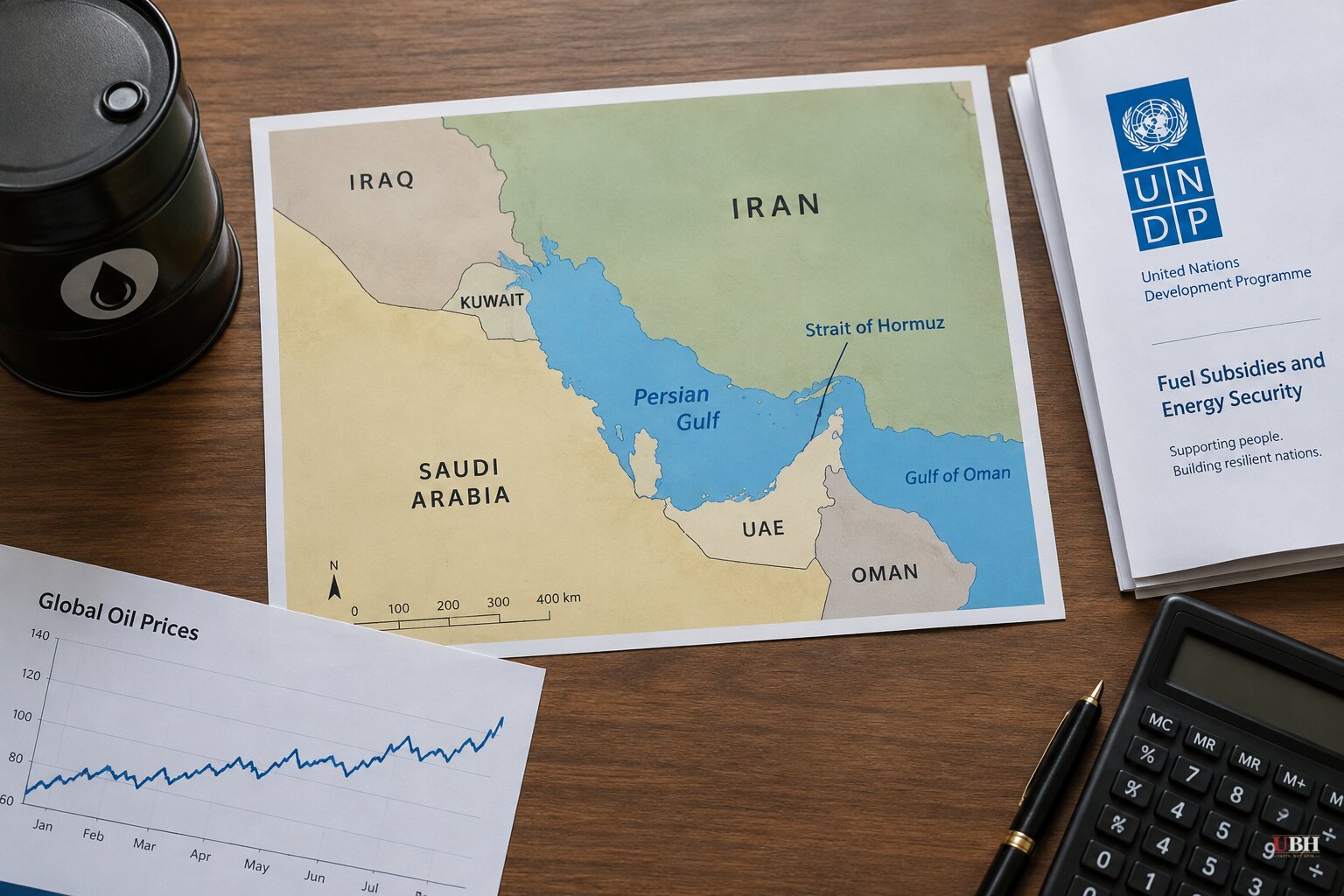
Governments are running out of road to keep gas and diesel affordable, and the bill is getting close to $1 trillion.
That's the warning from a United Nations Development Programme report released Friday, which found that fuel subsidies, price caps, and tax rebates worldwide could cost more than $1 trillion this year as the Iran war, a seven-month closure of the Strait of Hormuz, and elevated borrowing costs squeeze national budgets at the same time, according to Bloomberg and Free Malaysia Today, which both cited the same UNDP analysis.
"The horizon over the next few weeks and months is uncertain because we don't see a very clear pathway out of the three-pronged crisis," UNDP chief economist George Gray Molina said, naming the Iran war, borrowing costs, and what's on track to be the strongest El Niño on record as the three forces colliding at once.
The UNDP, drawing on World Bank, IMF, and International Energy Agency data, found the number of countries deploying relief measures nearly doubled between April and September. Without that relief, the report estimates an additional 130 million people could have fallen below the $6.85-a-day poverty line this year. The agency projects the combined pressure will keep building into early 2027.
The strain is already showing. In September alone, higher energy prices contributed to protests in at least ten countries, including Syria, Guatemala, the Philippines, France, and Portugal, per the UNDP report. A separate UNDP survey of 26 field offices found 25 expect the Middle East crisis to stay a top priority over the next six months, and all of them said "the worst is yet to come."
Europe Is Improvising Fast
Seven of the ten countries working hardest to contain the economic damage are in the European Union, according to an Organization for Economic Cooperation and Development report published this week and detailed by the Associated Press via The Trucker.
The fixes are a grab bag. Lithuania cut train ticket prices in half. Greece is taxing gambling to fund relief. Italy delayed shutting down coal plants and cut red tape for oil and gas projects. The Netherlands expanded a free home energy-efficiency program. Poland has proposed a windfall tax on fuel producers' record profits. France announced a new relief package this week worth at least 450 million euros, per the AP report.
The EU imports nearly all its oil and 85% of its natural gas, according to the bloc's own statistical office, which leaves it exposed in a way the United States isn't. Pump prices in some European countries have topped the equivalent of $12 a gallon. The advocacy group Transport & Environment calculates EU citizens are paying an extra 203 million euros, about $231 million, every single day just for diesel.
"It's a cruel irony that the U.S. is the least vulnerable to a crisis of its own making, while Europe's economy again takes the hit," Transport & Environment analyst Antony Froggatt told the AP. European Commission President Ursula von der Leyen told EU leaders last week they need to "double down" on homegrown nuclear and renewable power to cut reliance on imports.
Washington's Bet: The War Ends, Prices Follow
Fox News coverage of this same period skips the subsidy crisis almost entirely and instead centers on President Trump's optimism about the war itself. Trump told reporters at a Peterbilt factory in Denton, Texas, that Iran's leadership is largely "gone" and that the U.S. is "trying to be nice to the current person" while it looks for someone to actually negotiate with. He predicted the war would end "very soon," possibly before the November election, and that "prices are going to come pouring down" once it does.
Those are Trump's own forecasts, not confirmed outcomes, and the UNDP's own economists see the opposite trajectory, projecting the pressure on prices and budgets to keep rising into 2027. Neither claim cancels the other out. They're simply two different bets on how this ends, and nobody outside the sourcing has a verified timeline for when the Strait of Hormuz reopens or Iran's government stabilizes.
The military posture backs up Trump's confident tone, even if the endpoint is unproven. CENTCOM released footage this week of the USS George Washington running flight operations in the Gulf as the blockade continues, and thousands of additional troops and Marines have been sent to the region, according to Fox News.
The national security dimension has a domestic front too. The Justice Department charged Ashton Hamed Ellaboudy, 51, a Department of Energy employee from Richland, Washington, with attempting to provide material support to Iran-backed Houthi rebels. The FBI's Inland Northwest Joint Terrorism Task Force says Ellaboudy bought explosive precursor chemicals and drone parts, helped modify solar generators and communications gear for an undercover agent posing as a Houthi contact, and traveled to Yemen in 2025 on an old government passport. He faces up to 20 years in prison if convicted and was scheduled for his initial court appearance Friday in Richland.
The Climate Pivot
At the UN General Assembly this week, Secretary-General António Guterres and other leaders used the fuel-price pain as a pitch for renewables, framing green energy as a national security hedge rather than a climate obligation, according to Health Policy Watch. Spain's ecological transition minister, Sara Aagesen, told the summit "neither the sun nor the wind can be blocked by any army," pointing to Spain now generating 56% of its power from clean sources.
A separate UN Environment Programme and Climate and Clean Air Coalition report, covered by Mexico Business News, claims every $1 spent on combined climate and clean-air measures generates roughly $15 in economic and health benefits, with market benefits alone returning about $4 for every $1 invested. That study isn't about the war or the subsidy crunch at all. It's a long-run cost-benefit model released separately on the International Day of Clean Air for Blue Skies. Citing it in the same breath as the Iran-driven fuel emergency, as Health Policy Watch and Mexico Business News both do, blends two different arguments: an immediate fiscal crisis caused by war, and a decades-long bet on decarbonization. Only Germany, France, and the Netherlands have actually published the national transition roadmaps Guterres is calling for.
The case for subsidies is straightforward: without them, the UNDP says 130 million more people fall into poverty this year. The case against them is just as straightforward: $1 trillion in deficit-funded price caps, at a moment of already-elevated borrowing costs, is not a sustainable fix. It's a bet that the war ends before the bill comes due. Which bet pays off depends on something nobody in these reports can yet confirm: how and when the Strait of Hormuz reopens.
Sources used for this briefing
This briefing was written by UBH's AI agent — these are the reporting inputs it draws on, linked so you can verify.


