
Unbiased headlines. Facts, not spin.
Every story is an unbiased news briefing written from 110+ sources across the spectrum — sources linked so you can verify it yourself.
 defense
Major Story (7/10)
June 12, 2026 at 11:05 PM
defense
Major Story (7/10)
June 12, 2026 at 11:05 PM
UN Report Documents 310 Cases of Sexual Violence by Russian Forces. Ukraine Wants Them Removed from Peacekeeping Missions.
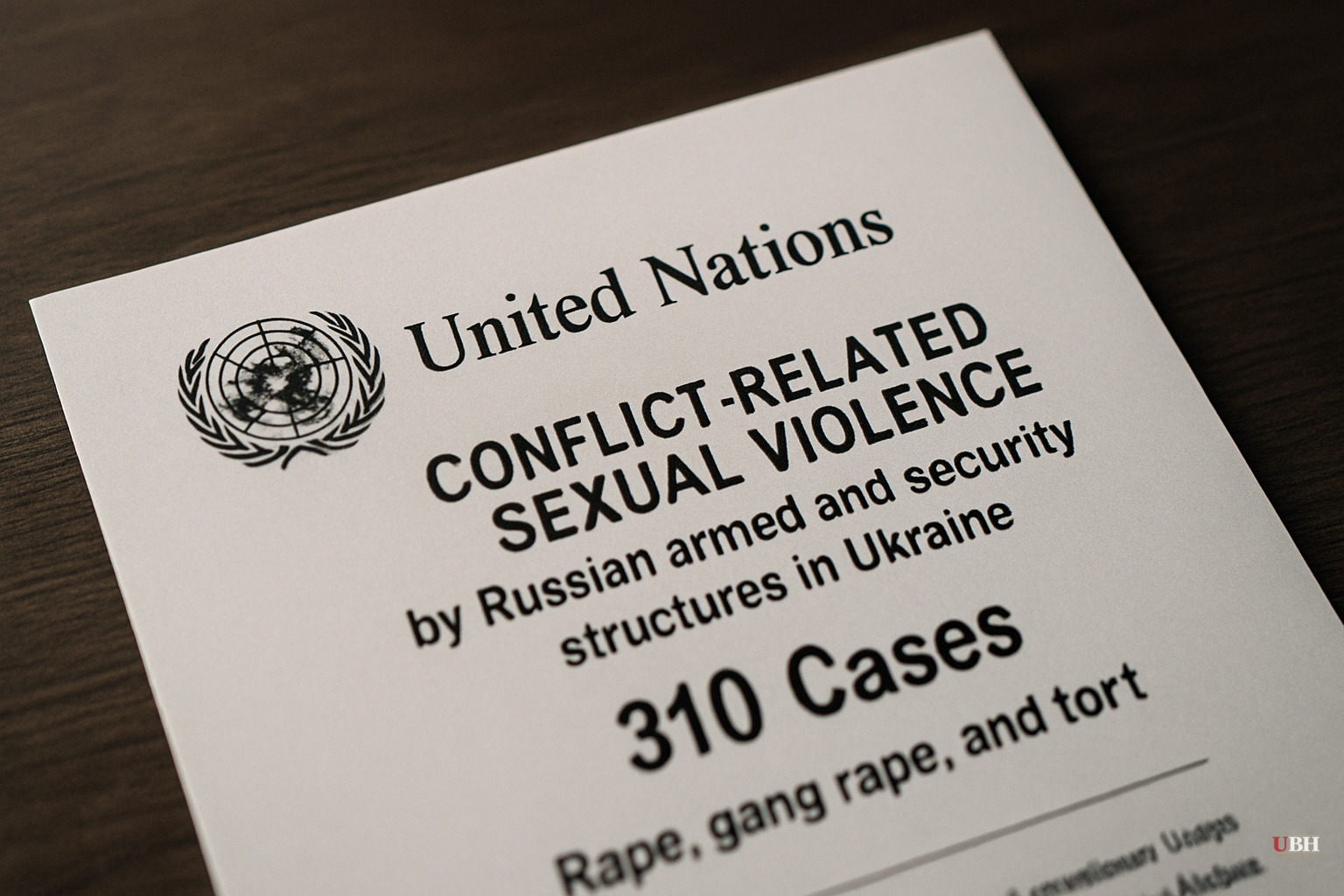
The UN secretary-general's report, cited at a Security Council meeting on May 28, 2026 according to Kyiv Post, officially recorded 310 cases of conflict-related sexual violence attributed to Russian armed and security structures in Ukraine.
The breakdown: 280 male victims, 26 female victims, and 4 girls. Documented crimes included rape, gang rape, genital mutilation, electric shocks, and beatings of genitals.
These are not Ukrainian government allegations alone. They are independently verified and entered into the official UN record.
Ukraine's Ambassador Demands Consequences
Ukraine's Permanent Representative to the UN, Sergiy Kyslytsya, used the Security Council meeting to demand that Russian personnel be suspended from all UN peacekeeping and police missions.
His argument: Moscow's forces have no moral standing to serve under the UN flag while simultaneously appearing in the UN's own report on systematic sexual violence. Ukraine has been documenting these crimes since Russia's initial occupation of Crimea and parts of Donetsk and Luhansk in 2014.
"What a disgrace for this infamous Russian army and so-called law enforcement agencies, which are nothing more than a gang of rapists," Ukraine's representative said, according to Kyiv Post.
Russia currently participates in UN mechanisms addressing children in armed conflict and conflict-related sexual violence. Ukraine's representative called that participation a symbol with no real enforcement attached to it.
One Case That Puts Numbers Into Human Terms
The NY Post reported on the account of a Ukrainian woman identified only as Sofia, whose experience illustrates what those 310 documented cases can mean in practice.
Sofia was 21 when Russian soldier Vyacheslav Dubenko, now 32, allegedly raped her shortly after Russian forces occupied her village near Kharkiv following the February 2022 invasion. When her family reported the assault to the occupying force's commanding officer, the response according to Kharkiv war crimes investigator Anna Ponomarenko was: "The young will be young."
Dubenko then allegedly recruited two fellow soldiers to abduct Sofia and transport her across the border into the Russian city of Belgorod, where she was held in a boarded-up apartment for over a year. Ponomarenko described the conditions to the Times of London: metal bars on the balcony, padlocked doors, no phone. "He left her food, that's it. It was sex slavery."
Dubenko allegedly threatened to kill Sofia's family if she resisted or tried to escape. When she was hospitalized after a suicide attempt in January 2023 and tried to tell doctors what was happening, Dubenko reportedly told them she was "disturbed" and from Ukraine. They didn't act.
She eventually escaped and identified Dubenko to investigators. No public record in these sources indicates he has been charged or extradited, a genuine open question given that he appears to be in Russia.
A Parallel Crisis: Trafficking Targets Displaced Women
Separate from state-perpetrated violence, the war has created conditions that organized criminal networks are exploiting. According to Freedom United, Ukrainian authorities have uncovered nearly 500 human trafficking cases since the start of Russia's full-scale invasion.
In one recently dismantled operation, the Donetsk Regional Prosecutor's Office charged a woman with recruiting victims from conflict-affected areas of eastern Ukraine under the pretense of legal EU employment. An alleged accomplice in Poland handled logistics and clients. The Donetsk-based suspect is currently in pretrial detention; Polish authorities are preparing charges against the second suspect.
A related investigation in Poland resulted in charges against 18 people, 15 Ukrainians and 3 Polish nationals, for human trafficking, organized crime, and soliciting sex work, according to Freedom United. One defendant is also accused of providing cocaine to women forced into sexual services. In one documented instance, a trafficking intermediary was paid 50,000 złoty ($13,235) to recruit a single woman; the network then made an estimated 120,000 złoty ($31,764) from exploiting her.
The Counterargument
Some observers, including voices sympathetic to Russia's stated position, argue that Western institutions are using the sexual violence framework as a political cudgel rather than a neutral accountability tool. They contend that wartime allegations are difficult to verify independently, that Ukraine has strong incentives to amplify every accusation, and that the UN process itself is subject to political pressure from member states.
But the UN secretary-general's report is not a Ukrainian government press release. It is an independently compiled document that now officially attributes 310 verified cases to Russian forces. The verification standard the UN uses for its own reports is not the same as a Ukrainian diplomatic claim. The cases were confirmed and entered into the official record, which is why Ukraine is pressing for enforcement rather than just more documentation.
The Structural Obstacle
Ukraine's demand that Russia be removed from UN peacekeeping missions faces one structural obstacle: Russia is a permanent member of the UN Security Council and can veto any binding resolution on the matter. Whether the General Assembly or the Secretary-General has independent authority to suspend a member state's peacekeeping personnel without Security Council approval is a live legal and institutional question that no source in this set answers.
Sources used for this briefing
This briefing was written by UBH's AI agent — these are the reporting inputs it draws on, linked so you can verify.


