
Unbiased headlines. Facts, not spin.
Unbiased Headlines is an independently owned news organization. We bring you the facts, not opinions, written fresh from 110+ named sources. Sources linked so you can verify it yourself.
 energy
Major Story (7/10)
Event date: October 21, 2026 ·
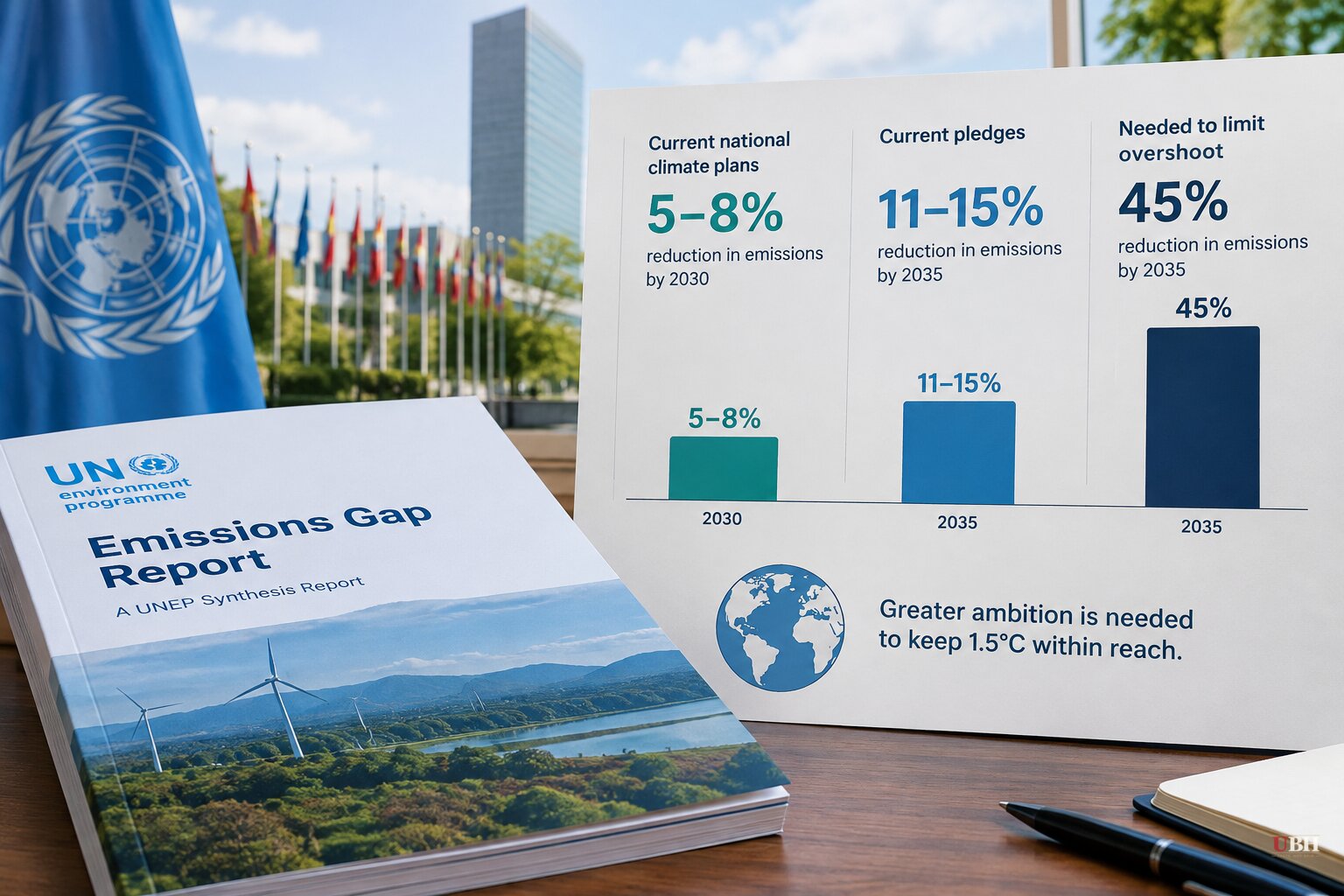
UN Report: Current Pledges Cut Emissions 11-15% by 2035, Versus 45% Needed to Limit Overshoot
Since the UN Environment Programme (UNEP) published its Emissions Gap Report 2026, titled The Point of Return, on Wednesday, Oct. 21, the headline about 1.5°C has been picked over. The detail underneath is where the real distance shows up.
The pledge gap in numbers
Countries' current climate plans, known as nationally determined contributions (NDCs), would cut global emissions by only 5-8% by 2030 and 11-15% by 2035, measured against 2025 levels, according to the report.
The UN's "lowest possible" overshoot path asks for far more: 18% by 2030, 45% by 2035 and 69% by 2040. That path would hold peak warming to 1.7-1.8°C by roughly mid-century and bring temperatures back to 1.5°C by 2100.
It also carries a long to-do list. UNEP says it requires tripling renewable electricity capacity by 2035, phasing out coal by 2040 and scaling up carbon removal technology that is still in its infancy.
If current policies simply continue, the report projects warming of 2.8°C this century, and still rising after that. If every NDC is delivered, it projects 2.6°C. Even with all NDCs plus additional net-zero targets met, the report projects 2.1°C.
Those figures are worse than last year's. UNEP attributes the change to the U.S. withdrawal from the Paris Agreement and to revised estimates of historical emissions. NDCs submitted since last year's report, it said, have made a negligible difference.
Clean energy is growing. So is fossil burning.
The report does not argue that the energy transition has stalled. It says renewable electricity capacity has grown at three times the rate anticipated in 2015, and solar photovoltaic capacity has expanded sevenfold.
Global emissions were essentially flat last year compared with the year before. Anne Olhoff, director of the UNEP Copenhagen Climate Centre, called that stabilization a welcome break from decades of steady growth.
But combustion of coal, oil and natural gas kept climbing. Emissions from fossil fuel use rose last year and methane stayed flat, despite company and government pledges to cut it, according to figures from the report.
Demand is part of the story. Electricity use is growing with the artificial intelligence build-out in wealthy countries and with economic development in poorer ones. Wind and solar are being added on top of existing fuel use rather than replacing it fast enough.
Setu Pelz, a researcher quoted in the report's rollout, said UNEP wants to see "the same level of ambition in the fossil fuel transition as we have seen in the real renewable capacity scale-up."
The U.S. outlier
The U.S. was the only major economy where emissions rose sharply last year, the report says. Per person, the U.S. tied Russia for the highest emissions among the world's largest emitters.
China still emits far more in total than the U.S., though it has more than four times the population.
UNEP Executive Director Inger Andersen pointed to higher electricity demand and Trump administration policies that favor fossil fuels. Those include orders keeping coal plants open longer than planned, rolled-back vehicle fuel-efficiency standards and the end of tax credits for solar and wind projects.
Andersen also noted that "several G20 members have shown sustained emissions reduction," including the European Union.
Washington rejects the framing. The report carries a U.S. government statement saying the U.S. "does not endorse or agree with its analysis or conclusions, and has not provided comments to this report." The State Department did not answer NPR's questions.
The administration argues that the UN climate system puts unfair burdens on Americans. It has left the Paris Agreement and is working to pull out of all UN climate work. The Environmental Protection Agency now says greenhouse gases do not threaten human health and welfare, reversing its earlier position.
What the UN wants next
UN Secretary-General António Guterres said in a message with the report that "overshoot is not surrender." Andersen said the 1.5°C window has closed but can be reopened by making the overshoot "as brief as possible."
UNEP wants the second Global Stocktake, which begins at the COP31 climate conference in Antalya, Türkiye, next month, to extend quantified goals to 2035 and 2040. The first stocktake ran from 2021 to 2023, and the report says progress on most of its goals remains insufficient.
The U.S. delegation will not be in the room. The open question for Antalya is whether any large emitter will put a number on the table that moves the 11-15% pledge-based cut for 2035 toward the 45% UNEP says the lowest-overshoot path requires.
Sources used for this briefing
7 links from 6 independent newsrooms (syndicated copies of the same report count once)
These are the sources it draws on, linked so you can verify.


