
Unbiased headlines. Facts, not spin.
Unbiased Headlines is an independently owned news organization. We bring you the facts, not opinions, written fresh from 110+ named sources. Sources linked so you can verify it yourself.
 energy
Notable (6/10)
Army and NASA Both Target 2028 for Nuclear Reactors While Nuclear Stocks Slide
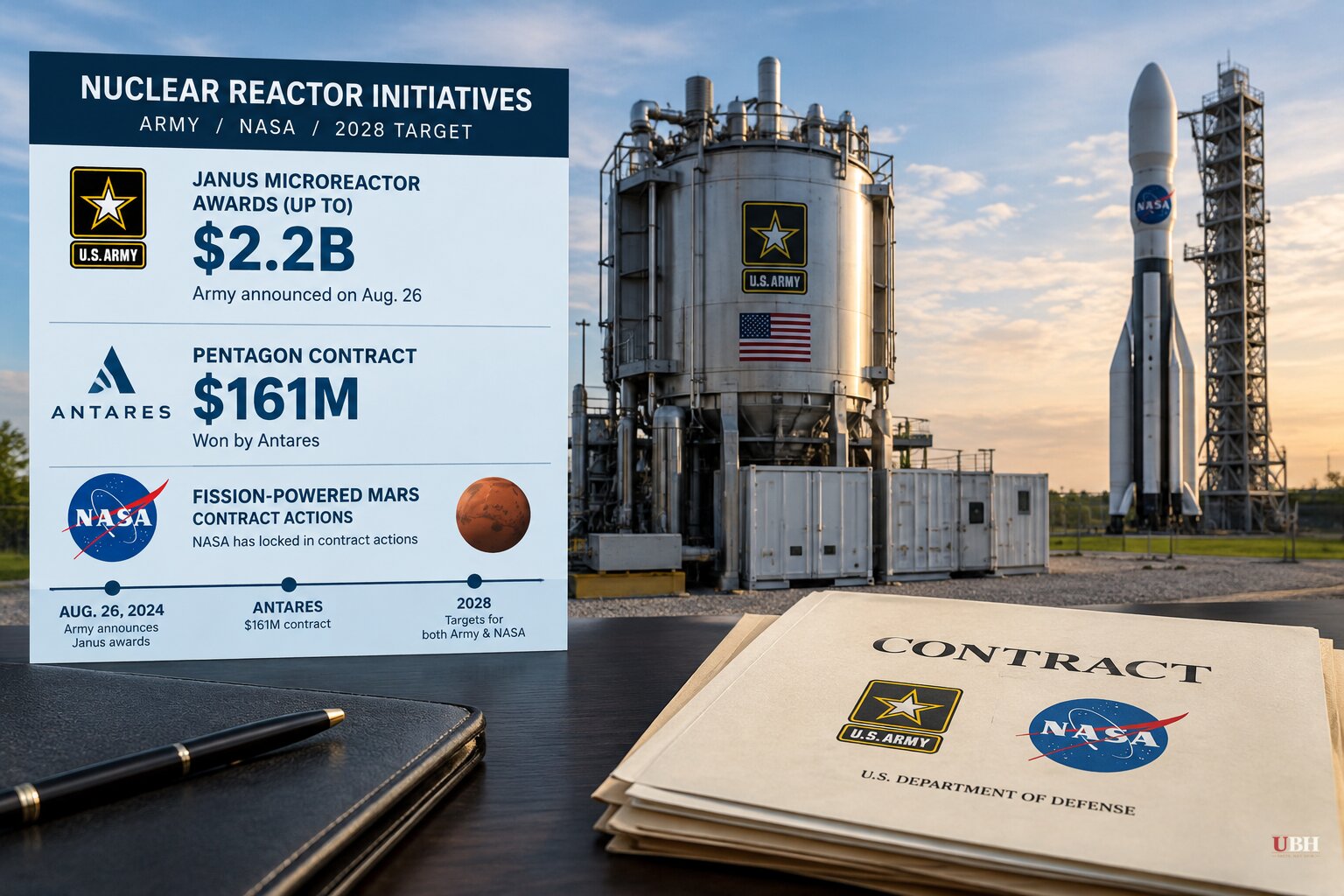
Since the Department of the Army announced up to $2.2 billion in Janus Program awards on Aug. 26, the push to put small nuclear reactors on military bases and spacecraft has picked up money and deadlines. It has also picked up a hard question: can anyone hit 2028?
The Army's Janus Program
Janus, launched in 2025, selected five nuclear vendors and five initial sites. The Army will award up to a combined $2.2 billion for the companies to own, construct and operate microreactors on military installations. All five first sites are in the lower 48 states.
The program envisions up to 20 reactors at Army, Navy and Air Force bases. The Army said the other 15 sites and vendors will be announced later, and that future locations could include Alaska and Pacific islands.
The reactors must be transportable by truck, rail or plane. The Army wants at least one running at one of the first five sites by the end of 2028.
The Army said it expects "significant private sector investment from each vendor." It has not said how much. That leaves the taxpayer share of the full 20-reactor buildout unclear beyond the $2.2 billion ceiling.
Reactors built for military use do not need Nuclear Regulatory Commission licenses. The Army said it is working with the NRC so that defense-built designs could later apply for licenses to sell commercially.
Antares and the moon
Antares is the company furthest along. In June it switched on its Mark-0 microreactor, the first to reach criticality in the Trump administration's pilot program for next-generation reactors.
The company now aims to install a 1-megawatt R1 reactor at Fort Bragg, North Carolina, by September 2028. In September the Department of Defense awarded Antares $161 million to develop an R1-S, a version integrated with a spacecraft, for flight certification.
Founder and CEO Jordan Bramble told Fortune he wants an R1-S on the moon as soon as 2030. "We've always believed since the beginning the [Department of Defense] would be the first adopter of advanced nuclear power," he said. "That's obvious at this point."
Fortune reports that Radiant, which makes a transportable 1-megawatt reactor sized to power roughly 750 homes, is the biggest Janus recipient. General Atomics is also working with the Army, as is BWX Technologies.
NASA's fission mission
On Oct. 20, NASA announced contract actions for Space Reactor-1 (SR-1) Freedom. The mission is scheduled to launch in late 2028 and deliver three robotic helicopters to Mars. It would be NASA's first fission-powered voyage beyond Earth orbit.
The spacecraft would use reactor heat to generate electricity for nuclear electric propulsion. Idaho National Laboratory, part of the Department of Energy, is designing the reactor. Sierra Lobo Inc. will supply the closed Brayton cycle power conversion system, under a NASA contract awarded in 2024 for work at Glenn Research Center in Cleveland.
"These contract actions not only reduce technical risk and help us maintain momentum toward our 2028 launch," said Steve Sinacore, the SR-1 Freedom program director.
That leaves about two years to integrate, test and prepare a reactor-and-propulsion system for flight.
Proven in labs, not yet in the field
The technology has a long record inside the Navy, whose submarines and aircraft carriers have run on nuclear power for decades. Fortune's reporting notes that the new microreactors have not yet been proven in the field commercially, only in testing. The gap shows in the lunar plans too: solar power and radioisotopes are seen as the shorter-term answer on the moon, with reactors as the permanent one.
The same reporting says the data center boom has slowed somewhat, nuclear stock valuations are down and planned IPOs have been canceled. Federal money is now carrying the schedule.
What the market says
BWX Technologies, a publicly traded Janus vendor with decades of Navy reactor work, closed Friday, Oct. 23, at $127.19 on the NYSE. Its 52-week range runs from $123.05 to $241.82, and the stock is down about 40% over six months, though up about 136% over five years. The company has a market cap of roughly $11.65 billion.
BWXT also raised its 2026 guidance for revenue and adjusted EBITDA in its most recent quarterly report. U.S. markets are closed for the weekend, so Friday's close is the latest price.
What comes next
The Army has yet to name the remaining 15 Janus sites and vendors. The next hard markers are the Army's end-of-2028 deployment target, Antares' September 2028 Fort Bragg date and NASA's late-2028 SR-1 Freedom launch window. Each depends on hardware that has not yet operated outside a test setting.
Sources used for this briefing
7 links from 5 independent newsrooms (syndicated copies of the same report count once)
These are the sources it draws on, linked so you can verify.


