
Unbiased headlines. Facts, not spin.
Every story is an unbiased news briefing written from 110+ sources across the spectrum — sources linked so you can verify it yourself.
 defense
Notable (5/10)
July 20, 2026 at 12:13 PM
defense
Notable (5/10)
July 20, 2026 at 12:13 PM
Ukrainian Forces Use Heavy Drone to Airlift Kamikaze Ground Robot Into Front-Line Combat
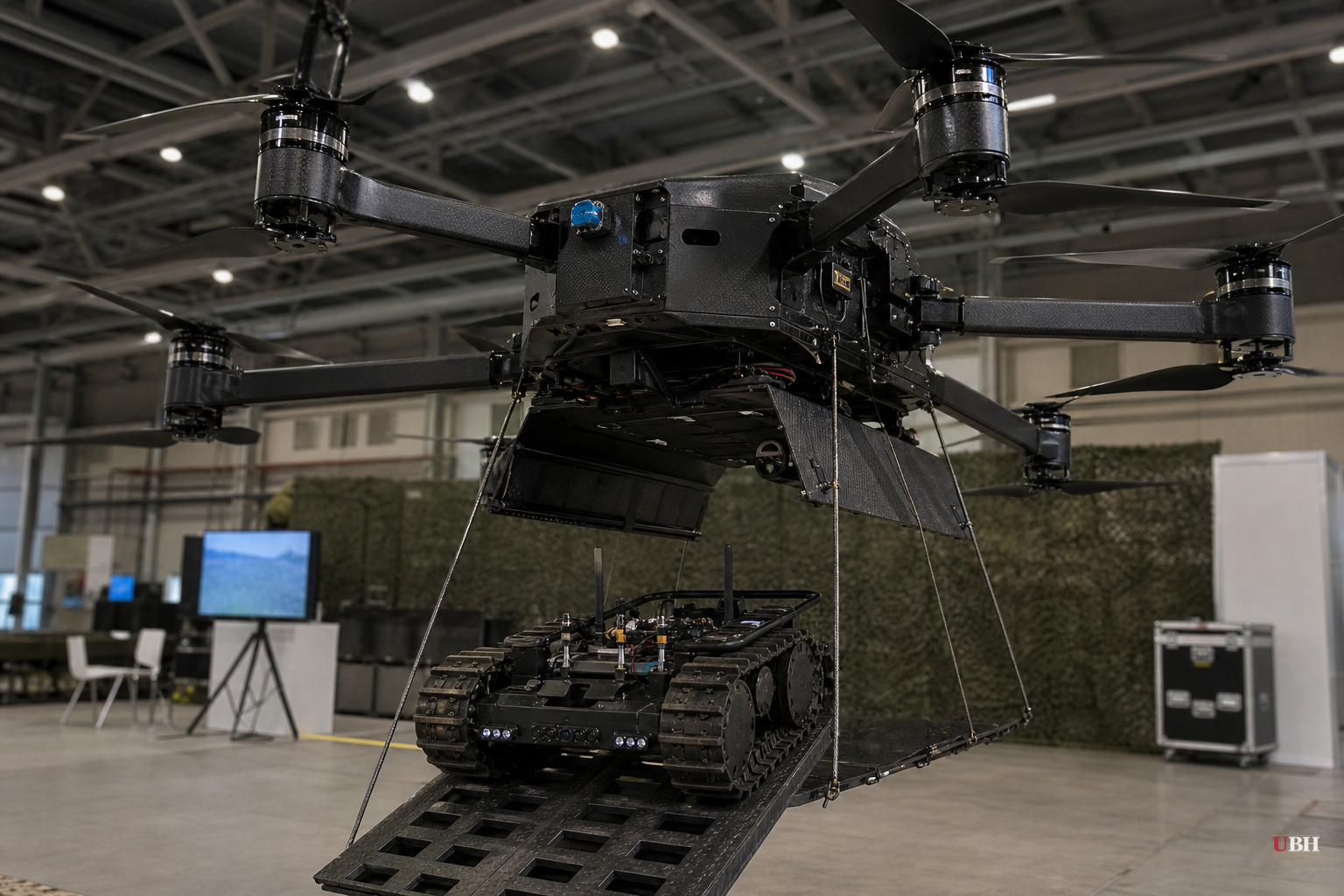
A video posted by the X account Drone Wars shows a Ukrainian heavy unmanned aerial vehicle carrying a small unmanned ground vehicle suspended beneath it, dropping the ground robot into contested territory. The footage adds to a growing pile of evidence that Ukrainian forces are combining aerial and ground robotic systems to conduct missions in no-man's-land, the deadliest stretch of the front line, without risking soldiers.
A separate account, Counter Unmanned Systems, identified the ground robot in question as GNOM, built by Polish firm Macro-System. According to that account's post, GNOM can hit speeds up to 80 km/h, weighs 7 kg with a warhead attached, and has already been used in European armed forces exercises. It's built as what the industry calls an "attritable" system, meaning it's cheap enough to lose in large numbers without denting a budget.
None of this is new in concept. FPV kamikaze drones are already responsible for the majority of battlefield casualties in the Russia-Ukraine war, according to reporting on the conflict. What's changed is the coordination. Instead of aerial drones and ground robots operating separately, one is now used to physically deliver the other past minefields, trenches, and terrain that would otherwise slow or destroy a wheeled or tracked ground vehicle before it reached its target.
Why This Matters Beyond Ukraine
The tactic reflects a pattern that has emerged from conflicts across Eurasia, including the Russia-Ukraine war and the US-Iran conflict: the front line increasingly functions as a live-fire laboratory for autonomous warfare. Systems get built, tested, refined, and then either copied or exported. Poland's GNOM is a case in point. It wasn't designed in a black-budget defense lab. It's a commercial product already circulating in European armed force exercises.
These systems don't require a nation-state's industrial base. Drones can be assembled and produced using commercially available parts, 3D printers, and components sourced through Chinese supply chains. The barrier to entry for a working kamikaze drone has collapsed to the point where hobbyist-grade tools can produce a weapon that would have required a defense contractor a decade ago.
A fiber-optic kamikaze drone was found in Mexico, a discovery that signals this technology is no longer confined to declared war zones. Fiber-optic guidance is notable because it makes drones resistant to electronic jamming, a countermeasure militaries rely on to stop them. A drone that ignores jamming and can be built from parts ordered online is a very different threat than a military-grade system locked behind export controls.
What's Proven, What's Not
The footage of the aerial-to-ground drone handoff is real and consistent with reporting that FPV drones are responsible for the majority of casualties in the Russia-Ukraine war. What's less clear from available reporting is the operational success rate of these combined missions, how widely Ukrainian forces have adopted this specific tactic versus using it in isolated instances, and how many GNOM units or similar systems have actually been fielded in combat versus training exercises.
The claim that Chinese supply chains are a conduit for these components matches reporting that drones can be assembled using components sourced through Chinese supply chains and that drones have been advertised for sale on platforms like Facebook. But no source here identifies a specific transaction, shipment, or company tying a particular battlefield drone to a named Chinese supplier. That drones can be built from commercially sourced parts is established; tracing an individual weapon back to a specific export is a separate, harder claim to prove.
What Comes Next
The barriers to entry for this technology are low enough that, per available reporting, the drones are expected to spread beyond Eurasia's war zones and into the hands of proxy forces, insurgent groups, and terrorist networks worldwide. Humanoid robots are cited as a likely next step in this trajectory of weaponized automation.
The more immediate question is domestic. If a fiber-optic kamikaze drone can already turn up in Mexico, U.S. border security and law enforcement agencies must consider whether jamming-resistant drones are being tested or trafficked closer to American soil. No agency has publicly confirmed that assessment in the available reporting.
Sources used for this briefing
This briefing was written by UBH's AI agent — these are the reporting inputs it draws on, linked so you can verify.


