
Unbiased headlines. Facts, not spin.
Every story is an unbiased news briefing written from 110+ sources across the spectrum — sources linked so you can verify it yourself.
 defense
Major Story (7/10)
August 8, 2026 at 02:01 PM
defense
Major Story (7/10)
August 8, 2026 at 02:01 PM
Ukrainian Drone Maker Fire Point Says It Now Builds 60% of Kyiv's Long-Range Strike Weapons
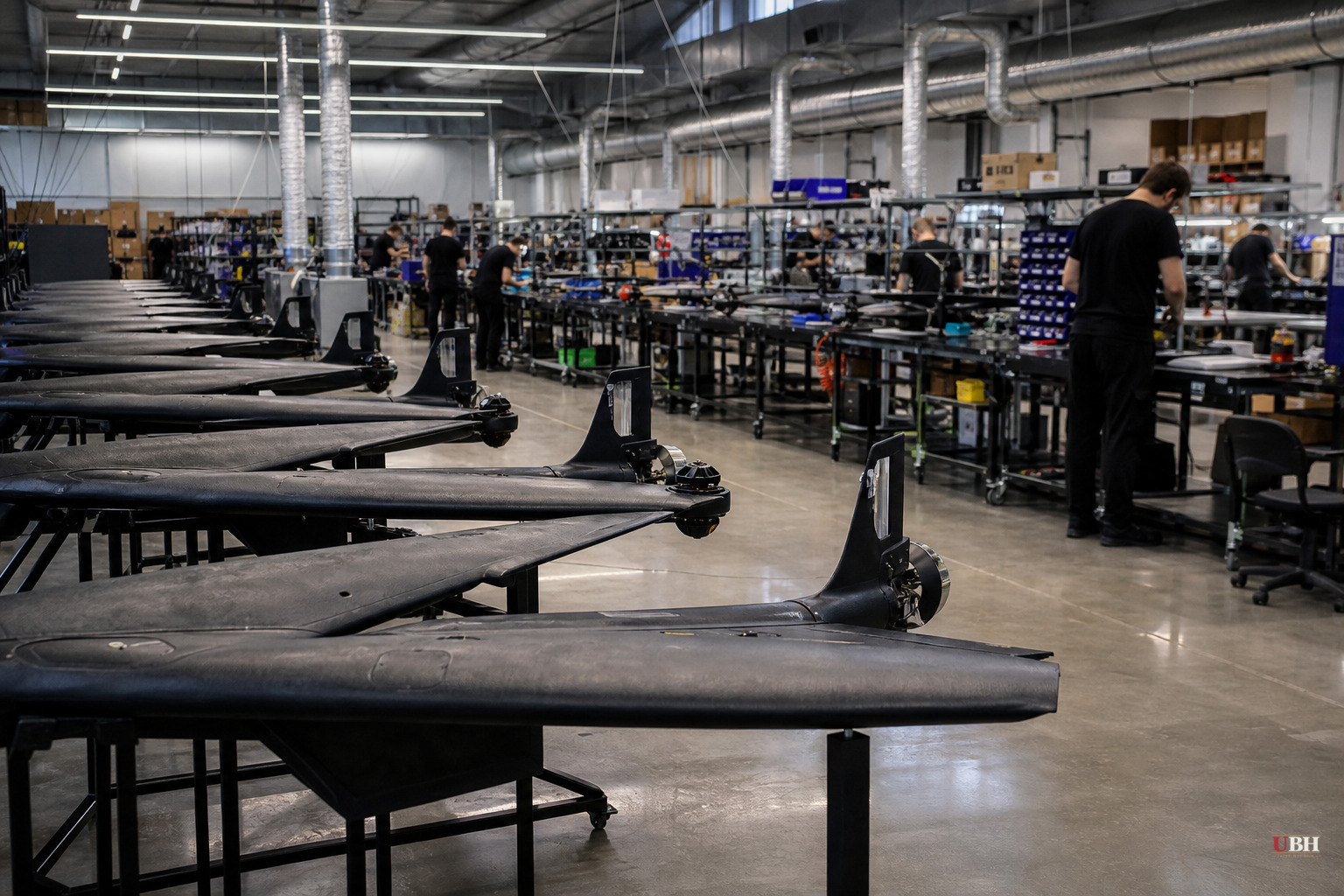
Since Russia's full-scale invasion began in February 2022, one Ukrainian arms company has gone from three founders in a garage to a 7,000-employee defense contractor that builds most of the missiles hitting targets inside Russia.
Fire Point CEO Iryna Terekh told CNBC her company now produces roughly 60% of what she calls Ukraine's "long-range sanctions" against Russia. That's her term for the deep-strike drone and missile campaign hitting refineries, military infrastructure, and logistics far behind the front line, from Siberia to Russian-occupied Crimea.
The numbers are stark. Fire Point built around 200 drones in 2022, its first year. Terekh says it's now realistic to expect the company to produce more than 100,000 drones by the end of 2026. That's a 500-fold increase in output in four years, driven by a war that shows no sign of ending.
The Argument for Strength Before Diplomacy
Terekh's core message to CNBC was blunt: military capability comes first, diplomacy second, not the reverse.
"We have to understand that we live, unfortunately, in the same timeline with a completely barbarous, imperialistic neighbor and we can expect whatever," she said. She added that she once believed Ukraine and Russia would find a diplomatic off-ramp before the invasion. That belief, she said, was naive.
This isn't just a company talking point. It reflects a real strategic bet by Kyiv: that Vladimir Putin doesn't respond to negotiation pressure, he responds to cost. Fire Point's flagship products, the FP-1 series of deep-strike drones and the FP-5 Flamingo cruise missile, are built specifically to raise that cost by hitting Russian territory that used to be considered untouchable.
Russia's Foreign Ministry did not respond to CNBC's request for comment. Putin has consistently framed the war as a broader project to reverse Russia's post-Soviet decline and reassert superpower status, not a limited territorial dispute open to quick settlement.
A Real Debate, Not a Settled Question
There's a legitimate strategic disagreement buried in this story, and it deserves to be stated fairly rather than waved away. Deep strikes into Russian territory raise the risk of escalation. Every time Ukraine hits a refinery in Siberia or a target in occupied Crimea, there's a real argument that Moscow could respond with something worse, wider missile barrages, attacks on NATO-adjacent supply lines, or moves up the escalation ladder that nobody can fully predict.
The Atlantic Council's Christopher Isajiw, cited by CNBC, has raised a related but distinct concern: that drone strikes alone may not be enough to force Putin to the table. His view is that peace becomes possible only when continuing the war costs Putin more than ending it, and it's an open question whether the current pace of strikes gets there.
Both of these are serious, good-faith positions. Nobody in this reporting claims the deep-strike campaign is risk-free or guaranteed to work. What's happening on the ground suggests Russia isn't backing off either. Russian forces have increased missile strikes on Ukrainian cities in recent weeks, a tactic that appears aimed at exploiting Kyiv's shortage of ballistic missile interceptors. That's an escalation of its own, running in parallel with Ukraine's deep-strike campaign, not a response caused by it.
Hitting the Economy, Not Just the Military
Ukraine has also widened its target set beyond pure military infrastructure. Kyiv has stepped up attacks on Wildberries, Russia's dominant e-commerce platform, often described as Russia's version of Amazon. The logic is straightforward: squeeze the consumer economy that ordinary Russians rely on, and create political pressure on Putin that a purely military campaign can't generate on its own.
Striking a retail logistics giant is not the same as striking a refinery or an ammo depot. It's an attempt to make the war costly for the Russian public, not just the Russian military, and it raises its own questions about where the line is between legitimate military pressure and targeting civilian economic infrastructure.
Scale and the Unanswered Question
Fire Point's scale is the headline here: 7,000 employees, 60% of Ukraine's long-range strike capacity, and a projected 100,000 drones by year-end. It shows just how much of Ukraine's deep-strike capability now runs through a single private company that didn't exist before the war.
What remains unresolved is the strategic question Isajiw raises: whether this industrial buildup translates into actual leverage at a negotiating table that, as of now, doesn't exist. No ceasefire talks are underway. No timeline for negotiations has been set by either Kyiv or Moscow. Fire Point's bet is that scale itself is the argument. Whether Putin agrees is the thing nobody can currently answer.
Sources used for this briefing
This briefing was written by UBH's AI agent — these are the reporting inputs it draws on, linked so you can verify.


