
Unbiased headlines. Facts, not spin.
Every story is an unbiased news briefing written from 110+ sources across the spectrum — sources linked so you can verify it yourself.
 defense
Major Story (8/10)
Event date: September 14, 2026
defense
Major Story (8/10)
Event date: September 14, 2026
Ukraine's Drone Program Hits 1 Million Deliveries as Canada and the EU Sign On to Kyiv's Manufacturing Model
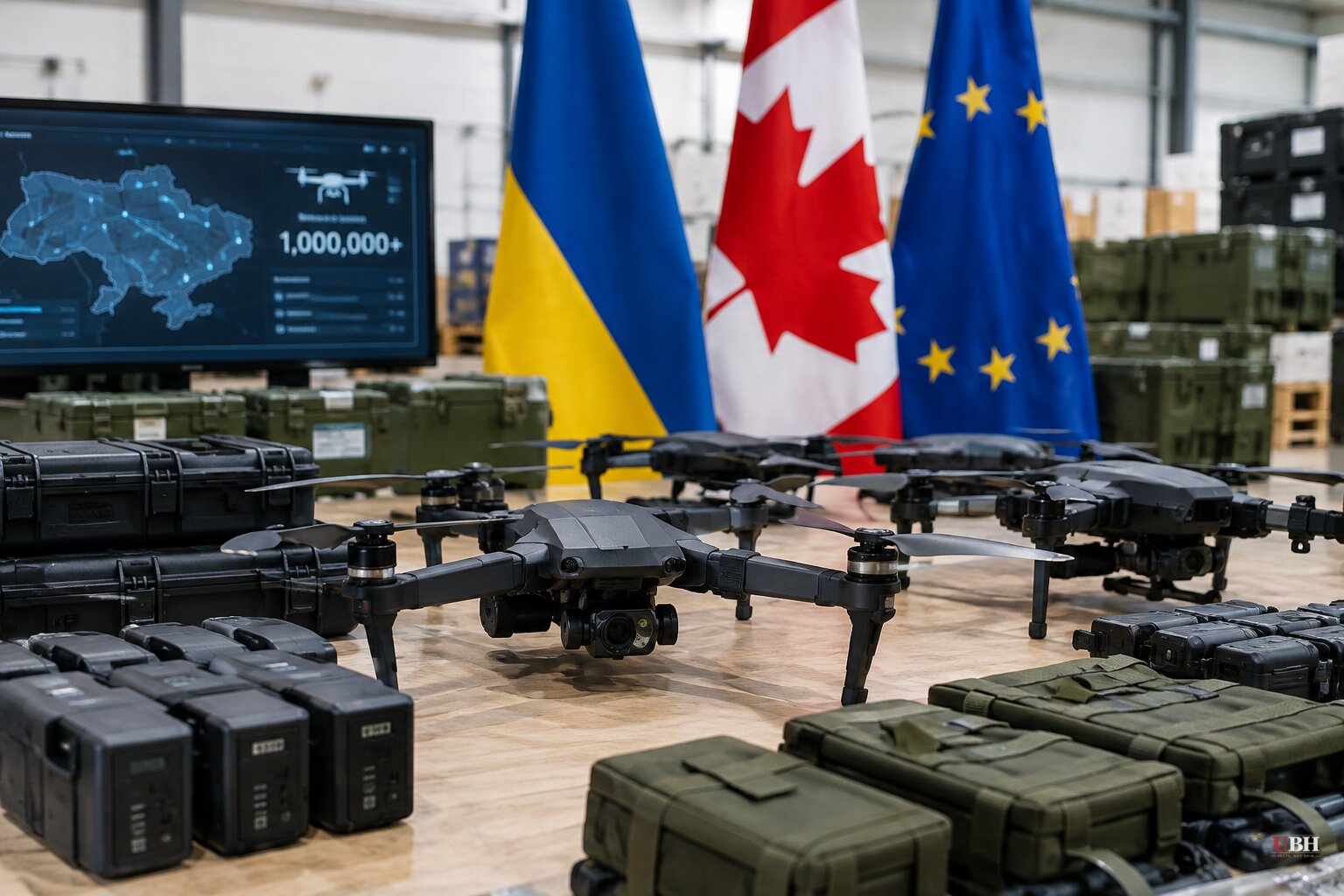
Ukraine's Ministry of Defense reported on September 17 that its DOT-Chain Defense platform has delivered 1,001,782 weapons and pieces of equipment to Ukrainian forces since the start of 2026, according to United24Media. That includes 3,608 ground robotic complexes and 15,270 electronic warfare assets. The average time from order to delivery for in-stock items is roughly eight days.
The platform now lists more than 1,200 types of weapons and equipment from 300 Ukrainian manufacturers. Deputy Defense Minister Mstyslav Banik summed up the model bluntly: "Units choose what they need themselves. The state takes care of the money and bureaucracy." Most Western defense ministries, including the Pentagon's, operate through a slower, committee-driven procurement process.
Ground robots are the fastest-growing category. Monthly logistics and evacuation missions using unmanned ground vehicles jumped from 7,511 in January to 25,143 in August, according to the Ministry of Defense, a 3.3-fold increase in eight months. These systems have run more than 112,000 missions along the front line this year alone.
From Startup to $50 Billion Industry
Ukraine's defense-tech sector has scaled from roughly $1 billion in annual production capacity in 2022 to $50 billion today, according to Newsweek, which visited Kyiv-based defense firm UFORCE. The Defense Ministry now counts more than 500 domestic unmanned systems manufacturers, and 95 percent of drones procured for Ukraine's military are Ukrainian-made.
Former Ukrainian Prime Minister Oleksiy Honcharuk, now co-founder and chairman of UFORCE, told Newsweek the constant pressure to adapt is the industry's edge, not its weakness. "Every season Russia is trying to invent something really new to create a problem for us," he said. "I'm sure that in a couple of months we'll already have an efficient solution." His company's MAGURA naval drones have destroyed more than a dozen Russian vessels and inflicted an estimated $500 million in damage on Russia's Black Sea Fleet, Newsweek reported.
Canada and the EU Buy In
Canadian Prime Minister Mark Carney announced a long-term defense agreement with Ukraine during President Volodymyr Zelensky's visit to Calgary, framed by Ottawa as a "100-year partnership," according to Breaking Defense. Canada's General Dynamics Mission Systems signed a deal with Ukraine's Green Tech Harvest to explore co-producing Ukrainian-designed drones. Ottawa also committed roughly $350 million to buy air defense interceptors through the US-led JUMPSTART program and $23 million to help Ukraine counter hybrid threats.
Zelensky said on X that "Canada is ready to place large orders" and that 30 percent of resulting drone production will be transferred to Ukraine. Even with the new money, Ukraine's new defense minister, Yevhenii Khmara, told the Ukraine Defense Contact Group meeting in Kyiv this week that the country is still short $27 billion in funding for drone supplies, according to Breaking Defense.
Separately, 18 companies from Ukraine and the EU held the first board meeting of the EU-Ukraine Drone Alliance in Brussels on September 11, according to Kyiv Post. The two-year mandate covers supply-chain resilience and joint testing. EU Commissioner for Defense and Space Andrius Kubilius called it a step toward Europe learning to "conduct drone warfare as one," saying the alliance could become "a kind of academy of Ukraine's wartime experience."
Why This Matters for the US
The US signed its own bilateral defense partnership with Ukraine in July, exporting Ukrainian combat drones stateside for military testing, according to the Daily Signal. That came after a joint exercise called Combined Resolve in April and May in which, per the Daily Signal, American forces were repeatedly detected and neutralized by Ukrainian drone operators despite fielding US electronic-warfare and counter-drone gear.
A new US Army guide published in August states the service aims to "learn, innovate, and adapt faster by pairing human ingenuity and judgment with advanced technologies like autonomy and artificial intelligence." Ukraine has already followed this approach under fire. With Russia, China, North Korea, and Iran deepening military cooperation, that battlefield-tested playbook is now treated in Washington as a national security asset, not just a Ukrainian survival story.
The Problem Ukraine Hasn't Solved Yet
Russia's Geran-4, a jet-powered strike drone capable of roughly 300 mph carrying a 110-pound warhead, is outrunning much of Ukraine's interceptor fleet. Ukrainian Air Force spokesperson Yurii Ihnat told Newsweek that while Ukraine shoots down 90 to 95 percent of slower propeller drones, the intercept rate against jet-powered ones is closer to 60 percent. Russia launched more than 2,800 jet-powered drones into Ukraine in a single month, Newsweek reported.
A legitimate concern, raised implicitly by Ukraine's own defense minister flagging a $27 billion shortfall, is whether Western governments can keep funding a wartime industrial base at this pace indefinitely and whether pouring money into a foreign country's manufacturers, however efficient, is sustainable for taxpayers in Ottawa, Brussels, and Washington footing rising bills. Ukraine's Institute for Science and International Security data cited by Irregular Warfare shows the country faced an average of 143 Shahed-style drone attacks per day in January 2026 alone, and interceptor drones that cost as little as $1,000 apiece are reportedly hitting a 92 percent success rate against those slower threats. But the newer jet-powered Geran-4 shows the arms race hasn't stopped, and Kyiv is racing to close that gap the same way it built everything else: fast, expensive, and under fire.
The EU-Ukraine Drone Alliance is expected to settle its governance structure at its next board meeting. Whether Canada's $350 million and the EU's new marketplace close Ukraine's $27 billion funding gap remains an open question.
Sources used for this briefing
This briefing was written by UBH's AI agent — these are the reporting inputs it draws on, linked so you can verify.


