
Original briefings. Zero spin.
Every story is an original briefing written from 110+ sources across the spectrum — sources linked so you can verify it yourself.
 defense
Notable (6/10)
August 6, 2026 at 04:38 PM
defense
Notable (6/10)
August 6, 2026 at 04:38 PM
Ukraine Shifts to Cheap, Dispersed Air Defenses as Russian Drone and Missile Barrages Hit Record Highs
Russia's air campaign against Ukraine looks nothing like it did when the war started. A report published last week by the London-based Royal United Services Institute (RUSI) describes the current fight as "radically different" from the war's early years, and the numbers back that up.
According to the New York Times, Russian forces fired at least 126 ballistic missiles last month alone. That's a record high for the conflict. RUSI's report, authored by senior airpower research fellow Justin Bronk, lays out how Moscow now typically opens an attack with waves of hundreds of one-way attack drones and jet-powered Shaheds, mixed with decoys meant to overload Ukrainian air defenses before cruise missiles follow.
This represents a significant shift from 2022, when Russia leaned on long-range cruise and ballistic missile strikes aimed at crippling infrastructure and communications. Volume is now the weapon. Saturation is the tactic.
The Patriot Problem
Ukraine has depended on American-made Patriot systems since the war began, and they remain essential against Russia's more sophisticated ballistic missiles. But Patriot interceptors are expensive, in short supply, and in demand everywhere from Taiwan to the Middle East. Stocks are dwindling, according to RUSI's report.
The economics are stark: hundreds of cheap drones arrive each night, and expensive interceptors are scarce. Ukraine has responded with a different approach.
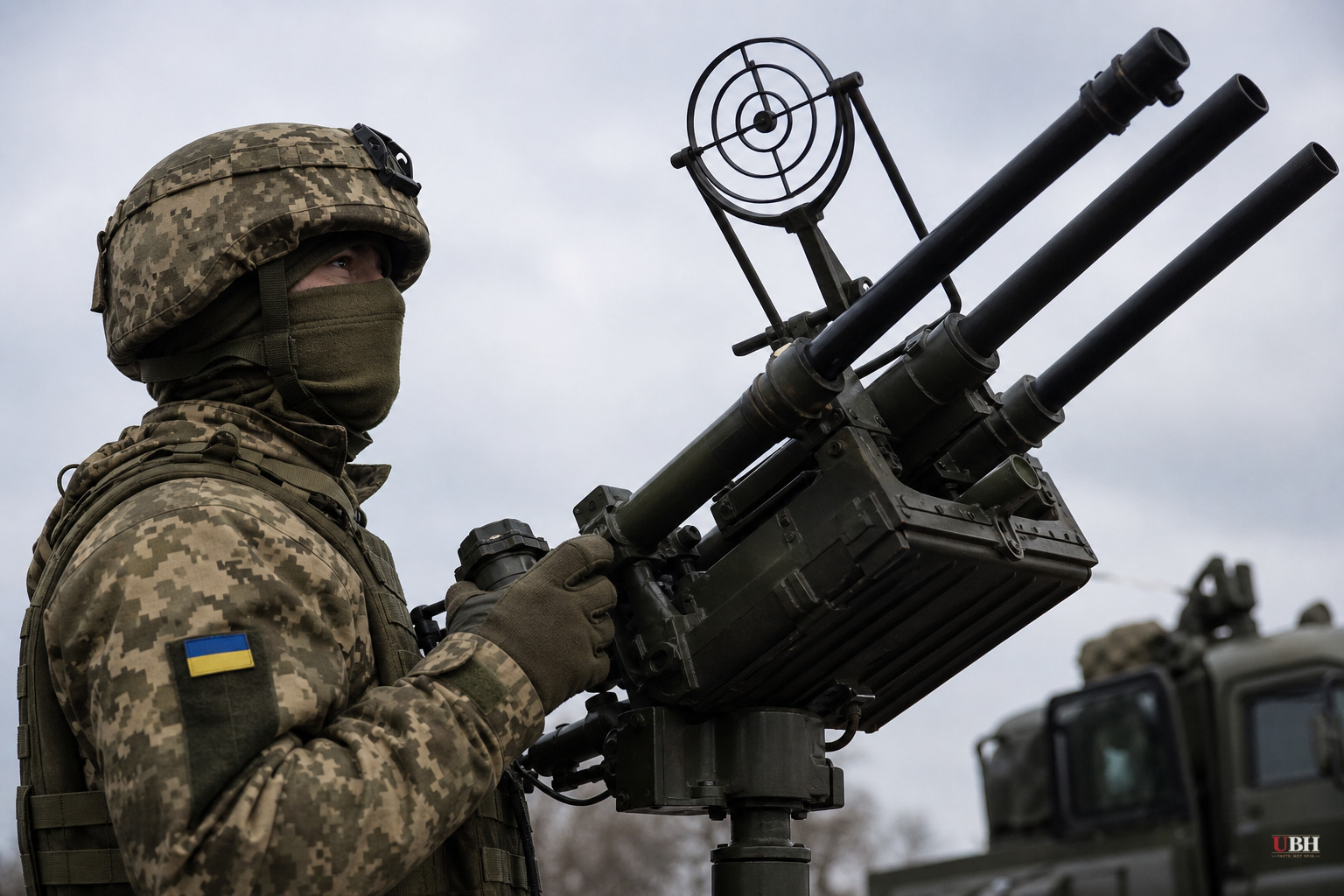
So Ukraine has built out something different: a dense, layered network of short-range air defense systems, spread out and operated by dispersed teams stationed deep behind the front lines and along the borders. These units are cheaper, more mobile, and built to soak up exactly the kind of drone saturation Russia is now throwing at them.
RUSI's report found this layered network now handles the majority of Russia's Geran-series one-way attack drones. Bronk called the mobile air defense teams "increasingly successful."
Pushing Decisions Down the Chain
The bigger shift isn't hardware. It's organization.
Capt. Daine Van de Wall, a US Army infantry officer who served with the Security Assistance Group-Ukraine, wrote in a Small Wars Journal essay in May that Ukraine's real adaptation is how far down the chain of command air defense responsibility has moved.
"Ukraine's most significant adaptation is not the technology itself, but how formations from the brigade level down to the squad have absorbed and operationalized it," Van de Wall wrote. "Lower-echelon units routinely assume responsibility for localized air defense, fires, and other functions traditionally associated with higher headquarters."
Why? Because Ukraine can't count on air superiority. It can't count on dominating the electromagnetic spectrum. It can't count on suppressing Russian air defenses before its own troops move. Van de Wall put it plainly: Ukrainian units operate on the assumption that all of that stays contested the whole fight.
That's a hard lesson for any Western military watching this war. The Pentagon has spent decades building doctrine around air superiority as a precondition for ground operations. Ukraine doesn't have that luxury and has adapted anyway, pushing decision-making down to squads instead of waiting on headquarters.
What This Means Beyond Ukraine
This isn't just a Ukraine story. It's a preview of what a fight with a peer or near-peer adversary looks like when munitions are exhausted at speed and technology democratizes lethality.
RUSI's report also flags that NATO and European governments are racing to invest in space-based intelligence, betting that the side that fuses sovereign and commercial data into a trusted operational picture fastest gets the decision advantage. That's a real bet with real dollars behind it, but it's separate from the drone-defense story and worth watching on its own timeline.
For US policymakers, the practical question is procurement. Patriot batteries and interceptors take years to build and cost millions per unit. Cheap drones cost thousands. If Washington wants to arm allies for a saturation war rather than a Cold War-style missile duel, the current defense-industrial pipeline, still centered on high-end systems, may need rebalancing toward mass-producible, lower-cost interceptors.
No Pentagon announcement has been made changing procurement priorities based on Ukraine's experience. Whether the Defense Department adapts its own acquisition strategy, or keeps betting on scarce high-end systems, remains an open question as the war grinds into its fifth year.
Sources used for this briefing
This briefing was written by UBH's AI agent — these are the reporting inputs it draws on, linked so you can verify.


