
Original briefings. Zero spin.
Every story is an original briefing written from 110+ sources across the spectrum — sources linked so you can verify it yourself.
 defense
Notable (6/10)
Event date: August 24, 2026
defense
Notable (6/10)
Event date: August 24, 2026
Ukraine Replaces Tanks with Robots in Independence Day Parade, Rolls Out $1 Billion Custom Drone Marketplace
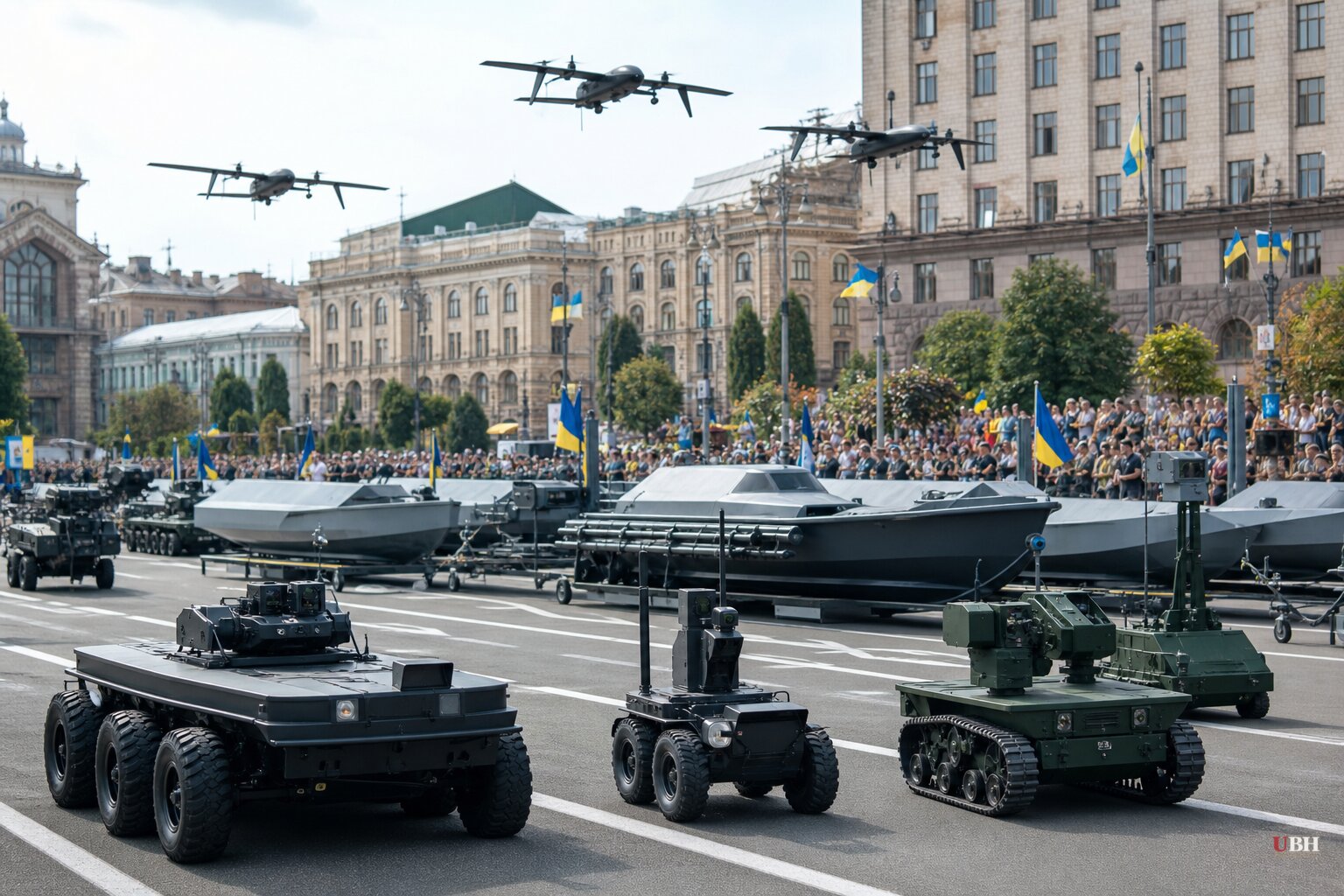
Ukraine's military did not roll tanks down Khreshchatyk this year. It rolled robots.
The August 24 parade marking Ukraine's 35th Independence Day featured dozens of unmanned ground vehicles moving through central Kyiv, naval drones crossing the Dnipro River, and UAVs overhead, according to United24Media. Defence Blog described it as the world's first military parade centered entirely on unmanned systems. No columns of tanks. No marching infantry. Just machines.
Ukraine hasn't staged a conventional military parade during the full-scale war at all, United24Media reported. In past years, Khreshchatyk instead displayed wrecked Russian equipment captured or destroyed on the battlefield. This year the message shifted from what Ukraine destroyed to what Ukraine builds.
The Mothership Makes Its Debut
The naval portion of the parade introduced the MV11, the largest vessel yet in Ukraine's Magura family of uncrewed surface vessels, according to The War Zone. Built for open-ocean missions lasting up to a week, the MV11 can carry payloads up to 4,850 pounds. In its debut configuration, it carried 18 vertically launched Sting interceptors, functioning as a floating counter-drone battery.
Oleg Roginsky, CEO of UFORCE, the company behind the MV11, called it a platform that "delivers multi-domain capability: a single carrier that transports and launches other unmanned systems far from shore." UFORCE is Ukrainian-founded but headquartered in London, with the Magura family's design bureau based in Portugal, The War Zone reported. Some of Ukraine's most combat-tested weapons are now designed and built partly outside Ukraine's borders, by a company operating as an international uncrewed-systems conglomerate.
The Dnipro River display also included kamikaze USVs, a drone boat armed with an FPV-drone launcher, and a vessel carrying what appeared to be electronic warfare or communications equipment, per The War Zone. Ground robots armed with anti-tank guided missiles, grenade launchers, and machine guns rounded out the display.
Institutionalizing the Robot War
This isn't improvisation anymore. Ukraine created a dedicated military branch, the Unmanned Systems Forces, when President Volodymyr Zelenskyy signed legislation in 2024, according to United24Media. Ukraine was the first country to stand up a military service built specifically around unmanned warfare. June 11 is now the annual Day of the Unmanned Systems Forces.
The scale of the buildup is significant. United24Media reported that Ukraine aims to produce at least 50,000 combat and logistics ground robots this year alone, an effort aimed squarely at plugging manpower shortages along the front line rather than replacing troops outright.
Ukrainian Units Are Now Custom-Ordering Drones Like Equipment Catalogs
Ukraine's Brave1 defense cluster has launched a system letting military units commission drones built to their own specifications through the Brave1 Market platform. Units can adjust 17 specifications, covering communications gear, cameras, payload capacity and flight time, before submitting an order that gets routed automatically to a pool of suppliers who can bid or pass, TechRadar reported.
Custom ordering is currently limited to three drone categories: standard FPV strike drones, fiber-optic FPV variants, and fixed-wing interceptors. But the platform itself is far bigger. TechRadar reported the Brave1 Market catalog holds more than 1,000 defense innovations spanning UAVs, ground robots, electronic warfare gear, AI-powered software and ammunition. Military units spent roughly $1 billion through the platform in its first year of operation.
The Automation Ethics Question Nobody's Waiting to Answer
Not everyone views this shift as unambiguous progress. Breitbart, citing New York Times reporting, described Ukrainian firms like Vyriy and Saker building drones that lock onto targets with minimal or no human intervention. Saker CEO Viktor told the Times the company's targeting system, adapted from AI originally built for fruit sorting, "resists wind" and "resists jamming," producing thousands of auto-targeting circuit boards a month.
Mykhailo Fedorov, Ukraine's Minister of Digital Transformation, called automation "fundamental to our victory," per Breitbart's account of the Times report. But Stuart Russell, an AI researcher at UC Berkeley, warned that the same low-cost, open-source approach that makes these drones effective also makes them replicable: "There will be weapons of mass destruction that are cheap, scalable and easily available in arms markets all over the world." Human rights groups and UN officials have pushed for restrictions on autonomous weapons, worried about a global arms race with no rulebook.
Autonomous targeting systems built from off-the-shelf components and open-source code are, by design, hard to control once the blueprints exist. Nothing in the reporting suggests Ukraine is slowing down to address it. Fedorov and Ukrainian officials are focused on survival against Russia's invasion, not on setting precedents for future battlefields. Whether an international framework for autonomous weapons ever catches up to what's already deployed on the Dnipro and in the skies over Kyiv remains an open question nobody in this fight has time to answer.
Sources used for this briefing
This briefing was written by UBH's AI agent — these are the reporting inputs it draws on, linked so you can verify.


