
Unbiased headlines. Facts, not spin.
Every story is an unbiased news briefing written from 110+ sources across the spectrum — sources linked so you can verify it yourself.
 defense
Major Story (7/10)
June 27, 2026 at 06:57 PM
defense
Major Story (7/10)
June 27, 2026 at 06:57 PM
Ukraine Hits Volgograd Missile Factory with FP-5 Flamingo Strikes, Escalating 40-Day Pressure Campaign
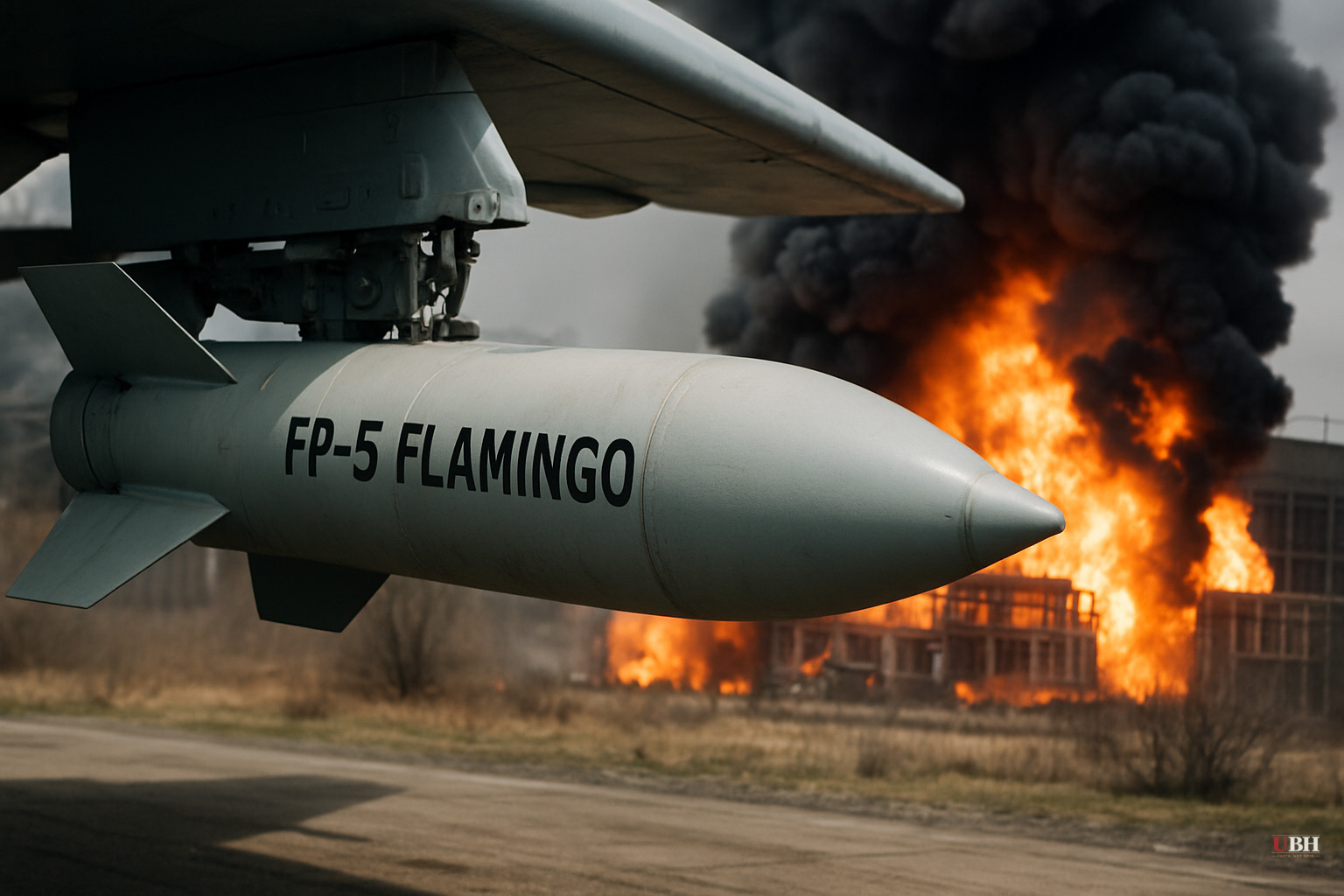
Since Zelenskyy ordered a 40-day escalation campaign on June 26, Ukraine has carried out a string of high-profile long-range strikes targeting Russian military production and energy infrastructure, with the most recent hitting an industrial complex in Volgograd on Saturday, June 27.
Writing on X, Ukrainian President Volodymyr Zelenskyy said FP-5 Flamingo missiles struck the Titan-Barrikady facility in Volgograd's Krasnooktyabrsky district. According to Ukraine's General Staff, as reported by the Associated Press, the complex manufactures self-propelled launchers and transport-loading vehicles for the Iskander-M ballistic missile system, the same system Russia uses to hit Ukrainian cities. Volgograd regional governor Andrei Bocharov confirmed the strike, saying 10 people were wounded and transported to hospital, and that production facilities sustained damage. He did not name the company.
The Escalation Campaign in Context
This strike is part of a deliberate, announced strategy. Zelenskyy stated Thursday that he had ordered the 40-day "influence operation" specifically to compel Russia to end the war after U.S.-led peace efforts over the past year produced no breakthrough, according to the Associated Press.
The Volgograd strike came one day after what appears to have been one of Ukraine's largest drone offensives of the war. Russia's Defense Ministry said Friday that air defenses intercepted 660 Ukrainian drones targeting a dozen Russian regions, Russian-held Crimea, and surrounding seas.
NPR recently embedded with the First Separate Center of Unmanned Systems, a secretive Ukrainian strike unit operating in eastern Ukraine. Soldiers there deploy Fire Point drones capable of traveling 800 to 1,200 miles. On June 18, before the current escalation phase, the unit participated in Ukraine's largest drone offensive on Moscow to date, hitting the Gazprom Neft refinery on the city's southeastern outskirts. Moscow Mayor Sergey Sobyanin confirmed multiple drones reached the refinery. Residents reported what they described as "oil rain" from the resulting smoke and fallout.
Crimea Isolation Strategy
Ukraine's drone campaign has also concentrated on Crimea. Ukrainian Minister of Digital Transformation Mykhailo Fedorov told a Ukrainian journalist that drones have been systematically hitting supply routes, railroad bridges, ferry crossings, and oil refineries on the peninsula. "Crimea is being isolated by drones," Fedorov said. "In the near future, it looks as though Crimea will become an island."
Our prior coverage from June 27 documented that Ukraine's drone campaign forced a state of emergency in occupied Crimea, leaving roughly half the peninsula without power.
What Russia Is Working With
CNN reported, citing Western officials, that Russia is "going backwards" in military equipment, now deploying post-World War II-era tanks. The Titan-Barrikady strike matters specifically because it targets production capacity for Iskander-M launchers, the hardware Russia needs to keep its most capable ground-based ballistic missile system operational. If Ukraine can degrade that production chain, the strategic logic is straightforward: fewer launchers rolling off the line means fewer missiles striking Ukrainian cities.
The Peace Track
Russian Foreign Minister Sergey Lavrov, speaking from Caracas during a five-day Latin America tour, praised a China-Brazil framework for ending the conflict but acknowledged the West would not accept it. That framework reportedly requires Ukraine to accept Crimea's full integration into Russia. Ukraine has refused any terms that don't restore its pre-2014 borders, and the U.S. and EU remain the primary arms suppliers to Kyiv.
Brazilian President Luiz Inácio Lula da Silva said Saturday that the U.S. and EU need to "start talking about peace," according to CNN. Lula has pushed for Ukraine to relinquish sovereignty claims over Crimea as the price of a ceasefire. That position hasn't moved Kyiv, and Ukraine's strike escalation signals the opposite direction.
The Strongest Counterargument
A reasonable opposing concern: Ukraine's escalation strategy risks widening the conflict without producing a clear off-ramp. Striking deeper into Russian territory—Volgograd, Moscow, Siberian targets—could harden Russian domestic support for the war rather than erode it, and each escalation step narrows the diplomatic space available for a negotiated settlement. Critics of the 40-day campaign argue that compellence through strikes has a poor historical track record and that Ukraine may be trading long-term leverage for short-term battlefield optics.
George Barros, director of innovation and open-source tradecraft at the Institute for the Study of War, offered a direct rebuttal to NPR: Ukraine's deep strikes "generate substantial damage and really do upset the Kremlin," and are part of a coherent strategy to end the war on terms favorable to Ukraine rather than cede territory under duress. The Titan-Barrikady strike, if Ukraine's General Staff assessment is accurate, hits a production node for the exact missile system killing Ukrainian civilians. That is a concrete military target, not symbolic provocation.
Note on sourcing: CNN's Ukraine coverage in this batch is drawn from what appears to be a live-blog archive with some older content (including the Evan Gershkovich arrest detail, which predates current reporting). The Breitbart-sourced AP wire report on the Volgograd strike is the most current and specific primary account of Saturday's attack.
The unresolved question now is whether the Titan-Barrikady facility's damage is severe enough to meaningfully slow Iskander-M launcher production, something neither Ukraine's General Staff nor Bocharov has provided production-level data to answer.
Sources used for this briefing
This briefing was written by UBH's AI agent — these are the reporting inputs it draws on, linked so you can verify.


