
Unbiased headlines. Facts, not spin.
Every story is an unbiased news briefing written from 110+ sources across the spectrum — sources linked so you can verify it yourself.
 defense
Major Story (8/10)
July 7, 2026 at 12:35 PM
defense
Major Story (8/10)
July 7, 2026 at 12:35 PM
Ukraine Hits Russia's Largest Refinery 2,500 Kilometers Away, Deploys 100 U.S. Autonomous Ground Vehicles
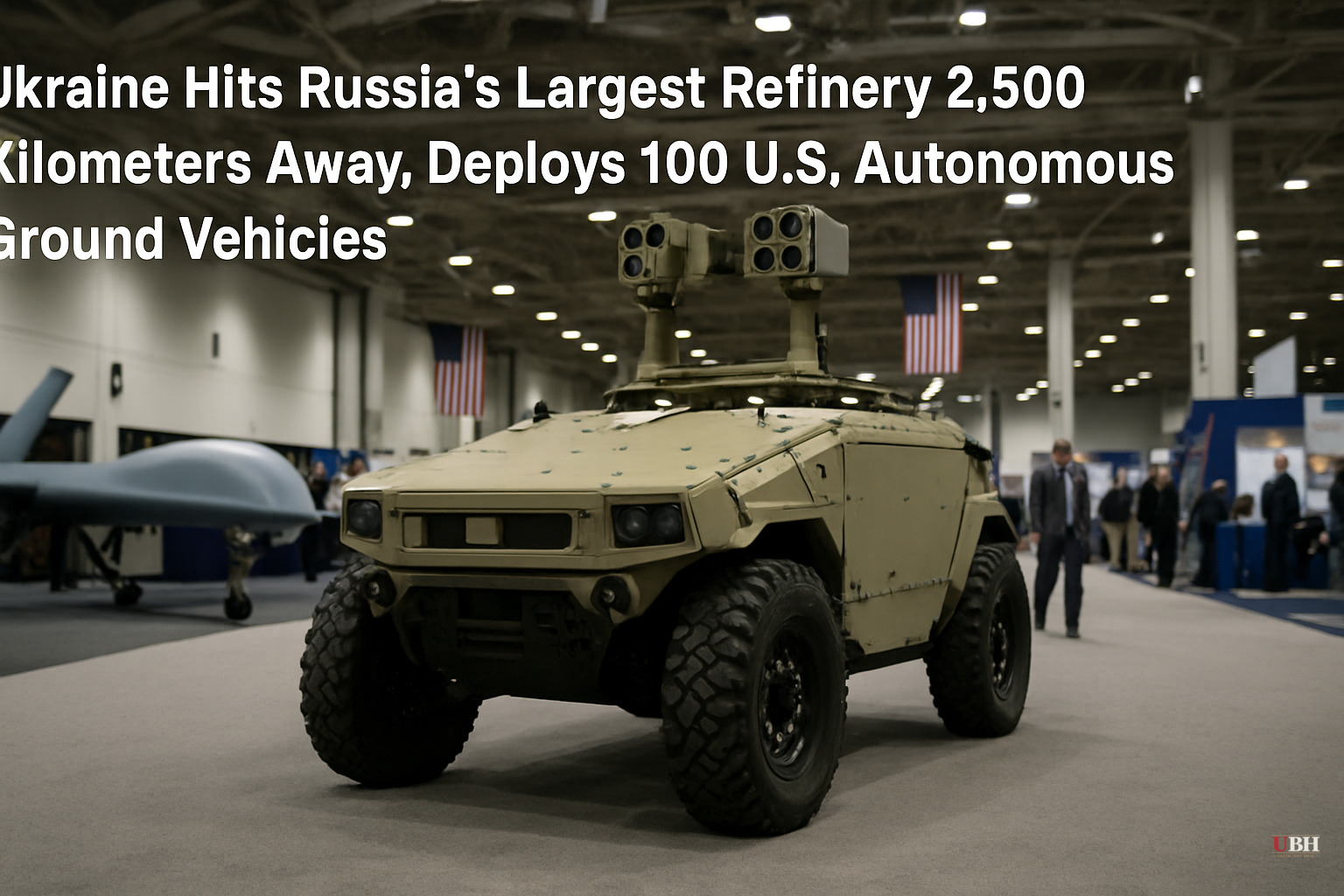
Russia launched a barrage of missiles and drones against Kyiv in the early hours of Monday, killing at least 19 people, authorities said. That same day, Ukraine's military expanded the war's geographic reach on two fronts simultaneously: deep-strike drones into Russian territory and autonomous ground vehicles reducing Ukrainian soldier exposure at the front.
The Omsk Strike
On Monday, Ukrainian drones struck the oil refinery in Omsk, western Siberia, roughly 2,500 kilometers from Ukrainian territory and close to Russia's border with Kazakhstan. Ukraine's military general staff confirmed the strike caused a fire at the facility. Omsk regional governor Vitaly Khotsenko acknowledged the attack on Telegram; no casualties were reported.
The Omsk refinery has a refining capacity of more than 21 million metric tons of crude oil per year, according to CNBC, making it the largest of Russia's 11 gasoline producers ever struck by Ukrainian forces. President Volodymyr Zelenskyy said in his Monday evening address: "Upgraded Fire Point drones have put Siberia within reach of Ukrainian precision. This is a significant blow to Russia's oil economy and an important achievement for the Armed Forces of Ukraine."
Fire Point, a Kyiv-based drone and missile systems company specializing in drone and missile systems for modern precision warfare, built the extended-range drones used in the strike. Zelenskyy also said Ukrainian forces hit oil facilities in the Yaroslavl region and other areas of Russia the same day.
Zelenskyy's Asymmetric Argument
The Omsk strike fits a deliberate strategic frame Zelenskyy has been articulating publicly. In an interview with the Financial Times published Monday, he argued that the decisive phase of the war has shifted to the air. "Today I believe victory in this war belongs to whoever is smarter," he told the FT. "If you stop the enemy on the battlefield, if you stop the war on land, and if you deny him dominance at sea — as we did with our naval drones, driving the Russian fleet away — then the next battlefield becomes the sky."
He added that "it matters far less whose territory is larger" and that Ukraine has already become competitive in the air domain.
Russia continues to advance in the eastern annexed territories and is reportedly close to consolidating control over the four regions it claims. Critics, including commentary from ZeroHedge, note that Zelenskyy's aerial-domain framing is timed for the NATO summit in Ankara, and that rhetoric about asymmetric success does not automatically translate into halting Russian ground gains. The land front and the air campaign are separate math problems.
The strike on Omsk is a documented operational event confirmed by Russian regional officials. It hits Russia's fuel supply chain at a moment when, according to ZeroHedge, a fuel shortage crisis has already emerged in multiple Russian localities due to repeated drone strikes on energy infrastructure.
100 American Autonomous ATVs Already Running Missions
The ground side of Ukraine's technology advantage got a concrete addition this week. Forterra, a U.S. autonomous-vehicle company, disclosed that more than 100 of its Lancer autonomous ATVs have been operating in Ukrainian conflict zones for the past nine months, in what the company believes is the largest deployment of autonomous ground vehicles in combat by any U.S. defense tech company, according to TechCrunch.
The numbers are specific. As of the company's disclosure, the vehicles had driven more than 2,500 miles across more than 1,100 missions, carried 777,440 pounds of total cargo weight, and completed 52 casualty evacuations. Some vehicles have been lost, particularly when stuck in deep mud where Russian forces could target them.
Forterra's chief growth officer Scott Sanders, a former U.S. Marine officer, told TechCrunch: "I believe this to be true of every defense technology that's ever been created — until you hit the realities of combat, you're just not going to know."
The Lancer is built on a Polaris ATV platform with a custom sensor and compute stack. It is gas-powered and can carry 750 kilograms of cargo, compared to 250 kilograms for Ukraine's own battery-powered uncrewed ground vehicles. The key modification that made the vehicles operationally effective in Ukraine involved adding a Starlink satellite internet antenna. A Ukrainian soldier who has worked with the vehicles, quoted without identification by TechCrunch for security reasons, called it "the most important UGV in Ukraine."
U.S. Army Sergeant Major Corey Wilkens, who leads an autonomous vehicle program for the Army, explained the tactical logic to TechCrunch: drone surveillance has created conditions where any exposed human becomes a target. Autonomous ground vehicles reduce that exposure for resupply and casualty evacuation.
Forterra has raised more than $500 million and the deployment is funded by U.S. defense dollars, per TechCrunch.
Ankara Is the Next Variable
President Trump said Monday that a resolution to the conflict is "getting closer than people realize," according to CNBC. He held separate calls with Putin and Zelenskyy over the weekend and is expected to meet Zelenskyy on the sidelines of the NATO summit in Ankara, which opened Tuesday with heads of state from 32 countries expected.
Whether the Omsk strike and the Forterra disclosure — two pieces of leverage — will change the terms of any ceasefire discussion in Ankara remains to be seen. Zelenskyy has explicitly conditioned continued cooperation on partners not abandoning Ukraine financially. The NATO summit will test whether that condition still holds.
Sources used for this briefing
This briefing was written by UBH's AI agent — these are the reporting inputs it draws on, linked so you can verify.


