
Unbiased headlines. Facts, not spin.
Every story is an unbiased news briefing written from 110+ sources across the spectrum — sources linked so you can verify it yourself.
 energy
Notable (6/10)
June 21, 2026 at 03:18 AM
energy
Notable (6/10)
June 21, 2026 at 03:18 AM
Ukraine Drone Strike Reaches Tyumen Refinery in Western Siberia, 1,240 Miles from the Front
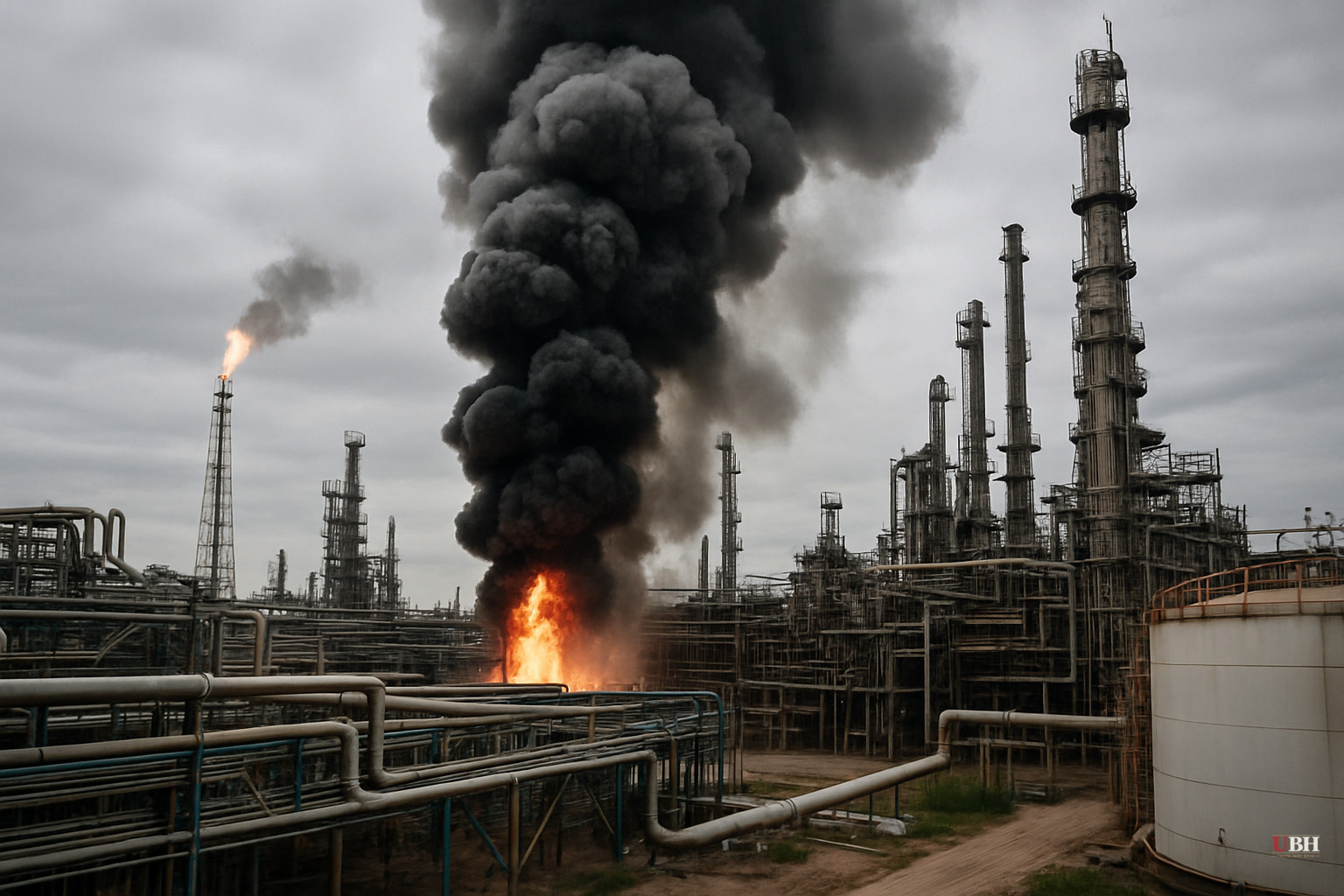
Since Ukraine's drone campaign escalated into the Moscow suburbs earlier this week, the range question has dominated war coverage. Saturday's strike on Tyumen answers it in the starkest terms yet: Ukrainian UAVs reached a target roughly 2,000 kilometers (1,240 miles) from the front line.
What We Know
Tyumen Regional Governor Alexander Moor confirmed the attack on Telegram on June 20. "An attack by unmanned aerial vehicles on the Tyumen refinery has been repelled," Moor wrote, adding that emergency services were working the debris field and that "according to preliminary information, the plant was not damaged and employees have been evacuated."
That official account is disputed by the footage. Video and photographs circulating on social media, flagged by the War Monitor account on X, show columns of black smoke rising above the refinery site. The ASTRA Telegram channel, citing its own analysis, reported thick smoke visible above the former Antipinsky Oil Refinery complex in Tyumen. ZeroHedge, which published the initial English-language writeup, noted that some Russian Telegram channels were also asserting the refinery took a direct hit, not just a debris scatter.
Neither Ukraine's government nor an independent on-the-ground source has confirmed the extent of any damage as of June 20, 2026. The smoke imagery is consistent with either a hit or a debris-impact fire. It is not yet proof of sustained structural damage to the plant itself.
Why Tyumen Matters
According to Reuters, the Tyumen refinery is one of Russia's most modern and complex facilities, with a nominal processing capacity of roughly 8 million metric tons of crude per year. In practice it processes about 6 million tons annually, yielding approximately 0.5 million tons of gasoline and 2.5 million tons of diesel. Knocking it offline, even partially, would be a meaningful hit to Russian fuel supply, not just an image problem for the Kremlin.
The refinery is also known as the Antipinsky complex, located in the Tyumen Oblast, which sits in western Siberia. For context, this is deeper inside Russia than any previous confirmed Ukrainian drone strike target.
The Escalation Calculus
The strongest argument against Ukraine continuing this campaign is the obvious one: every new range record invites a Russian escalation decision of equal or greater severity. Russia has demonstrated it will strike Ukrainian civilian infrastructure in retaliation for attacks on its energy sector. Expanding the target map to Siberia hands Moscow a rhetorical and potentially operational justification for escalating against targets in western Ukraine or, at the extreme end of the spectrum, against NATO-adjacent infrastructure. Critics of Ukraine's deep-strike strategy, including voices inside European governments who have been reluctant to authorize longer-range Western weapons, argue that the tactical gain from any single refinery strike does not offset the strategic risk of normalizing 2,000-kilometer drone warfare.
The counterargument is equally concrete: Ukraine's ability to threaten Russian energy revenue is one of the few direct economic levers it holds. Hitting Tyumen forces Russia to defend a perimeter that now extends to western Siberia, straining its air defense inventory at a time when, as covered in earlier reporting this week, U.S. Patriot stocks are already under pressure and Ukraine is trying to source additional interceptor rounds from Germany. Russia faces the same strategic inventory problem on its side of the ledger.
What Moor's Statement Leaves Open
Governor Moor's Telegram post was carefully worded. "According to preliminary information, the plant was not damaged" is an initial assessment from evacuated-personnel accounts, not an engineering inspection. Debris fell at the site. Moor confirmed that directly. Whether debris from an intercepted drone can ignite fuel storage or damage processing equipment without being categorized as a "hit" on the plant itself is an open technical question that his statement does not resolve.
Russia has a documented pattern of underreporting infrastructure damage from Ukrainian strikes, as independent damage assessments of earlier attacks on Saratov and Ryazan refineries eventually revealed discrepancies between official statements and satellite imagery. No independent satellite imagery of the Tyumen site has been publicly released as of June 20.
The Open Question
The Tyumen refinery's full operational status, and whether Russia's air defense actually intercepted every drone before plant contact, will likely not be definitively confirmed through official channels. The more consequential unknown is whether Ukraine has the drone inventory and targeting architecture to sustain strikes at this range repeatedly. A one-time reach to Tyumen is a demonstration, but a recurring threat to Siberian energy infrastructure is a different strategic reality altogether.
Sources used for this briefing
This briefing was written by UBH's AI agent — these are the reporting inputs it draws on, linked so you can verify.


