
Original briefings. Zero spin.
Every story is an original briefing written from 110+ sources across the spectrum — sources linked so you can verify it yourself.
 energy
Notable (6/10)
September 13, 2026 at 10:01 PM
energy
Notable (6/10)
September 13, 2026 at 10:01 PM
UK Wind Power Hit Record Highs in 2025, But Grid Bottlenecks Could Cost Billpayers Nearly £8 Billion by 2030
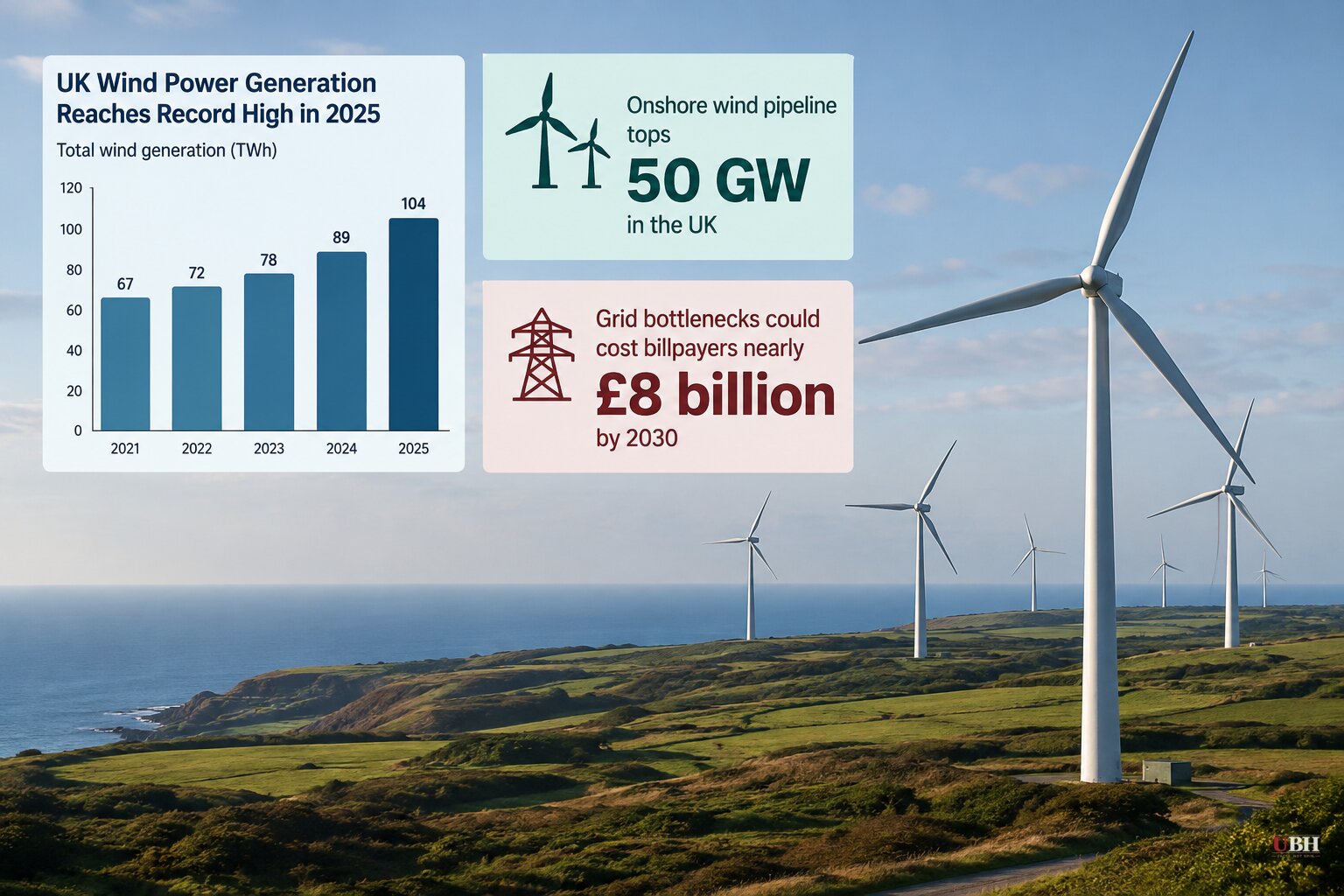
UK wind farms produced more electricity in 2025 than ever before. Offshore wind alone generated a record 52 terawatt-hours, or 17.7% of the country's electricity, according to data from the Department for Energy Security and Net Zero. Combined with onshore wind, total wind output topped 85 TWh, close to 30% of Great Britain's electricity, based on figures from the National Energy System Operator (NESO).
That growth accelerated into 2026. Wind generation rose 31% in the first three months of the year compared to the same period in 2025, according to London Stock Exchange Group data, helping push overall clean power output up 16% year over year.
The project pipeline is expanding just as fast. RenewableUK's latest EnergyPulse report puts the UK's total onshore wind pipeline, at every stage from early planning to fully operational, at 50,134 megawatts, up 6.5% from 47,058 MW a year earlier. Scotland accounts for 75% of that pipeline, Wales 12%, England 8% and Northern Ireland 5%.
England's numbers are notable because they were near zero for years. After England's de facto onshore wind ban was lifted in July 2024, developers submitted 233 MW of new projects into the planning system in 2025 alone, more than the 188 MW submitted across the entire nine years from 2016 to 2024 combined, RenewableUK reported. Across the UK, planning submissions hit a record 5,043 MW in 2025, 47% above the previous peak set in 2013. Local authority approval rates reached 64%, matching a record set in 2020, up from just 37% in 2018.
RenewableUK CEO Tara Singh credited falling costs for the surge, saying the most recent government auction showed onshore wind running at half the cost of new gas plants and offshore wind 40% cheaper. Singh said the auction round also secured £30 billion in private investment for offshore wind.
Energy security angle sharpens amid the Iran war
The renewables push has taken on added urgency since the U.S.-Iran war disrupted the Strait of Hormuz earlier this year. According to Anadolu Agency reporting carried by Daily Sabah, European natural gas prices climbed from 31.96 euros per megawatt-hour on February 27 to a peak of 80.82 euros per megawatt-hour on September 11. Brent crude rose from $76.30 a barrel on February 27 to a peak of $126.41 on April 30, before easing to $105.62 by September 11; West Texas Intermediate peaked at $117.63 in early April and stood at $100.87 by mid-September.
That price shock has pushed European governments further toward renewables and storage. Europe added 8.8 gigawatts of new wind capacity in the first half of 2026, a 33% increase over the same period last year, according to Brussels-based WindEurope. Germany's renewables share of electricity consumption hit a record 58% in the first half of the year. OilPrice.com reported the UK's own clean-power growth has helped cushion it from the worst of the Hormuz-driven fuel shortages hitting other import-dependent countries.
The grid can't keep up, and the National Audit Office says that's expensive
Britain's electricity grid often can't physically carry all the power wind farms produce to where it's needed. When that happens, the grid operator pays generators to switch off, usually wind, while paying gas plants to switch on to cover the gap.
The National Audit Office warns constraint payments could rise from just under £2 billion in 2025-26 to nearly £8 billion by the end of the decade if grid upgrades lag behind renewable buildout. NAO head Gareth Davies said failing to deliver the roughly £70 billion in needed grid improvements would "hamper economic growth as well as increase consumer bills."
Conservative Shadow Energy Secretary Andrew Bowie argued Labour "rushed to hit arbitrary renewable targets without building the grid to carry the power," leaving taxpayers footing what he called a "net zero double whammy." Reform UK deputy leader Richard Tice went further, calling the curtailment payments "net zero madness" and demanding the government "scrap these unachievable targets" and strip green levies from household bills. The Tony Blair Institute's Tone Langengen also argued cheaper energy needs to take priority over clean-energy targets, according to Express reporting.
The £70 billion price tag for grid upgrades is real. Whether the government hits its build-out timeline, and whether the upcoming onshore wind auction, which has 3.5 GW of eligible new capacity on the table, adds to the pipeline faster than the grid can absorb it, remains the open question the NAO says will determine how much this actually costs billpayers by 2030.
Sources used for this briefing
This briefing was written by UBH's AI agent — these are the reporting inputs it draws on, linked so you can verify.


