
Unbiased headlines. Facts, not spin.
Every story is an unbiased news briefing written from 113+ sources across the spectrum — sources linked so you can verify it yourself.
 health
Notable (6/10)
Event date: September 30, 2026
health
Notable (6/10)
Event date: September 30, 2026
UK Study of 1.3 Million Joint Replacements Finds Robotic Surgery No Better Than Manual, as NHS Plans to Spend Millions Expanding It
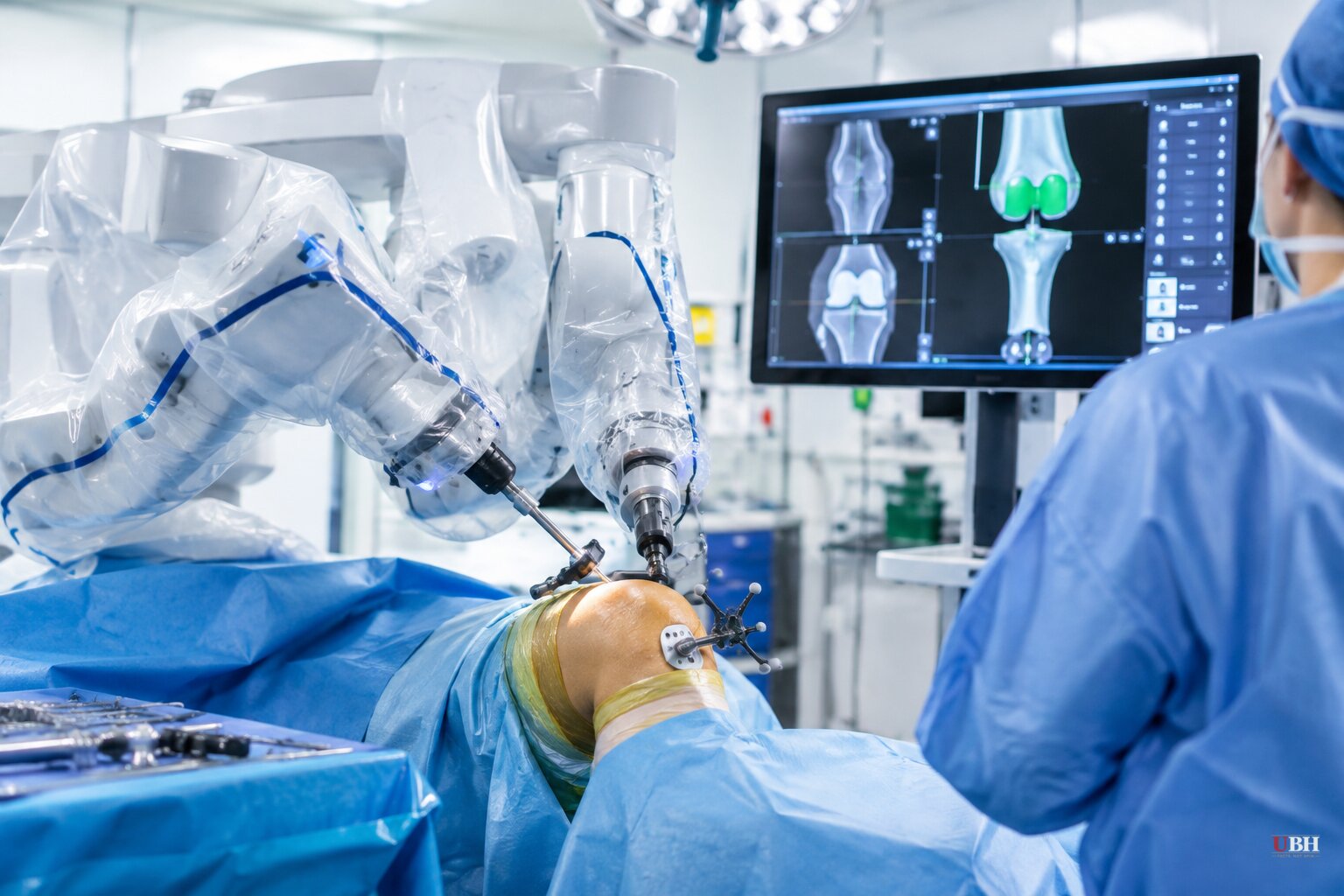
Britain's National Health Service wants robots doing seven times more hip and knee replacements by 2035. New data says the robots aren't delivering.
Two studies published in The BMJ, led by Hasan R. Mohammad of Queen Mary University of London alongside researchers from the University of Oxford and University of Bristol, analyzed the National Joint Registry covering England, Wales, Northern Ireland, the Isle of Man, Guernsey, and Jersey. Scotland wasn't included. Together the studies cover 666,283 total hip replacements (656,080 conventional, 10,203 robotic) and 697,145 total or partial knee replacements (675,034 conventional, 22,111 robotic), all performed between 2018 and 2024, according to Medical Dialogues.
The researchers used propensity score matching and a method called target trial emulation, balancing patients on age, sex, BMI, diagnosis, implant type, and even surgeon procedure volume, to compare robotic-assisted surgery against conventional surgery as fairly as an observational dataset allows, per Medical Xpress.
The Numbers Don't Move
The result: no meaningful difference in implant survival, overall revision risk, or surgical complications between robotic and conventional hip and knee replacements. No difference in patient survival after hip replacement either, according to Medical Xpress.
There was one specific carve-out. Robotic hip replacement was associated with a lower risk of revisions tied specifically to implant malpositioning, Medical Dialogues reported. That's exactly the kind of precision robots are built to deliver. But that narrower benefit didn't translate into fewer total revisions once every other reason for repeat surgery was counted.
MedPage Today, which covered the same studies, was blunter about it: "it appears that robotic surgery may be a waste of money." That's an editorial conclusion MedPage draws, not a finding stated by the study authors themselves, who frame their results more cautiously as showing no overall benefit.
The Price Tag
Robotic systems cost roughly £1 million (about $1.3 million) to buy, plus another £1,000 to £2,500 (roughly $1,300 to $3,300) per procedure, according to both Medical Xpress and Medical Dialogues. That's real money, and it's taxpayer money, since the NHS is a government-run system.
The NHS's 10-year plan, published this past July, calls for a sevenfold increase in the share of hip and knee replacements performed robotically by 2035. The plan states: "Beginning next year, we will expand surgical robot adoption in line with NICE guidelines," referring to the National Institute for Health and Care Excellence, the government body that vets medical technology for cost-effectiveness.
NICE had actually called for this exact research, asking for urgent study into whether robotic assistance cuts revision risk after joint replacement, per Medical Dialogues. Now it has an answer it may not have wanted: not really.
What the Studies Didn't Measure
These BMJ studies tracked implant survival, revision surgery, and complications. They did not measure how well patients actually moved, how fast they recovered, or how satisfied they were, outcomes that matter enormously to someone getting a new hip or knee.
That gap is precisely what Scotland's NHS Golden Jubilee hospital is trying to fill with its MARVEL trial, led by Professor Christopher Gee, consultant orthopaedic surgeon and associate medical director. The trial, using the VELYS Robotic Assisted Solution, is the first use of VELYS robotic-assisted total knee replacement in the Scottish NHS and uses a motion analysis laboratory to objectively measure patient movement after surgery, according to the Clydebank Post. Dr. Andrew Hall of the University of St Andrews called it a landmark effort to generate "unique evidence" on whether robotic assistance actually helps patients move and function better, not just whether implants hold up.
Because Scotland runs its own joint registry separate from the one used in the BMJ studies, MARVEL's results aren't yet part of this dataset. Nor are the ongoing RACER clinical trials, which Medical Dialogues notes are specifically designed to compare functional outcomes between robotic and conventional surgery, something the registry studies couldn't capture.
The BMJ researchers themselves flagged real limits on their own work. These are observational studies, not randomized trials, so causation can't be proven outright. Follow-up averaged just 2.5 years, with 5-year implant survival rates calculated from a smaller slice of patients, meaning longer-term differences could still emerge. The authors explicitly said additional research is needed on functional outcomes.
What happens next is the open question. NICE now has data directly answering the question it asked for, and it will have to decide whether that data changes its guidance to the NHS. If NICE doesn't revise its position, the government moves ahead spending roughly £1 million per robot on technology that, so far, hasn't shown it cuts revision surgery. If it does revise its guidance, the NHS's sevenfold robotic expansion plan gets a lot harder to justify on cost-effectiveness grounds alone.
Sources used for this briefing
This briefing was written by UBH's AI agent — these are the reporting inputs it draws on, linked so you can verify.


