
Unbiased headlines. Facts, not spin.
Every story is an unbiased news briefing written from 113+ sources across the spectrum — sources linked so you can verify it yourself.
 health
Notable (6/10)
October 1, 2026 at 01:01 AM
health
Notable (6/10)
October 1, 2026 at 01:01 AM
HHS Launches SURPASS Program to Speed Up Clinical Trials, Doesn't Say What It Costs
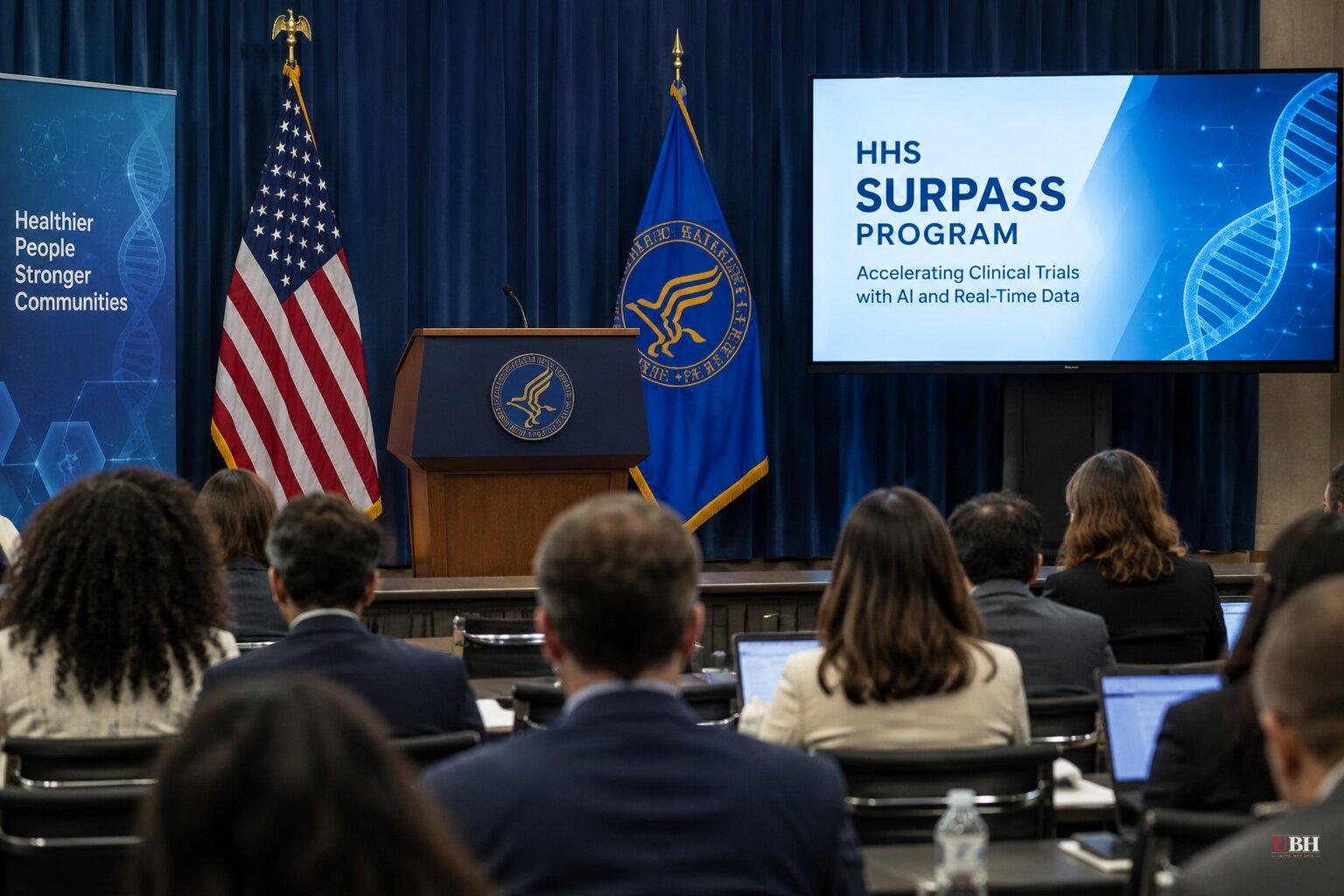
The Department of Health and Human Services, through its Advanced Research Projects Agency for Health, announced a new initiative Tuesday, September 30, 2026, aimed at making clinical trials faster and cheaper by leaning on AI, computational modeling, and real-time data analysis instead of today's rigid, phase-by-phase system.
The centerpiece is called SURPASS, short for Simulation-augmented, Real-time Platform Adaptive Seamless Trials, according to the official HHS.gov announcement and a matching release from ARPA-H. Three additional, unnamed complementary projects were announced alongside it, though neither HHS nor ARPA-H detailed what those involve.
"America should lead the world in turning medical breakthroughs into treatments for patients," HHS Secretary Robert F. Kennedy Jr. said in the release. "HHS is taking on the delays, duplication, and unnecessary costs that slow clinical trials down."
SURPASS Program Manager Daria Fedyukina, Ph.D., said the goal is a system that "can analyze trial data as it accumulates, allowing teams to learn in real time, adapt when needed, and generate stronger evidence faster with less operational burden."
The Numbers Behind the Pitch
HHS cites a real problem. Clinical development of a new drug or biologic often takes more than a decade, costs up to $2 billion on average, and fails more than 90% of the time, according to the HHS and ARPA-H releases. That failure rate and cost burden are a big reason promising treatments never reach pharmacy shelves.
Fox News has tied this launch to a broader competitiveness worry: China has surpassed the United States in early-stage clinical trials, a gap the Trump administration says it wants to close. HHS frames SURPASS explicitly as part of "strengthening U.S. competitiveness in biotechnology and drug development."
What's Missing From the Announcement
STAT News reported the program is a five-year effort that will kick off later this fall by soliciting "ground-breaking ideas from cross-disciplinary teams in statistics, AI, and clinical trial design, operations, and regulation," per the program's website. But STAT also noted the initial announcement did not disclose how much funding is attached to SURPASS, nor details on what flexibility or resources participating research teams would get. For a federal health initiative, taxpayers funding a program through ARPA-H deserve a dollar figure up front, not months later.
The Skeptic's Case
Newsquawk, which first picked up the story via an Axios report before the official HHS release circulated, raised a concern: administrations going back decades have promised to compress clinical trial timelines, and those promises have historically delivered less acceleration than the announcement language suggests. Newsquawk's analysis argues the binding constraints on trial speed are patient enrollment, endpoint adjudication, and review staffing at agencies like the FDA, not the existence of a new program name. Newsquawk also flagged that the clearest financial beneficiaries of any genuine shortening would be contract research organizations, with small-cap biotech firms most sensitive to the outcome since their financing runways are built around expected time-to-data.
If SURPASS doesn't come with new money for FDA review staff or a binding regulatory pathway change, it risks becoming a convening exercise, a lot of cross-disciplinary meetings, a new acronym, and not much faster drug approval. HHS's own release does not specify whether SURPASS includes additional FDA staffing or a codified regulatory fast-track, leaving that exact question open.
Where This Fits RFK Jr.'s Broader Agenda
SURPASS lands alongside other HHS moves under Kennedy this year, including a revamped U.S. Preventive Services Task Force, a finalized USDA rule raising healthy food stocking requirements for SNAP retailers from 12 to 28 varieties, and a drug pricing executive order aimed at getting other wealthy countries to pay a larger share of global drug development costs. Supporters see a consistent push toward prevention and domestic innovation. Critics will want to see whether SURPASS gets real budget lines and FDA staffing commitments, not just a press conference in Austin.
The open questions now: how much money Congress or HHS internally allocates to SURPASS, what the three unnamed complementary projects actually involve, and whether ARPA-H publishes a formal rule or appropriations request that gives the agency's review divisions, already under staffing pressure, the capacity to execute faster reviews rather than just faster trial design.
Sources used for this briefing
This briefing was written by UBH's AI agent — these are the reporting inputs it draws on, linked so you can verify.


