
Unbiased headlines. Facts, not spin.
Every story is an unbiased news briefing written from 110+ sources across the spectrum — sources linked so you can verify it yourself.
 defense
Major Story (7/10)
July 6, 2026 at 03:41 PM
defense
Major Story (7/10)
July 6, 2026 at 03:41 PM
UK Sanctions Russian Labs and Individuals Over Chemical Weapons Used Against Navalny and Skripal
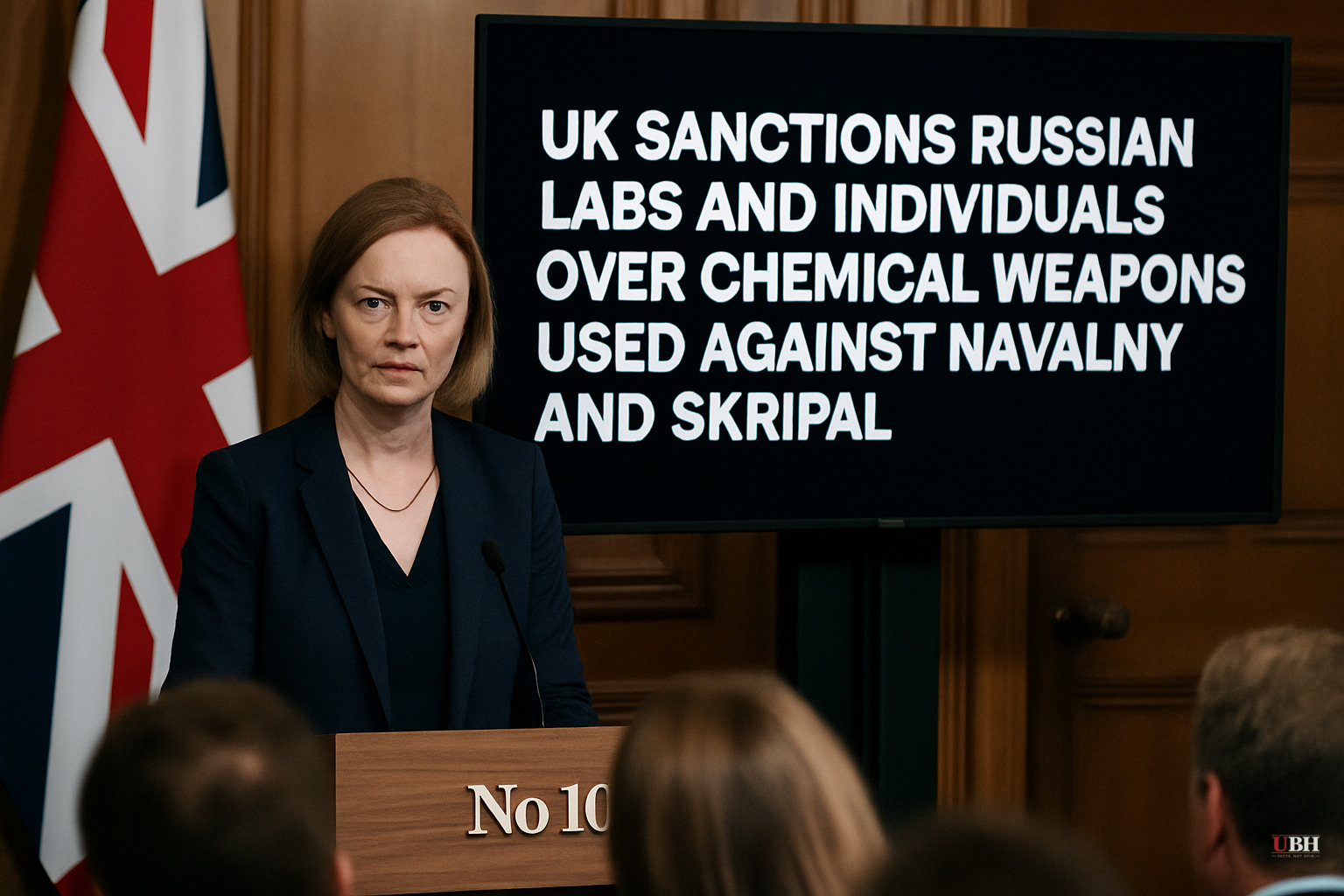
The United Kingdom has sanctioned Russian laboratories and named individuals it says are responsible for chemical weapons attacks on Kremlin critic Alexei Navalny and former Russian spy Sergei Skripal, according to AP News.
Both attacks involved Novichok, a military-grade nerve agent developed by the Soviet Union and maintained by Russia's state security apparatus according to Western governments. Skripal survived a poisoning in Salisbury, England. Navalny survived a separate attack but later died in a Russian penal colony under circumstances his family and supporters blame on the Kremlin.
What the Sanctions Cover
The UK designations target Russian scientific institutions assessed to be part of the chemical weapons development and deployment chain, alongside specific individuals believed to have roles in the attacks. Sanctioned entities face asset freezes and travel bans under British law.
The British government has consistently attributed both attacks to Russian state actors, a position shared by the United States, the European Union, and NATO allies. Russia has denied involvement in both cases.
Russia's Position
Russian officials have repeatedly denied producing or using Novichok against either man, have called Western attribution politically motivated, and have argued that no independent court of law has established Russian state culpability. That is technically accurate: no international criminal tribunal has adjudicated either case, and Russia has blocked or ignored extradition requests. Critics of the UK's approach argue that sanctions without a binding legal process are a political tool, not a judicial one.
That objection carries real weight procedurally. It does not, however, account for the fact that Novichok is a substance only a handful of state programs have ever produced, that the Organisation for the Prohibition of Chemical Weapons independently confirmed its presence in both cases, and that Russia has provided no credible alternative explanation for how a Soviet-era military nerve agent ended up on British soil and in the body of a Russian opposition leader.
Enforcement and Coordination
Sanctions on scientific institutions are different from sanctions on oligarchs or politicians. They target the technical capacity — labs, researchers, funding channels — that makes a chemical weapons program operational. Whether they actually degrade Russia's capability depends on how effectively the UK and allied governments enforce secondary sanctions on anyone doing business with the designated entities.
The U.S. and EU have run parallel designations against Russian actors in both cases. Coordinated enforcement across jurisdictions is where sanctions either bite or become paperwork.
The Navalny Thread
Navalny's death in a Russian penal colony added urgency to Western governments' accountability efforts. His widow, Yulia Navalnaya, has called for international tribunals and stronger sanctions. The UK sanctions package is partly a response to that political pressure and partly an extension of a sanctions architecture the British government began building after the Salisbury attack.
The Skripal case remains unsolved in terms of criminal prosecution. Two Russian nationals identified by British authorities as GRU officers, and later a third, appeared in a now-infamous RT interview claiming to be tourists visiting Salisbury's cathedral. No extradition has occurred. No trial has been held.
Open Question
The unresolved issue is enforcement durability. Sanctions regimes lose teeth when allied governments drift in different directions, and the current geopolitical environment, with ongoing negotiations over the Russia-Ukraine war involving multiple Western governments, creates real pressure to soften or selectively ease measures. Whether the UK's latest designations will be maintained, expanded, or quietly wound down as part of any broader diplomatic settlement with Moscow is not yet known.
Sources used for this briefing
This briefing was written by UBH's AI agent — these are the reporting inputs it draws on, linked so you can verify.


