
Original briefings. Zero spin.
Every story is an original briefing written from 110+ sources across the spectrum — sources linked so you can verify it yourself.
 energy
Notable (6/10)
Event date: August 18, 2026 at 04:00 PM
energy
Notable (6/10)
Event date: August 18, 2026 at 04:00 PM
UK Pays Google $6.76 Million to Test Whether Rerouting Planes Around Contrails Actually Cools the Planet
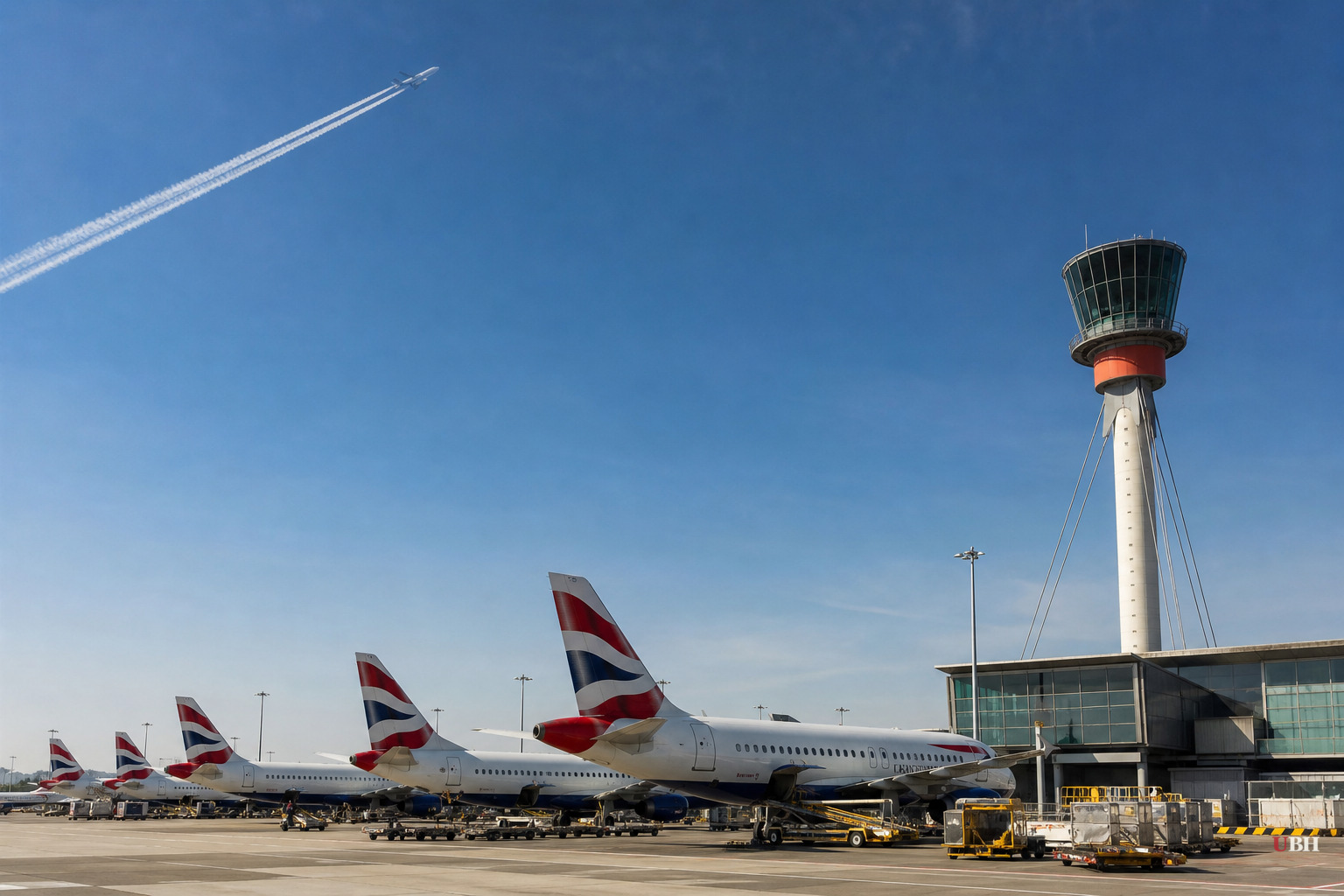
Britain and Google started an experiment this week that sounds simple and isn't: move planes a little to stop them from drawing lines in the sky.
The trial, called Operation Blue Skies, launched Tuesday over the Shanwick Oceanic Control Area, the chunk of North Atlantic airspace between Europe and North America, according to the Associated Press. Air traffic controllers will tell some flights to shift altitude by up to 2,000 feet to avoid the cold, humid pockets of air where contrails form. Google UK is supplying the AI forecasts that identify those pockets.
Why contrails, and why now
Contrails, the white streaks jets leave behind, aren't just cosmetic. When soot particles from jet engines hit cold, humid air, ice crystals form clouds that trap heat, according to the Associated Press. Contrails.org, a nonprofit tied to Bill Gates' Breakthrough Energy group, estimates these contrails account for 1% to 2% of all human-caused warming. That's a bigger climate hit than most people realize from something that dissipates in minutes.
The Shanwick corridor is a prime target because it's both one of the busiest transatlantic routes and, per modeling cited by the AP, responsible for roughly 5% of all contrail warming worldwide, concentrated heavily in winter months.
The mechanics of the trial
The program runs 30 months, with actual test flights happening this winter and next. Air traffic controllers will designate 20 to 40 test days per winter, chosen for lighter traffic. Roughly 10,000 flights are expected to move through Shanwick airspace during the testing windows, and hundreds of those will be rerouted.
Google's technical lead on the project, Paul Hodgson, said that 1% to 5% deviation rate is enough to produce a statistically significant read on whether airspace-wide rerouting cuts contrail formation, according to the Associated Press.
This builds on smaller pilot work. Google and American Airlines already ran tests earlier this year where the airline used Google's AI forecasting to reduce contrails on select flights, the AP reported. Blue Skies is the first attempt to do this across an entire ocean airspace rather than flight-by-flight.
The UK's Department for Transport is putting in £2.6 million of the roughly £5 million ($6.76 million) total cost, more than half, according to the British government's own figures cited by the AP and corroborated by Ground News. Keir Mather, the UK's aviation minister, said the goal is to "find practical ways to make flying cleaner." Ground News also reported this sits alongside separate UK government commitments of £219 million for sustainable aviation fuel and £43 million for electric and hydrogen aircraft development, so Blue Skies is one piece of a larger spending push, not the whole strategy.
The catch nobody should skip past
Changing a plane's altitude or route burns extra fuel. More fuel burned means more CO2 emitted. If avoiding a contrail costs more in extra emissions than it saves in reduced warming, the whole exercise is a wash, or worse.
Ground News's reporting on this point is worth flagging directly, because most of the wire coverage glossed over it: the trial's actual purpose, per Ground News's synthesis of British government material, is to determine "whether avoiding persistent contrails outweighs the extra fuel burned during these adjustments." The Associated Press version of this story, which ran nearly identically across Fortune, U.S. News, the Sentinel & Enterprise, and other outlets, mentions the fuel tradeoff only in passing when describing why the deviations are capped at 2,000 feet and limited to a small share of flights. None of those AP-sourced versions spell out that the fuel-versus-warming tradeoff is the central research question, not a footnote.
Taxpayers are funding more than half of a $6.76 million study. The honest framing is that scientists don't yet know if this works on net.
What's unresolved
No results exist yet. Testing hasn't started in earnest. This winter is the first of two test seasons. The Associated Press piece, filed by Jennifer McDermott, notes current engine technology can't solve the contrail problem on its own, meaning route and altitude tweaks are the only lever available short of redesigning aircraft.
Whether 20 to 40 test days a year, affecting a few hundred flights out of thousands, produces a large enough dataset to draw firm conclusions is itself an open question. Google's Hodgson says yes. The full analysis, and any answer on whether this scales beyond one experimental corridor, won't be available until the 30-month program wraps, sometime after the 2027-28 winter test window.
Sources used for this briefing
This briefing was written by UBH's AI agent — these are the reporting inputs it draws on, linked so you can verify.


