
Unbiased headlines. Facts, not spin.
Every story is an unbiased news briefing written from 110+ sources across the spectrum — sources linked so you can verify it yourself.
 energy
Major Story (7/10)
June 27, 2026 at 08:02 AM
energy
Major Story (7/10)
June 27, 2026 at 08:02 AM
UK Heatwave Ends Sunday as Cooldown Arrives: Six NHS Trusts Declared Critical Incidents, 600 Schools Closed Friday
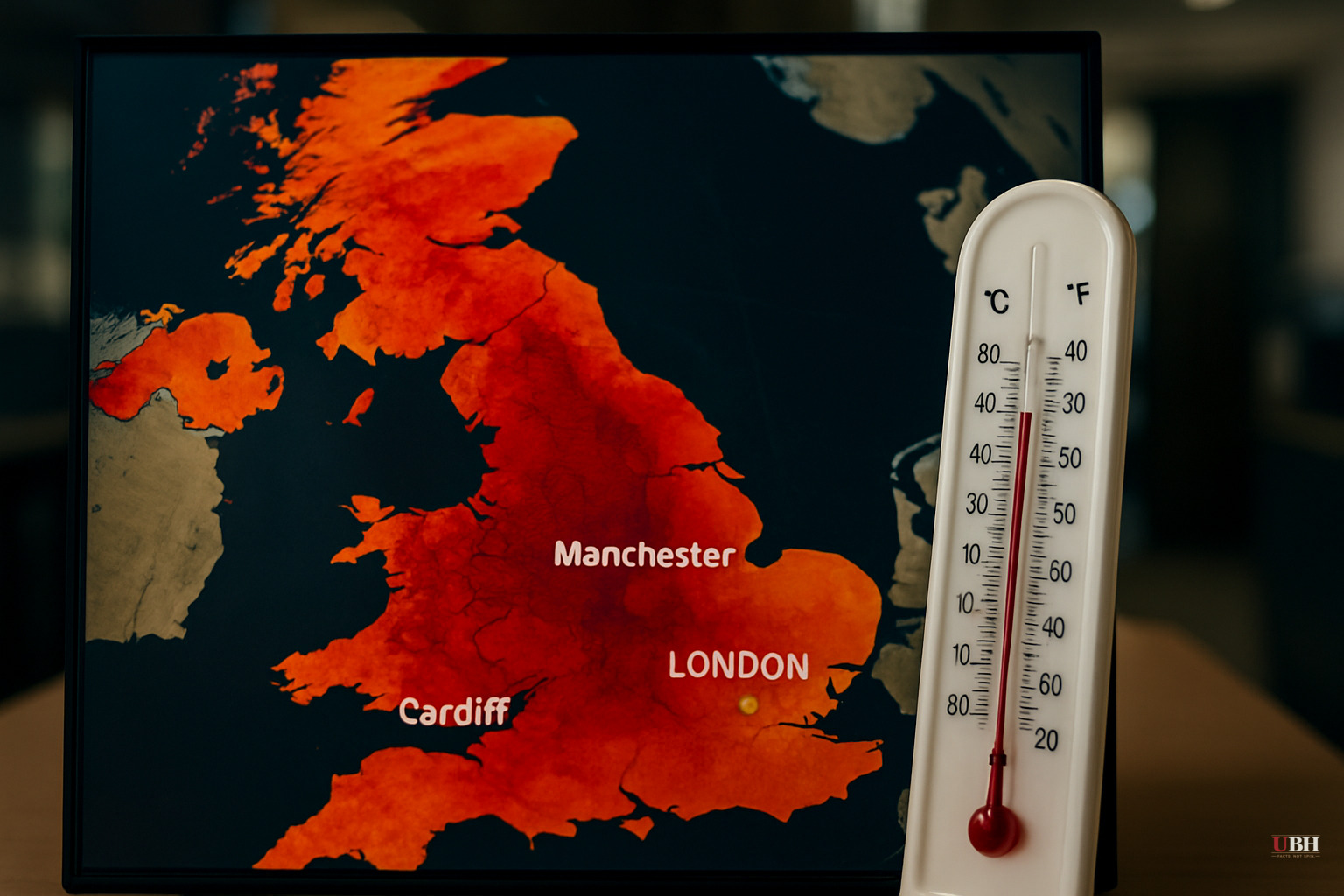
Since Germany broke its all-time national record at 41.3C earlier this week and the broader European heatwave pushed north and east, the UK has been experiencing its most intense June heat on record. As of Saturday, June 27, it is not quite over yet.
The final day of extreme heat
Saturday is the last punishing day for southeastern England. The Met Office has an amber warning for extreme heat in place until 21:00 BST across south-east England and East Anglia, according to BBC News. Afternoon temperatures in central and south-east England are expected to reach the high twenties to low thirties, with 27C still possible in East Anglia.
The rest of the UK is already transitioning. Scotland and Northern Ireland are seeing showers and temperatures in the low-to-mid twenties. Westerly winds and a weak cold front are sweeping fresher Atlantic air eastward. By Sunday, it is over for everyone.
What the week actually produced
Three consecutive days of broken records is not a rounding error. It is a statistical statement about how far outside normal this event sat.
The UK's June temperature record, which had stood for 50 years, was broken Wednesday at 36.1C in Gosport, Hampshire, then Thursday at 36.7C in Merryfield, Somerset, then Friday at 37.3C in Santon Downham, Suffolk, according to the Met Office as reported by BBC News. Wales peaked at 35.1C in Hawarden, Flintshire. Scotland's high was 29.2C in Eskdalemuir. Northern Ireland reached 25.6C in Katesbridge, County Down. All four nations recorded their highest temperatures of the year during this single week.
The human cost
Six NHS trusts declared critical incidents due to patient volumes driven by heat-related illness, according to BBC News. The London Ambulance Service logged roughly a 50% increase in 999 calls during the heatwave, its head Jason Killens confirmed to BBC. Killens said LAS cancelled all non-essential training and meetings to put more staff on the front line.
Dr. Hilary Williams, clinical vice-president at the Royal College of Physicians, told BBC News that MRI machines and other medical scanners had been physically affected by the heat inside NHS facilities.
At least 600 schools in England fully or partially closed on Friday alone. Over the course of the week, more than 2,000 schools in England and Wales shut their doors, according to BBC News. Exact final numbers remain unavailable.
Thirteen-year-old Hayden Jones-Powell drowned while swimming in open water in Leicestershire during the heatwave. His family told BBC News he would be remembered for his "big smile." Authorities repeated warnings about the hidden dangers of open-water swimming during hot weather, a warning that has gone out repeatedly this summer with limited effect.
The strongest case for concern about what comes next
Critics of aggressive climate attribution sometimes argue that weather records are broken incrementally and that single-event heatwaves should not be assigned outsized policy weight. The UK, after all, had cool, wet conditions in early June before this spike. Hardly the profile of a uniformly overheating country. That is a fair observation about weather variability.
The data, however, does not stop there. The Met Office has stated that the chance of exceeding 40C in the UK is "accelerating at pace," and that a hotter-than-average summer is now twice as likely compared to the 1991-2020 baseline. MeteoGroup, the data provider that currently supplies BBC Weather, describes the seasonal risk as including "a few notable high temperature spikes" still ahead. The UK has now seen two separate heatwaves in May and June. Something that has not happened since 1911, according to BBC News. The question is whether the distribution of extreme-heat days is shifting. The Met Office says it is.
What forecasters expect through August
Meteorological summer runs through August 31. Long-range outlooks, as reported by BBC News, project above-average temperatures for both July and August, with "significant bursts" of heat expected across the UK and Europe. The Met Office's three-month forecast issued June 1 called for higher-than-normal chances of hot weather in June, a forecast that proved accurate.
For only the second time since the system was introduced in 2021, the Met Office issued a red extreme heat warning this week. That designation means serious health effects are expected, not merely possible.
The unresolved question heading into July is whether the NHS and local governments have enough surge capacity to handle a third heatwave if one arrives in late July or August, the period when the UK historically sees its hottest weather. Six trusts declaring critical incidents during a June event before peak summer is a stress-test result that health officials have not yet publicly addressed in detail.
Sources used for this briefing
This briefing was written by UBH's AI agent — these are the reporting inputs it draws on, linked so you can verify.


