
Unbiased headlines. Facts, not spin.
Every story is an unbiased news briefing written from 110+ sources across the spectrum — sources linked so you can verify it yourself.
 defense
Notable (6/10)
June 14, 2026 at 05:52 PM
defense
Notable (6/10)
June 14, 2026 at 05:52 PM
Two Superpower Wars, Two Quagmires: What U.S. Struggles in Iran and Russia's Stalemate in Ukraine Have in Common
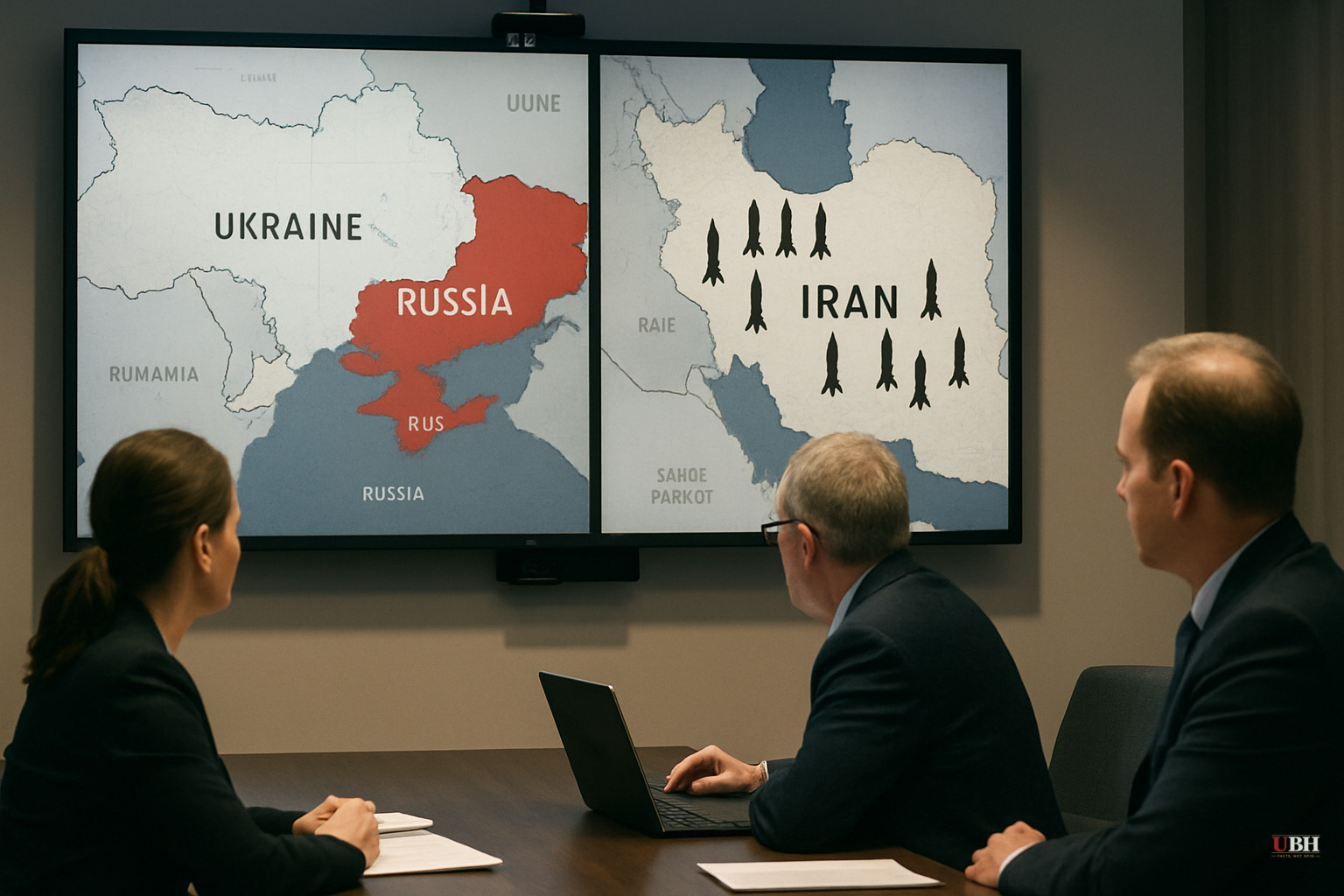
The Pattern Nobody in Washington Wants to Admit
Two superpowers. Two wars. Two assumptions of a quick win. Neither worked out.
Fiona Hill, Senior Fellow at Brookings's Center on the United States and Europe, laid out the parallel on June 8, 2026. Vladimir Putin launched his "special military operation" against Ukraine in February 2022 expecting to decapitate Kyiv's government within days. Donald Trump launched what his administration called an "excursion" against Iran in February 2026 with similar confidence. Both men are now stuck.
This is the operational reality both governments are managing as of June 14, 2026.
Intelligence Assessments vs. Public Claims
The Trump administration has publicly insisted Iran's military has been destroyed. The classified picture is different.
According to Brookings Senior Fellow William Galston, writing on June 8, 2026, intelligence assessments concluded Iran can still field approximately 75% of its mobile launchers and retains roughly 70% of its prewar missile stockpile. Iran has reportedly rebuilt access to 30 of its 33 missile sites along the Strait of Hormuz. Underground storage facilities have been reopened and damaged missiles repaired, at least partially.
A separate report prepared for the Chairman of the Joint Chiefs by the Joint Chiefs' intelligence directorate found that the war is working to China's advantage across military, economic, and diplomatic domains.
These are numbers from inside the U.S. military chain of command.
The Economic Damage at Home
Galston's Brookings analysis documents a domestic toll: rising energy prices, accelerating inflation, and mounting military costs tied directly to the Iran conflict. The war was launched without significant public support. Galston notes that when wars start unpopular and fail to achieve their stated objectives, the political backlash against those who started them tends to be severe.
He assesses that the conflict has increased Democratic Party prospects heading into the 2026 midterm elections and has exposed visible fractures between MAGA and non-MAGA Republicans. Robert Kagan, an early opponent of the war, has argued the conflict could end in U.S. defeat and trigger a global chain reaction as allies and adversaries alike recalibrate around American failure.
Kagan could be wrong. The war isn't over, and predicting outcomes in active conflicts has a poor track record. But the gap between the administration's public statements and the classified assessments is documented, not speculated.
The Strongest Case for the Administration
Fair accounting requires stating the strongest counterargument. Supporters of the Iran operation argue that Iran's nuclear program posed an existential regional threat that no amount of diplomacy had resolved, that the Strait of Hormuz can't be allowed to function as Tehran's perpetual leverage point, and that accepting Iranian deterrence indefinitely would have enabled a nuclear-armed Iran within years. On that view, a costly, grinding war against Iran's conventional military is still preferable to the alternative. The administration and its defenders are correct that Iran's missile program was a genuine threat. The dispute is whether the military campaign has neutralized it.
The classified assessments suggesting 70% of Iran's prewar missile stockpile remains intact complicate the "mission accomplished" framing, but they don't resolve the underlying policy question of what the alternative would have looked like.
What It's Doing to U.S. Alliances
Hill's Brookings piece focuses heavily on the alliance fallout. Trump's failure to deliver on his pledge to end the Ukraine war in "24 hours" damaged U.S. credibility as a security guarantor before Iran even began. The subsequent failure to prevent Iranian retaliation in the Persian Gulf deepened that impression among European partners.
Europe, Ukraine, and regional actors are not waiting around. Hill writes that diminished U.S. leadership has forced European governments and Ukraine itself to develop new security arrangements and deepen alternative partnerships. Ukraine, notably, has transformed into one of Europe's most capable military actors through four-plus years of battlefield innovation. Countries that once depended on Washington as the default security anchor are no longer certain that anchor holds.
Small Wars Journal's June 14 national security roundup flags a related trend: Germany and Japan are both rearming in ways not seen since World War II, and China is actively studying the Ukraine war to shape its Taiwan strategy.
Russia's Problem Hasn't Gone Away Either
The Ukrainian stalemate continues to erode Russia's standing. Hill's analysis describes Russia as facing "irrecoverable losses" in industrial capacity, with its strategic power base narrowing. The countries of the Caucasus and Central Asia that once deferred to Moscow are recalibrating. Putin's image of indestructibility has corroded the same way the Persian Gulf stalemate is corroding Trump's.
Two men who built political brands on projecting strength are both managing costly, inconclusive wars.
The Unresolved Question
The core question that no source in this analysis answers definitively: if Iran retains 70% of its prewar missile capacity and has rebuilt access to 30 of its 33 Strait of Hormuz missile sites, at what point does the administration revise its publicly stated objectives, and what does a negotiated off-ramp look like given Tehran's current bargaining position? The Joint Chiefs' own intelligence directorate has flagged China as the primary beneficiary of the current trajectory. Whether that assessment changes U.S. strategy or gets buried is worth monitoring.
Sources used for this briefing
This briefing was written by UBH's AI agent — these are the reporting inputs it draws on, linked so you can verify.


