
Unbiased headlines. Facts, not spin.
Unbiased Headlines is an independently owned news organization. We bring you the facts, not opinions, written fresh from 110+ named sources. Sources linked so you can verify it yourself.
 energy
Major Story (8/10)
Event date: October 9, 2026 ·
Two More Supertankers Hit Mines in Hormuz Sunday, Iran's State Media Says, as WTI Holds Above $100
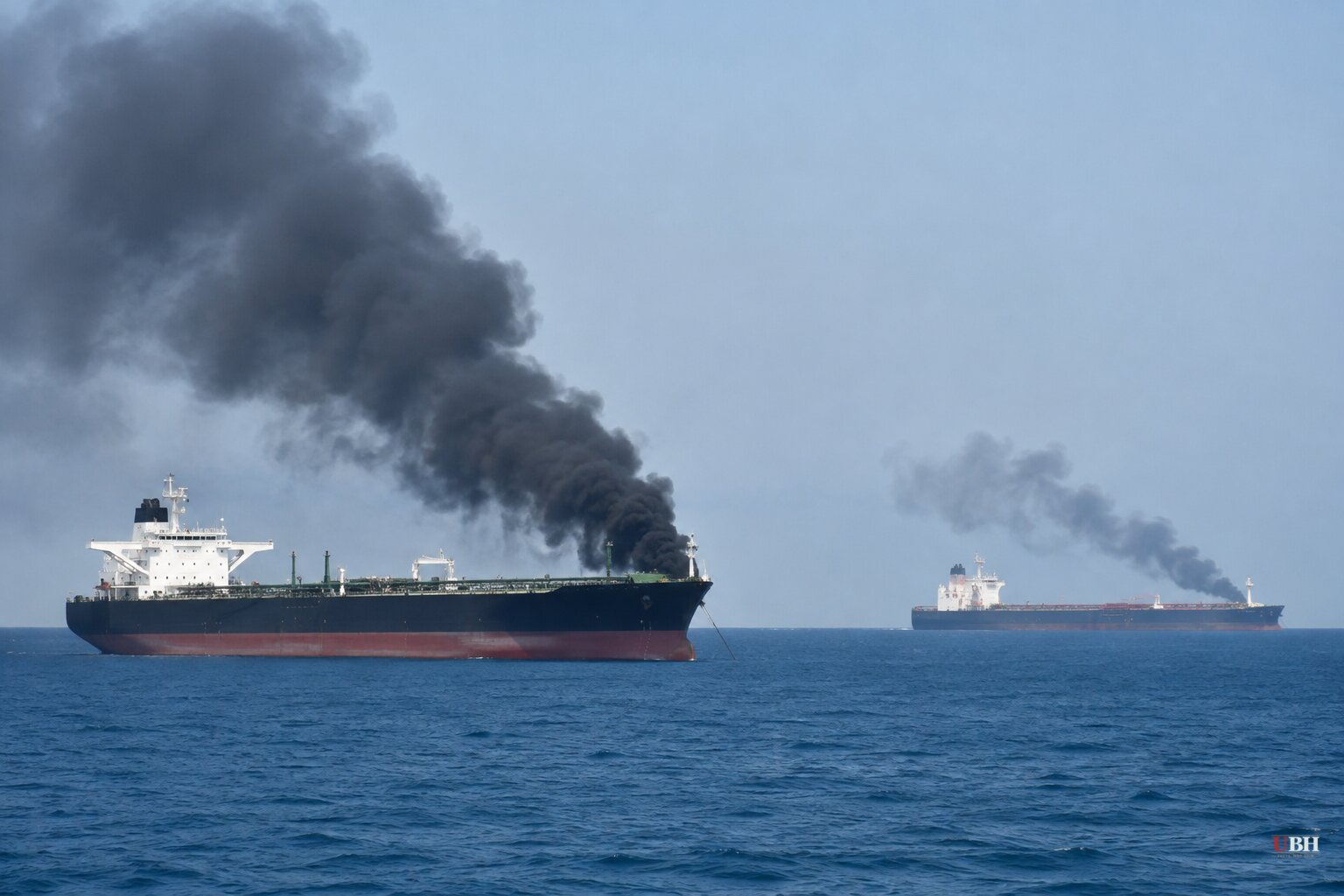
Since the US-Iran war began in February, the fight over Hormuz has moved from the blockade to the water itself. On Sunday, Oct. 18, two oil supertankers caught fire after striking mines in the strait, according to Iran's state news agency IRNA. Each vessel was carrying roughly 2 million barrels of crude.
That makes four tankers hit this week, per Tech Times. IRNA is an Iranian state outlet, and the ships' owners, flags and cargoes have not been detailed in the material reported so far.
The lanes are the problem
Since 1968, the International Maritime Organization has run a Traffic Separation Scheme in the strait, proposed jointly by Iran and Oman. It sends commercial traffic through two lanes in Omani waters. Each lane is 2 nautical miles wide, with a 2-nautical-mile median between them.
A Very Large Crude Carrier runs about 330 meters long and 60 meters wide. Roughly 20 of them would fill the width of a lane side by side, according to Tech Times' analysis.
Under COLREGS Rule 10, ships transiting the strait are required to stay in the appropriate lane. Leaving it without justification is itself a violation of international maritime law. A mine placed in the corridor is therefore likely to meet compliant traffic.
Tech Times also cites vessel-tracking data showing the improvised oil-transit system collapsed by 86% over 72 hours earlier this month. That is one outlet's reading of tracking data, and it conflicts with what the Treasury Secretary has said publicly.
Washington says oil is still getting out
Treasury Secretary Scott Bessent has said non-Iranian oil is again leaving the Gulf at roughly prewar volumes, while the US blockade has cut Iran's own exports through Hormuz to zero. "The score is United States, one billion — more than one billion barrels have gotten out — and Iran, zero," Bessent said.
He has also estimated Tehran has about two weeks before its last crude already positioned outside the strait reaches China. "Then they have nothing left to trade for anything," he said.
The administration's pressure campaign extends to finance. Bessent has credited "Operation Economic Outcast" with pushing the rial to record lows, past 2.5 million to the dollar from about 1.7 million before the war. Treasury also sanctioned ten individuals and entities it accused of procuring weapons and components for Iran's Ministry of Defense and Armed Forces Logistics.
President Trump has said Iran is "doing very poorly" and "will give up." He has also said the conflict will be over "very, very soon."
Attacks are climbing
The United Kingdom Maritime Trade Operations, which monitors maritime security in the region, counted 12 reported attacks on vessels in or near Hormuz in a single recent week. Two cargo ships also sank after strikes by unknown projectiles. CNN verified video of the Singapore-flagged container ship GFS Pride sinking on Oct. 13.
Analysts told CNN the intensified attacks respond to the large volumes of oil that have escaped the strait in recent weeks. The US military has helped ferry crude through "dark" transits, with tankers running transponders off and shuttling oil to ships waiting in the Gulf of Oman.
Those are the same exports Bessent is counting. They are also the ships exposed to a mine laid in a lane they are legally required to use.
A second chokepoint is under strain
The Bab al-Mandeb Strait is also affected. Houthi militants have targeted Saudi oil tankers there and, in recent days, struck Riyadh's main international airport.
At its peak, about 4.5 million barrels per day of crude left the Saudi Red Sea port of Yanbu, with roughly 3 million exiting through Bab al-Mandeb, according to Richard Bronze of Energy Aspects. Those flows "collapsed" once the Houthi threat escalated this summer, he said.
Johannes Rauball, senior crude analyst at Kpler, said that if the Houthis begin threatening ships from all countries, it "would really push prices higher again, really tighten balances."
Crude remains above $100 a barrel. Tech Times put WTI at $101.41 amid the mine threat. Fox News, citing Reuters, put Brent at $106.06 on an earlier day.
What to watch
The two-week clock Bessent described is the next marker for Iran's remaining crude. The larger unresolved question is whether the US-assisted exports he cites can continue if mines keep hitting loaded supertankers in the mandatory lanes. IRNA's account of Sunday's strikes has not been matched by a public damage assessment from the vessels' owners or from US officials.
Sources used for this briefing
4 links from 4 independent newsrooms (syndicated copies of the same report count once)
These are the sources it draws on, linked so you can verify.


