
Unbiased headlines. Facts, not spin.
Every story is an unbiased news briefing written from 110+ sources across the spectrum — sources linked so you can verify it yourself.
 defense
Major Story (7/10)
September 17, 2026 at 06:43 AM
defense
Major Story (7/10)
September 17, 2026 at 06:43 AM
Two Epstein Victims Sue His Estate Over Child Sex Abuse Images Federal Investigators Sat On For Years
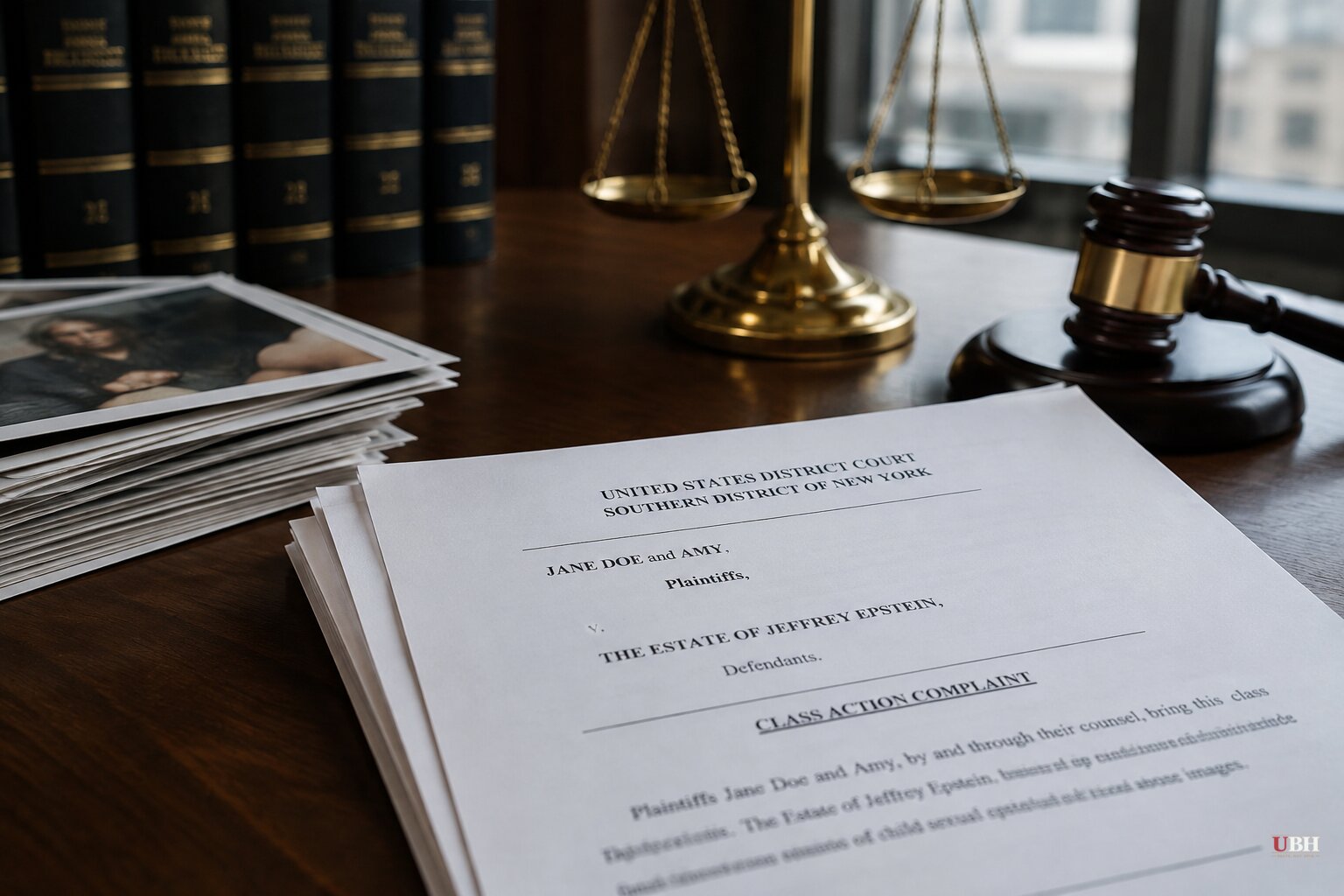
Two women filed a federal class action lawsuit Tuesday against the executors of Jeffrey Epstein's estate, alleging their childhood images turned up in his enormous collection of child sexual abuse material and that nobody bothered to tell them.
The suit was filed in the Southern District of New York against Darren Indyke, Epstein's longtime attorney, and Richard Kahn, his accountant, who are named solely as co-executors of the estate, according to NBC News and Reuters reporting carried by KELO-TV. Epstein died by suicide in 2019 at the Metropolitan Correctional Center while awaiting trial on sex trafficking charges, and he was never prosecuted for producing or distributing child pornography.
The two named plaintiffs go by Jane Doe and Amy. Jane Doe says Epstein stole partially nude photographs of her taken when she was 12 years old as part of a legitimate artist study, kept by the photographer in a lockbox, according to Courthouse News Service. Amy says her image is part of what the complaint calls one of the most widely distributed child sexual abuse material series on the internet, images seized from Epstein's properties in 2019 that Courthouse News reports are still being traded today.
A collection spanning five states and decades
The lawsuit, brought under Masha's Law, a provision of the 2006 Adam Walsh Child Protection and Safety Act, lays out an eight-count complaint. It alleges Epstein began collecting child sex images in the early 1990s and kept a so-called "modeling book" of sexualized photos of children in a locked safe, which he and unnamed co-conspirators claimed was for developing child models for Victoria's Secret, according to NBC News.
The complaint also alleges Epstein directed an assistant, Sarah Kellen, to pay teenage girls for nude photographs starting in the 2000s, according to Courthouse News. Material was recovered from his properties in New York, Florida, Ohio, New Mexico and the U.S. Virgin Islands.
The FBI began reviewing "tens of thousands of videos" tied to Epstein's collection in 2025 and issued a memo confirming a large volume of the seized images depicted likely minors, according to Ars Technica. Survivors allege that despite that review, the Justice Department has largely failed to notify the people pictured in it.
"Few if any" victims notified
The plaintiffs estimate roughly 40 victims can be identified through records already held by the estate and the federal government, including through the National Center for Missing and Exploited Children's Victim Identification Program, according to Ars Technica. They allege NCMEC only reviewed a small number of images tied to the Ghislaine Maxwell trial, without a full review or victim notification.
Ars Technica noted it could not immediately reach NCMEC to verify the survivors' claims, and no source in this reporting includes a response from NCMEC or the Justice Department. Whether the notification gap survivors describe reflects genuine bureaucratic failure, resource limits, or an ongoing investigative process that hasn't yet reached these victims is an open question the lawsuit itself is designed to force into discovery.
The dollar figures don't fully match across coverage
Reuters, KELO-TV, The Standard and The Straits Times report the suit seeks "at least $6 million" on behalf of more than 40 people and asks that the estate pay class members $150,000 each. Courthouse News reports the plaintiffs are seeking "over $5 million in punitive damages" specifically. Ars Technica frames the math differently, describing remedies that could total $150,000 per victim, per image, per violation. A formula like that, if applied broadly across an estimated 40-plus victims and a collection described as containing thousands of images, would produce a far larger figure than the $6 million floor cited elsewhere. The $6 million figure appears to be a minimum threshold stated in the filing, not a cap.
Hillary Nappi of AWK Survivor Advocate Attorneys, representing the plaintiffs alongside Jennifer Freeman of Marsh Law, told Reuters the case could ultimately involve thousands of class members, since most people pictured in Epstein's collection have never been identified. Daniel Weiner, a lawyer representing Indyke, declined to comment to multiple outlets. An attorney for Kahn did not respond to requests for comment.
The lawsuit asks the court to order the estate and federal authorities to work with NCMEC on a coordinated identification and notification program. No criminal charges related to the CSAM allegations have been filed against anyone connected to Epstein's estate. The case now heads toward a response from the estate's executors, whose silence so far leaves the central factual dispute—how much the government knew and when—unresolved.
Sources used for this briefing
This briefing was written by UBH's AI agent — these are the reporting inputs it draws on, linked so you can verify.


