
Unbiased headlines. Facts, not spin.
Every story is an unbiased news briefing written from 110+ sources across the spectrum — sources linked so you can verify it yourself.
 energy
Notable (5/10)
June 28, 2026 at 04:50 PM
energy
Notable (5/10)
June 28, 2026 at 04:50 PM
Twenty Years On, Al Gore's 'An Inconvenient Truth' Predictions Face a Data Problem
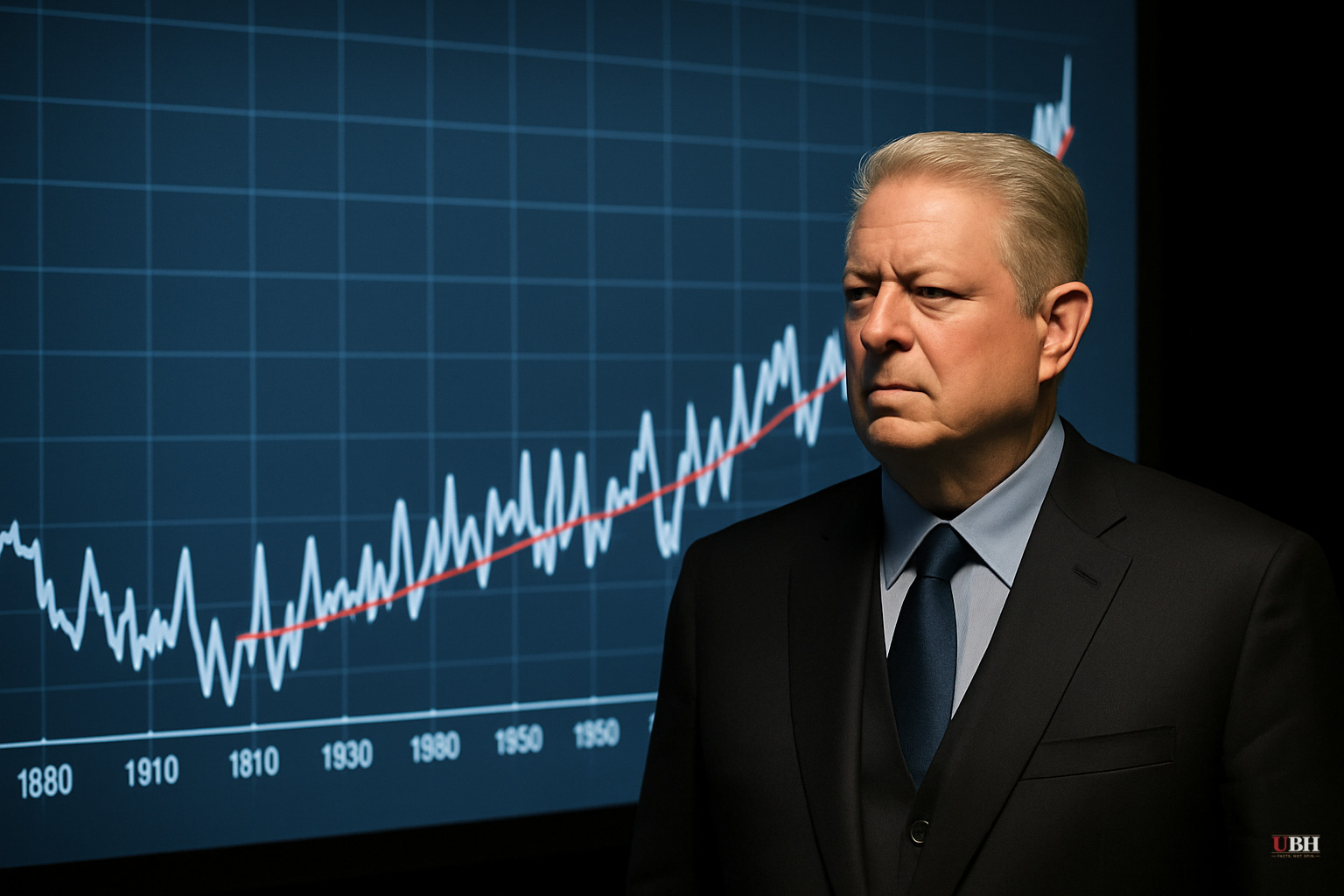
The Film's Claims vs. the Record
In 2006, former Vice President Al Gore released An Inconvenient Truth, a documentary built around urgent predictions: rising seas swallowing coastlines, hurricanes intensifying dramatically, wildfires consuming ever-larger swaths of land, and polar bear populations collapsing. The film won an Academy Award and helped Gore share the 2007 Nobel Peace Prize.
Twenty years is enough time to check the tape.
Bjorn Lomborg, president of the Copenhagen Consensus, wrote a review in Newsweek examining the film's specific predictions against the data. His findings are concrete. Deaths from climate-related disasters have declined, not surged. Hurricane frequency and intensity have not followed the catastrophic upward trajectory Gore warned about. Globally, land area burned by wildfires has actually decreased over the past quarter century. And polar bear populations, one of the documentary's most memorable visual symbols of climate fragility, have more than doubled since the 1960s, according to Lomborg's Newsweek piece.
Lomborg's conclusion: "Gore's apocalyptic climate predictions have aged poorly."
What Defenders of the Film Would Say
The strongest counterargument is worth stating plainly. Critics of Lomborg and similar reviewers argue that cherry-picking individual predictions misrepresents the film's core scientific thesis, which was grounded in mainstream climate science at the time and remains supported by the broad consensus on CO2-driven warming. Global average temperatures have continued to rise. Arctic sea ice extent has declined. Sea levels are measurably higher than in 2006. Defenders would argue that the film's general warning was correct even if some specific timelines and metrics were off, and that Lomborg, a longtime climate-economics contrarian, is not a neutral reviewer.
Scientific predictions, especially over complex systems, rarely land precisely. Directional accuracy is distinct from forecast precision.
But the specific claims in the film were specific. They weren't general. Gore presented them with enough confidence to drive major policy arguments. And two decades is a reasonable window for accountability.
The Galileo Standard
Gary Abernathy, writing via The Empowerment Alliance, draws a direct historical comparison. When Edwin Hubble demonstrated in 1929 that the universe was expanding rather than static, Albert Einstein, who had theorized a static universe, called his own error "my biggest blunder" and moved on. The Catholic Church took 359 years to formally acknowledge Galileo was right about heliocentrism. Antoine Lavoisier's 18th-century experiments overturned the phlogiston theory, and his contemporaries conceded the point.
The pattern in science, at its best, is that evidence updates conclusions.
Gore has not publicly offered a comparable accounting of which predictions missed and why. His representatives and supporters have periodically defended the film as broadly accurate, but a systematic, named acknowledgment of the specific data discrepancies Lomborg and others have documented has not materialized, at least not in any prominent public forum as of June 28, 2026.
Why This Matters
An Inconvenient Truth was used directly in policy debates, in school curricula, and in public messaging campaigns about climate urgency for years after its release. When specific claims in that messaging don't survive contact with two decades of data, it matters for public trust.
Credibility in science communication is not a renewable resource. Every overstated prediction that doesn't materialize hands ammunition to people who want to dismiss legitimate climate research entirely. The scientists and communicators doing rigorous work on actual warming trends, sea level measurements, and extreme weather attribution pay a real reputational cost when advocacy documents get treated as peer-reviewed science and then fall short.
The honest position is that climate change is real, CO2 concentrations are higher than in 2006, and some warming trends have continued. Also, specific catastrophist predictions made in 2006 for conditions by 2026 have not all come true. Both things can be accurate simultaneously. Acknowledging the second doesn't cancel the first.
The unresolved question is whether advocates and institutions that championed An Inconvenient Truth will do what Einstein did: name what was wrong, explain why it was wrong, and revise accordingly. So far, that accounting has not happened publicly.
Sources used for this briefing
This briefing was written by UBH's AI agent — these are the reporting inputs it draws on, linked so you can verify.


