
Unbiased headlines. Facts, not spin.
Every story is an unbiased news briefing written from 110+ sources across the spectrum — sources linked so you can verify it yourself.
 defense
Low Interest (4/10)
July 20, 2026 at 05:00 AM
defense
Low Interest (4/10)
July 20, 2026 at 05:00 AM
Tuvalu Police Board Chinese Fishing Vessel Accused of Faking Its Location at Sea
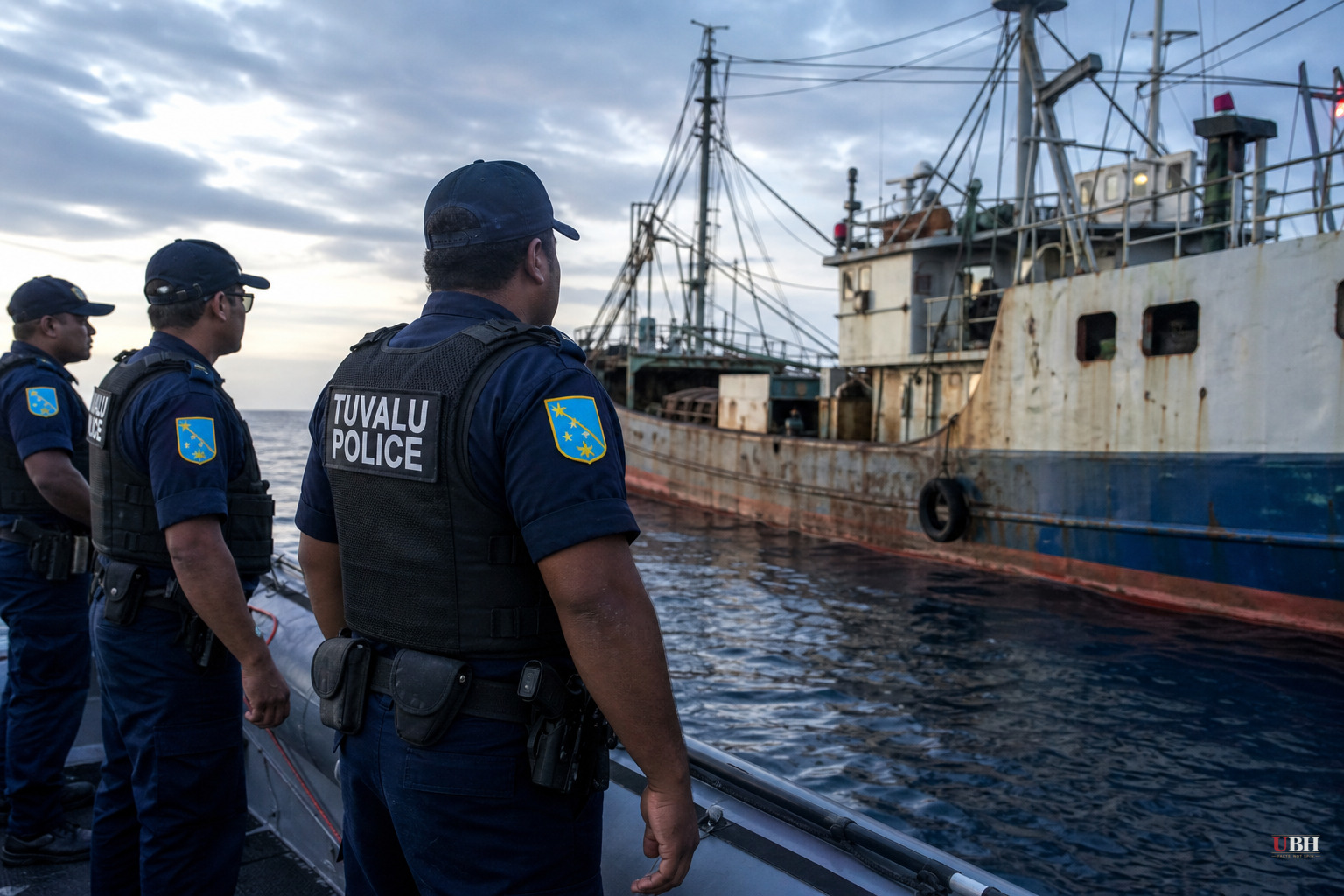
Tuvalu Police, working off a Sea Shepherd patrol boat, boarded and arrested a Chinese longliner called the Lu Rong Yuan Yu 138 on July 9 for allegedly fishing illegally in Tuvalu's waters, according to the Australian Associated Press (AAP) as reported by The Epoch Times and republished by ZeroHedge.
The vessel allegedly had its navigation lights switched off and was transmitting false position data, a practice known in maritime enforcement circles as "spoofing." Investigators reportedly found the ship broadcasting a location sitting exactly on the equator at 0 degrees, a suspiciously round number that helped tip them off.
Once officers boarded, they found the vessel had no valid permit to fish in the area. It was detained and escorted to the Port of Funafuti, Tuvalu's capital, for further investigation, according to AAP.
Going Dark Is Reportedly Routine
Peter Hammarstedt, chair of Sea Shepherd Australia, told AAP that switching off automatic identification systems (AIS) or feeding them false data is common practice for illegal fishing operations, particularly from Chinese vessels operating in the Pacific.
"It's very common practice, especially in the Pacific Ocean, for Chinese fishing vessels to transmit false positions," Hammarstedt said. He added that some vessel-tracking websites show Chinese fishing boats appearing on land, including in the Mongolian desert, an obvious sign the ship is elsewhere and simply inputting fabricated coordinates to mislead investigators.
That claim comes from Sea Shepherd, an advocacy and direct-action conservation group, not a neutral government regulator, and it should be read with that in mind. But the mechanics described are consistent with known AIS spoofing techniques documented across global fisheries enforcement: vessels either disable transponders entirely or transmit manipulated coordinates to mask their real position.
A Small Nation, a Massive Ocean
Tuvalu is described in reporting as a small South Pacific nation. Its exclusive economic zone, the ocean area where it holds fishing rights, spans roughly 750,000 square kilometres, according to AAP. That's a large stretch of ocean patrolled by a nation with limited assets to keep an eye on it.
Tuvalu's only operational patrol boat was damaged in a cyclone, and the country has partnered with Sea Shepherd for the past two years to help fill the enforcement gap, according to AAP. Without that partnership, the vessel in question likely never gets boarded at all.
The core issue is the mismatch between how easy it is to fake a ship's location with cheap electronics and how little a small island nation can do to catch it. Most illegal fishing in these waters reportedly goes undetected, according to AAP, because there simply aren't enough patrol assets to check.
What's Actually Proven Versus Alleged
The Lu Rong Yuan Yu 138 was boarded, detained, and is under investigation. It allegedly lacked a valid fishing permit and allegedly was transmitting false position data. None of that has been adjudicated in a Tuvaluan court as of this writing, and no outcome, fine, or conviction has been reported.
The broader claim that Chinese vessels routinely spoof their locations across the Pacific is an allegation from Sea Shepherd's Hammarstedt, not an independently audited statistic. It's a serious claim worth taking seriously given Sea Shepherd's years of direct enforcement work in the region, but it's still one advocacy group's characterization of a pattern, not a government tally of confirmed spoofing incidents.
AAP also reports that Australia and Pacific nations have recently ramped up efforts to clamp down on illegal fishing under the Pacific Islands Forum Fisheries Agency Fishing Authorisation.
What Happens Next
The Lu Rong Yuan Yu 138 remains at the Port of Funafuti pending investigation, according to AAP. No charges, fines, or penalties have been publicly announced yet. Whether Tuvalu's legal system, with its limited resources, can actually prosecute a case against a foreign-flagged commercial vessel is itself an open question that will play out over the coming weeks.
The bigger unresolved issue is structural. As long as AIS spoofing remains cheap and easy while patrol capacity in small Pacific states stays minimal, this case will be one intercepted vessel out of an unknown, and likely much larger, number that never get caught. As Hammarstedt put it to AAP, "The fishing vessels that do this kind of behaviour operate under the expectation that they're just not going to get caught."
Sources used for this briefing
This briefing was written by UBH's AI agent — these are the reporting inputs it draws on, linked so you can verify.


