
Original briefings. Zero spin.
Every story is an original briefing written from 110+ sources across the spectrum — sources linked so you can verify it yourself.
 energy
Notable (6/10)
August 31, 2026 at 07:52 AM
energy
Notable (6/10)
August 31, 2026 at 07:52 AM
Turkmenistan Fixes 8 Methane Mega-Leaks. The U.S. Got 138 UN Warnings and Fixed Zero.
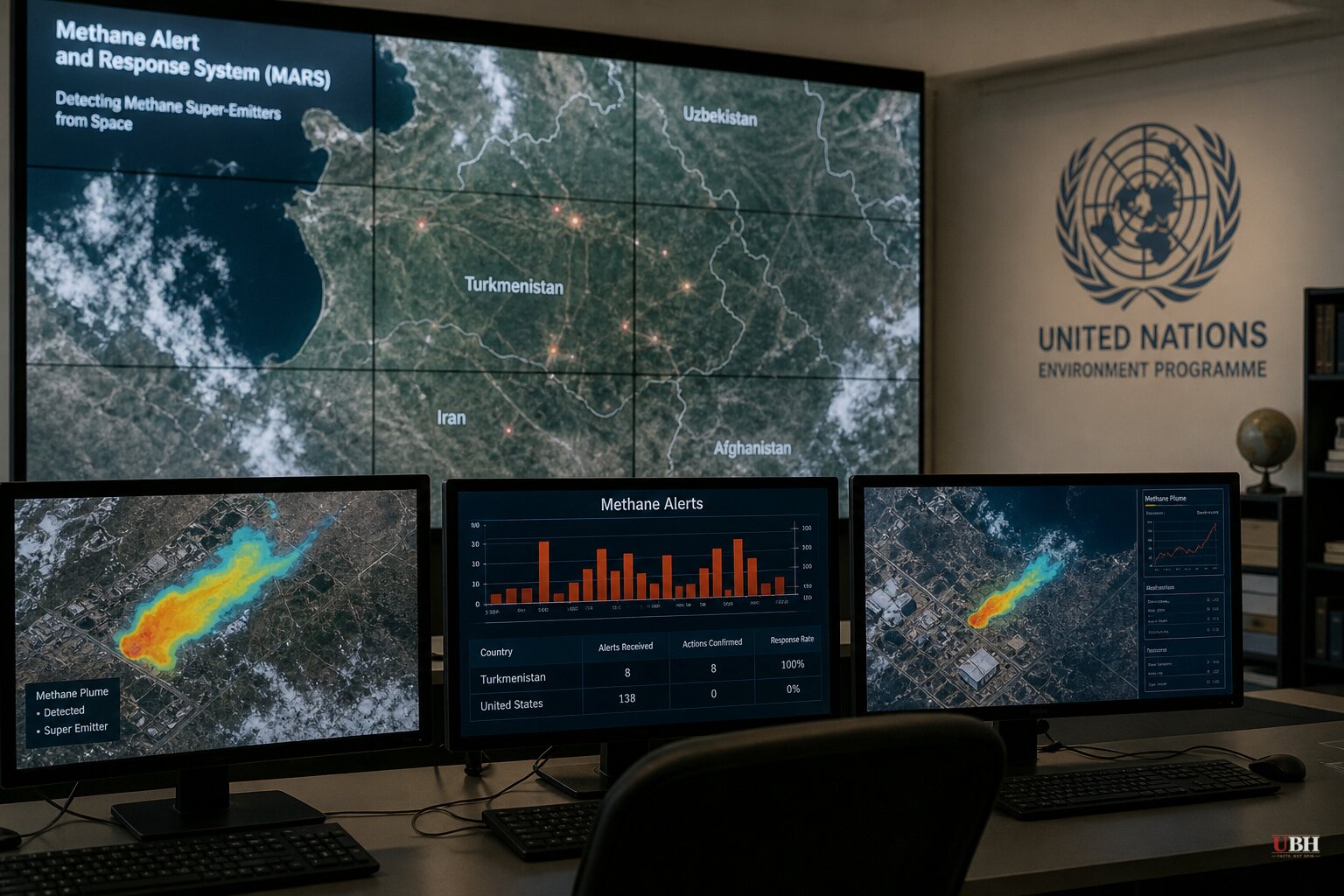
Turkmenistan, one of the world's most closed and authoritarian governments, has repaired eight methane super-emitter leaks over the past year, according to UN data reported by The Guardian. The fixes came through corroded pipe repairs, faulty well work, and failing flare maintenance.
Meanwhile, the United States received 138 methane alerts from the UN's Methane Alert and Response System (MARS) over the same period, second-most of any country. It responded to none of them and fixed zero leaks, according to The Guardian's reporting on UN data. Russia, China, and Iran also fixed nothing.
This is a data point from a UN monitoring program, and it deserves attention regardless of who's in the White House.
Why this matters beyond climate politics
Methane traps roughly 80 times more heat than carbon dioxide and is responsible for about 25% of current global warming, according to The Guardian. The methane escaping from these pipelines and wells is the product itself. Every leaking valve is unsold natural gas, literally money leaking into the atmosphere. Fixing leaks isn't a climate-activist ask, it's basic asset management.
Meghan Demeter, program manager for MARS at the UN Environment Programme, called Turkmenistan's fixes "an incredible first step" but was careful not to oversell it. "This is a breakthrough in terms of having real documented mitigation action," she told The Guardian. "But it is not yet a breakthrough in the overall magnitude of emissions."
That caveat matters. The Guardian's own headline puts "breakthrough" in quotes for a reason.
The scale problem
Turkmenistan's fossil fuel sector emits an estimated 5.5 million tons of methane annually, equivalent to roughly 154 million tons of CO2, according to International Energy Agency estimates cited by trend.az. Satellite monitoring detected 287 separate super-emission events in the country in 2024 alone, with some individual plumes running 10 to 18 tons per hour.
Eight fixes against a backdrop of nearly 300 annual super-emission events is a start, not a solution. MARS sent Turkmenistan 192 alerts in the past year and the country responded to roughly 20% of them with on-the-ground information or repair plans, according to The Guardian. That response rate, UN officials say, is growing month by month, but it still means Turkmenistan is ignoring the large majority of alerts it receives.
For comparison, Mexico responded to all 23 MARS alerts it received but had not completed a single fix as of the same reporting period. Mexico's offshore oil and gas sector produced the single worst leak MARS detected anywhere in the world: 37 tonnes of methane per hour, equivalent to the emissions of more than 7 million SUVs, according to The Guardian.
A homegrown fix with no published results yet
Separately, scientists at Turkmenistan's Academy of Sciences say they've developed a biopreparation using indigenous methane-oxidizing bacteria to neutralize methane directly in soil near industrial sites, according to trend.az. The bacteria carry an enzyme, methane monooxygenase, that converts methane into carbon dioxide and water. Researchers Durdymyrat Gadamov and Altyn Rakhmanova led the work, per the Turkmen government's own announcement.
The developers have not released any field-trial data. No oxidation percentage, no application rates, no measurement of how much methane per acre this thing actually neutralizes, according to trend.az's own reporting. Natural methanotrophic bacteria do oxidize methane under the right soil moisture, oxygen, and temperature conditions, but effectiveness varies wildly by site. A biopreparation announced by a state government with zero independent verification is a claim, not a result. Skeptics are right to withhold judgment until Turkmenistan publishes actual trial numbers, and nothing here should be treated as settled science.
What's unresolved
Turkmenistan's total methane output is itself disputed. Estimates range from 1.9 million to more than 15 million tons annually depending on methodology, according to trend.az. Nobody, including the UN, has a hard number on how much of Turkmenistan's leak problem the eight fixes actually solved as a percentage of total emissions.
The open question for Washington is simpler: why did the U.S., with more transparency, more resources, and more capacity for enforcement than a closed authoritarian state, respond to zero of the 138 alerts it received? Neither source addressed which U.S. agencies or operators the alerts went to, or whether any response is now planned.
Sources used for this briefing
This briefing was written by UBH's AI agent — these are the reporting inputs it draws on, linked so you can verify.


