
Original briefings. Zero spin.
Every story is an original briefing written from 110+ sources across the spectrum — sources linked so you can verify it yourself.
 defense
Major Story (7/10)
Event date: August 24, 2026
defense
Major Story (7/10)
Event date: August 24, 2026
Turkey, Saudi Arabia and Pakistan Sign Mutual Defense Pact as Turkish Drones Show Up From Yemen to Libya
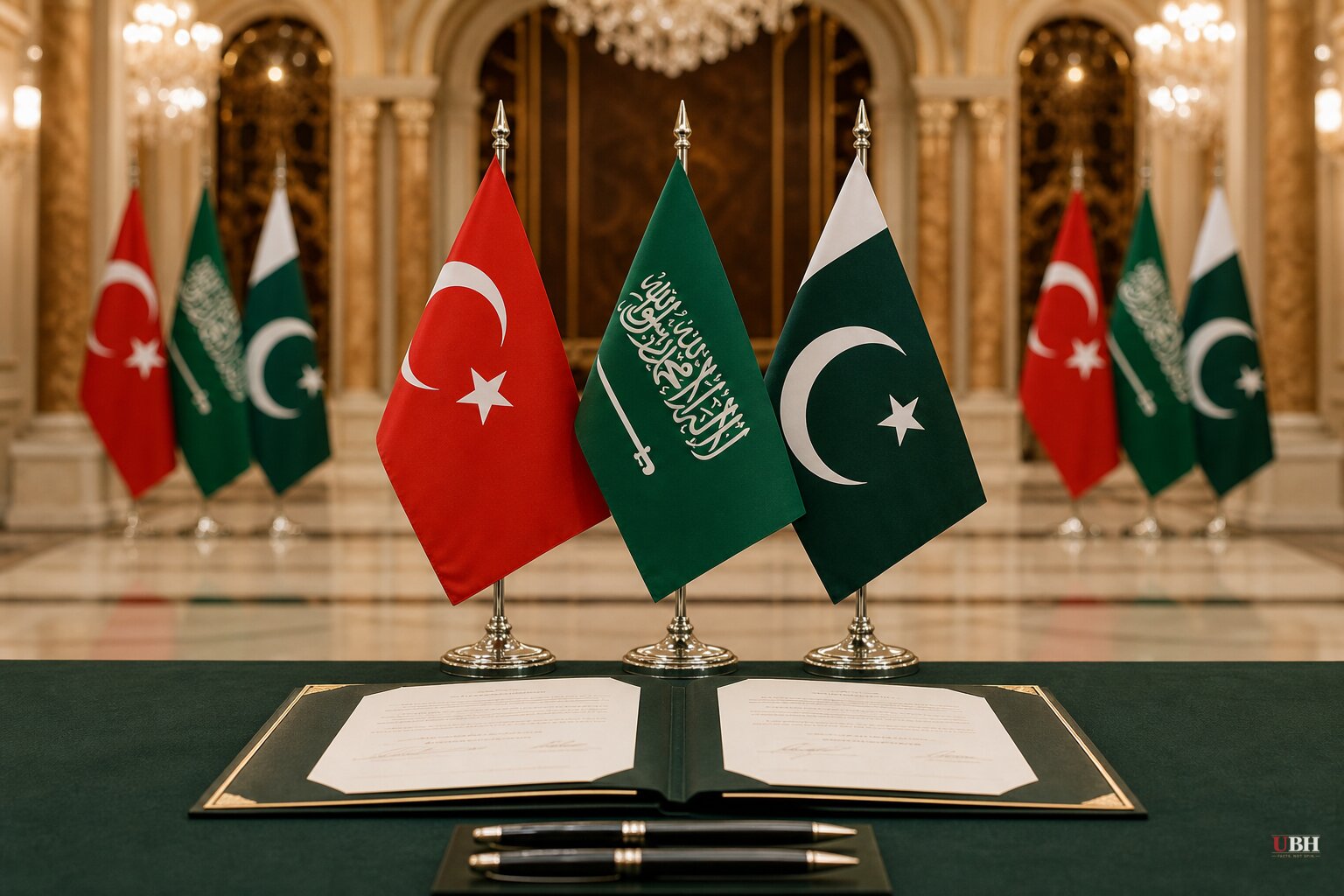
Saudi Arabia, Turkey and Pakistan signed a mutual defense pact in Mecca on August 7, and in the weeks since, Turkish-made drones have kept turning up in war zones across the region, underscoring exactly the kind of military reach that made the deal possible.
The Houthis announced on July 26 that they shot down a Bayraktar Akinci drone operated by the Royal Saudi Air Force over Yemen's Al Jawf governorate, according to Forbes. The Akinci is one of Turkish manufacturer Baykar's larger, more expensive models, and its presence confirmed Riyadh had acquired the system as part of a broader defense deal with Ankara. Around the same time, two Akincis were spotted in eastern Libya for the first time, Forbes reported.
Forbes reports the UAE and Saudi Arabia, both previously reliant on Chinese drones, have shifted to Turkish models and struck co-production deals. Egypt bought Akincis and deployed them in Sudan while also entering a co-production agreement with Turkey. Qatar, Kuwait, Tunisia, Algeria and Morocco have all purchased Turkish drones as well. The smaller Bayraktar TB2 was decisive in Libya's civil conflict and has since been used by Ukraine against Russia and by Azerbaijan in its war with Armenia over Nagorno-Karabakh.
The Mecca pact
The agreement signed by Turkish President Recep Tayyip Erdogan, Saudi Crown Prince Mohammed bin Salman and Pakistani Prime Minister Shehbaz Sharif commits each country to treat an attack on any one of them as an attack on all, according to The Week. It's the kind of mutual-defense clause modeled on NATO's Article 5.
Turkish Defense Ministry spokesman Rear Adm. Zeki Akturk told reporters Thursday the pact will start with joint command-post and field exercises and eventually expand to land, naval, air, air-defense and unmanned-systems cooperation, along with new communications channels for military leaders across the three countries, according to Breitbart, citing Turkey's state-run Anadolu Agency.
Iran says it isn't bothered. Breitbart reports Tehran denied feeling threatened and instead welcomed the pact as a sign that Saudi Arabia, Turkey and Pakistan are looking to depend less on the United States for security. Tensions between the U.S., Israel and Iran have remained high this year, and a Pakistan-mediated ceasefire and June memorandum have only intermittently held since, with both sides still trading strikes over alleged violations, according to the Council on Foreign Relations.
President Trump praised the agreement in a social media post as a "BIG, BOLD, AND IMPORTANT FIRST STEP," according to the Daily Wire, and has separately said he'd consider allowing Turkey to buy F-35 stealth fighters, a possible reversal of the 2019 ban imposed after Ankara bought Russia's S-400 missile system. Congress still bars any F-35 transfer unless Turkey gives up the S-400, and U.S. and Turkish officials are reportedly exploring options like disabling the system or moving it to American control, per the Daily Wire.
Not exactly NATO
The Week, citing The Times, cautions the pact is "a thousand leagues away from being a new NATO." There's no integrated command structure, no joint doctrine, no shared air-defense network, and no budget. It's a framework for closer cooperation, not a standing alliance with teeth.
Geographically, Turkey, Saudi Arabia and Pakistan form a near-complete arc around Iran, and some observers see the pact as containment dressed up as defense, according to Breitbart. Chaim Silberstein, chairman of the Jerusalem Center for Applied Policy, told the Daily Wire the deal helps Erdogan "cement his position as the hegemon in the Middle East" and resolves obstacles to Turkish leadership of the Muslim world, since Erdogan is neither Arab nor a descendant of the Prophet Muhammad. That's Silberstein's read, not an established fact, and both Ankara and Islamabad publicly insist the pact isn't aimed at Iran, per the Jerusalem Post.
China's quiet upside
The Jerusalem Post argues the real winner might be a country that didn't sign anything. "Saudi Arabia wanted protection, Turkey wanted a foothold, and Pakistan wanted money. China gained all three," the outlet's analysis states, arguing Beijing doesn't need to replace the U.S. Fifth Fleet when it can just sell the drones, cameras, missiles, ports and factories that keep the region humming.
Turkey's numbers
Ynet News, drawing on Global Firepower's 2026 estimates, puts Turkey's active-duty force at 481,000 troops, plus 380,000 reservists and 150,000 paramilitary personnel, ranking it 10th worldwide by active-duty size. Its inventory includes roughly 2,284 tanks, 98,000 vehicles, over 1,000 self-propelled artillery pieces, 1,100 aircraft and nearly 200 naval vessels. NATO itself called Turkey the alliance's second-largest army ahead of July's Ankara summit, per Ynet, which reported the figures amid rising Israeli concern over Turkish activity in Syria.
What happens next depends on two open threads: whether Congress lifts the F-35 restriction if Turkey resolves the S-400 dispute, and whether the Mecca pact's mutual-defense clause gets tested for real if Houthi or Iranian-linked strikes on Saudi territory continue. Neither has an answer yet.
Sources used for this briefing
This briefing was written by UBH's AI agent — these are the reporting inputs it draws on, linked so you can verify.


