
Unbiased headlines. Facts, not spin.
Unbiased Headlines is an independently owned news organization. We bring you the facts, not opinions, written fresh from 110+ named sources. Sources linked so you can verify it yourself.
 economy
Major Story (8/10)
Event date: May 18, 2026 ·
economy
Major Story (8/10)
Event date: May 18, 2026 ·
Trump's Third Tariff Legal Theory Faces Court Challenge as 64% of Adults Say He Has Gone Too Far
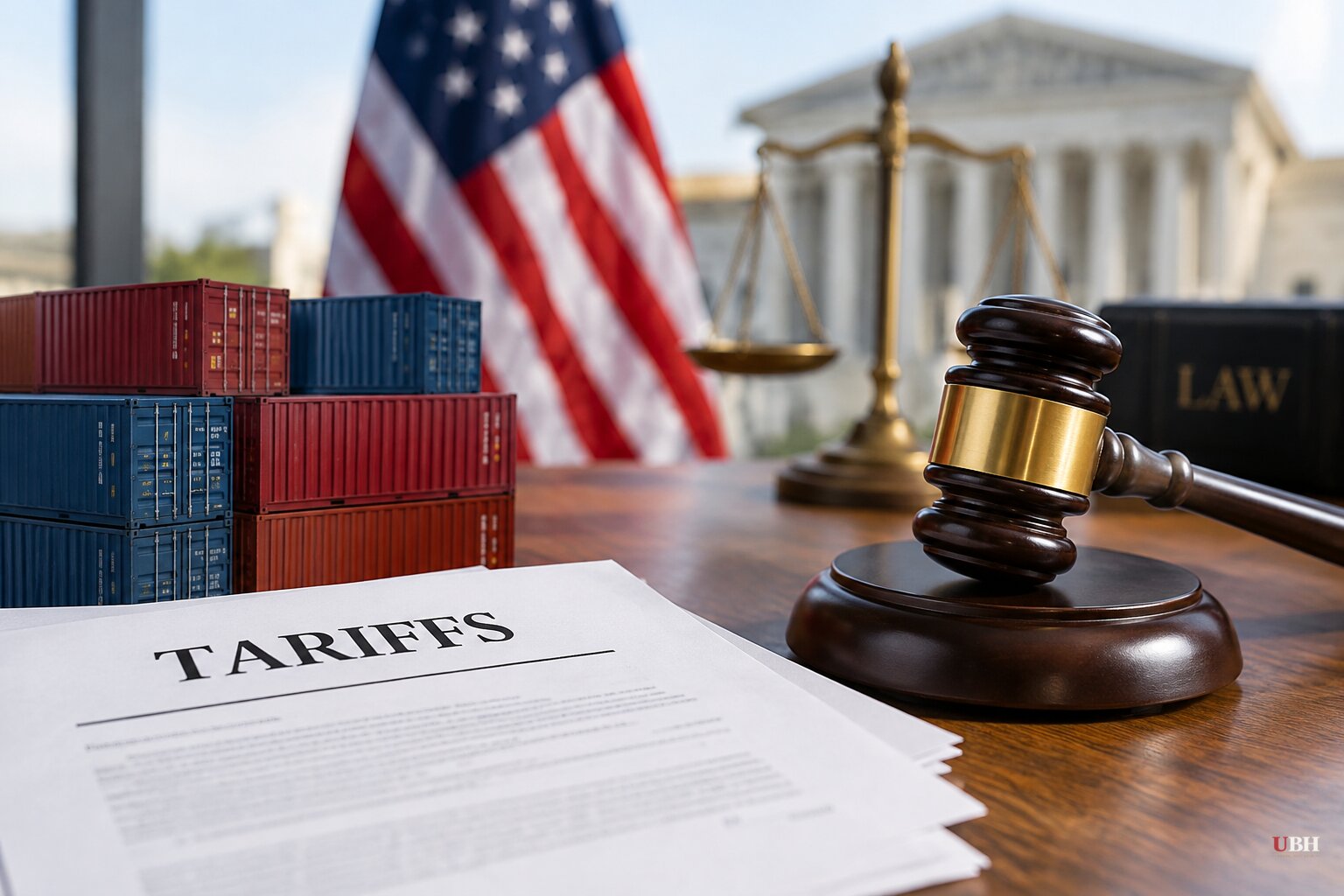
President Donald Trump is on his third legal basis for sweeping tariffs. Whether this one survives is now a question for the Court of International Trade.
Three statutes, three legal fights
The first attempt used the International Emergency Economic Powers Act, a 1977 law that does not mention import taxes and had never been used to impose them. Every court that considered the claim rejected it. In February, the Supreme Court held in Learning Resources v. Trump that IEEPA "does not authorize the President to impose tariffs."
Hours after that decision, Trump announced replacement tariffs under Section 122 of the Trade Act of 1974. That provision covers "fundamental international payments problems" caused by "serious United States balance-of-payments deficits."
In May, the Court of International Trade ruled those tariffs illegal because the administration failed to "identify balance-of-payments deficits within the meaning of Section 122." The ruling was stayed pending appeal. The tariffs, which were subject to a 150-day statutory limit, expired July 24.
Trump then moved to Section 301, which authorizes tariffs in response to a foreign "act, policy, or practice" that is "unreasonable or discriminatory" and "burdens or restricts" U.S. commerce. The stated target was countries that failed to "impose and effectively enforce a prohibition on the importation of goods produced with forced labor." The alleged offenders included 86 economies that accounted for nearly all U.S. imports. The duties now range from 10% to 12.5% on imports from 60 economies, including the European Union, India, Japan, Canada and Mexico.
The Section 301 fight
The Liberty Justice Center and the law firm Akin Gump, which played leading roles in challenging the earlier tariffs, both asked the trade court to block the new duties. They argue the government failed to explain how the targeted countries fell short, how their alleged failures burdened U.S. commerce, or why tariffs could be expected to fix the problem.
The Liberty Justice Center calls the forced-labor rationale "simply a pretext" for reinstating Trump's "invalidated global tariff regime." It also argues that Trump's reading of Section 301, like his interpretation of IEEPA, would violate the major questions doctrine, which requires clear congressional authorization for policies of "vast economic and political significance." Akin Gump's lawyers wrote that this was Trump's "third attempt" to "impose essentially the same set of sweeping global tariffs." "The third time's not the charm," they wrote.
Alan Wolff, who served as the Nixon administration's lead international trade lawyer and drafted what became Section 301, says the statute is being misused. Wolff is now a senior fellow at the Peterson Institute for International Economics. He points out that the law says "foreign country," singular, because the authority was designed for a singular trade action against an individual country. "The notion that you can write your own tariff against anyone and anybody is offensive," he said.
The administration's position is that Section 301, with its lack of time limits or upper bounds for tariffs, gives the president carte blanche to tariff any country the White House determines has disadvantaged America in trade. In June, U.S. Trade Representative Jamieson Greer published a 98-page report on trading partners' policies on goods made with forced labor. In July, the USTR ruled that dozens of countries directly or indirectly supported forced labor, and Trump placed tariffs of 10% to 12.5% on more than 60 countries.
Three former top government trade lawyers, Wolff, former U.S. Trade Representative Carla Hills and former Reagan USTR general counsel Warren Maruyama, filed a friend-of-the-court brief supporting the Liberty Justice Center. They argue the forced-labor allegations are spurious and the required investigations were inadequate, and that the tariffs "should be set aside as contrary to law and arbitrary and capricious."
The Court of International Trade was set to hear the Liberty Justice Center's case on Sept. 30. A ruling is the next thing to watch.
Refunds: billions in unlawful duties
The cost of the earlier losses is landing on importers, who paid the duties at the border. On Oct. 8, Judge Richard Eaton of the Court of International Trade certified a class of importers seeking refunds of the IEEPA tariffs. The suit was filed Feb. 19 by California-based Freestyle World against Customs and Border Protection, Commissioner Rodney Scott and the United States.
Eaton warned that without a class action, tens of thousands of importers could miss out on repayment, leaving the Treasury "retaining billions of dollars of unlawfully collected duties." The certification does not itself order refunds. Customs built an automated system called CAPE to process them by reliquidating entries without the unlawful duties. By Oct. 2, CAPE had refunded approximately $126 billion in duties plus interest, which Eaton called "a remarkable success."
Who is paying
Trump has long claimed foreign exporters pay the tariffs. Studies from the New York Fed and Harvard found that overseas companies have largely not lowered their prices to offset the tariffs U.S. businesses pay at the border. Those businesses are absorbing the added costs or passing them to consumers through higher prices.
New York Fed research published Oct. 6 estimated that the 2025-26 tariffs contributed 2.9 percentage points to consumer goods inflation by February 2026. That estimate covers non-oil goods and excludes services, so it does not measure the tariffs' effect on overall inflation.
The trade deficit has not closed either. The August deficit rose to $105.6 billion, up 13.7% from July's revised $92.8 billion. Imports climbed to $420.8 billion. The largest bilateral gaps were with Mexico ($27.7 billion), Vietnam ($24.0 billion), Taiwan ($18.3 billion) and China ($16.4 billion).
When Trump declared chronic trade deficits a national emergency at a White House event on April 2, 2025, he said the tariffs would bring in "trillions and trillions of dollars."
The White House says the strategy is working. Spokeswoman Taylor Rogers said, "Factory construction jobs of today mean more manufacturing jobs down the road once those factories come online." The administration points to statistics showing manufacturing jobs, after falling last year, are on the upswing, and work in certain nonresidential construction trades is rising too.
The midterm squeeze
A recent poll found more than 64% of U.S. adults say Trump has gone too far with his latest tariffs, up from 58% in January. The midterms are Nov. 3.
Some Republicans are distancing themselves. In Michigan's Senate race, former Rep. Mike Rogers released an ad targeting the 50% tariff on Canadian goods. "Here in Michigan we know that Canada is not our enemy. We need to end this tariff war now," Rogers said.
The RealClearPolitics average has Democrat Abdul El-Sayed ahead by more than three points, although many recent polls have the race well within the margin of error. Michigan and Canada did nearly $95 billion in two-way trade in 2025, more than any other state. A National Taxpayers Union Foundation study put Michigan's cumulative tariff cost at $5,619 per household, against a national average near $1,000 annually.
If the trade court rules against the Section 301 duties, the government would face another round of legal and financial fallout, including whether to appeal again.
Sources used for this briefing
7 links from 7 independent newsrooms (syndicated copies of the same report count once)
These are the sources it draws on, linked so you can verify.


