
Unbiased headlines. Facts, not spin.
Every story is an unbiased news briefing written from 110+ sources across the spectrum — sources linked so you can verify it yourself.
 defense
Major Story (8/10)
July 10, 2026 at 09:01 AM
defense
Major Story (8/10)
July 10, 2026 at 09:01 AM
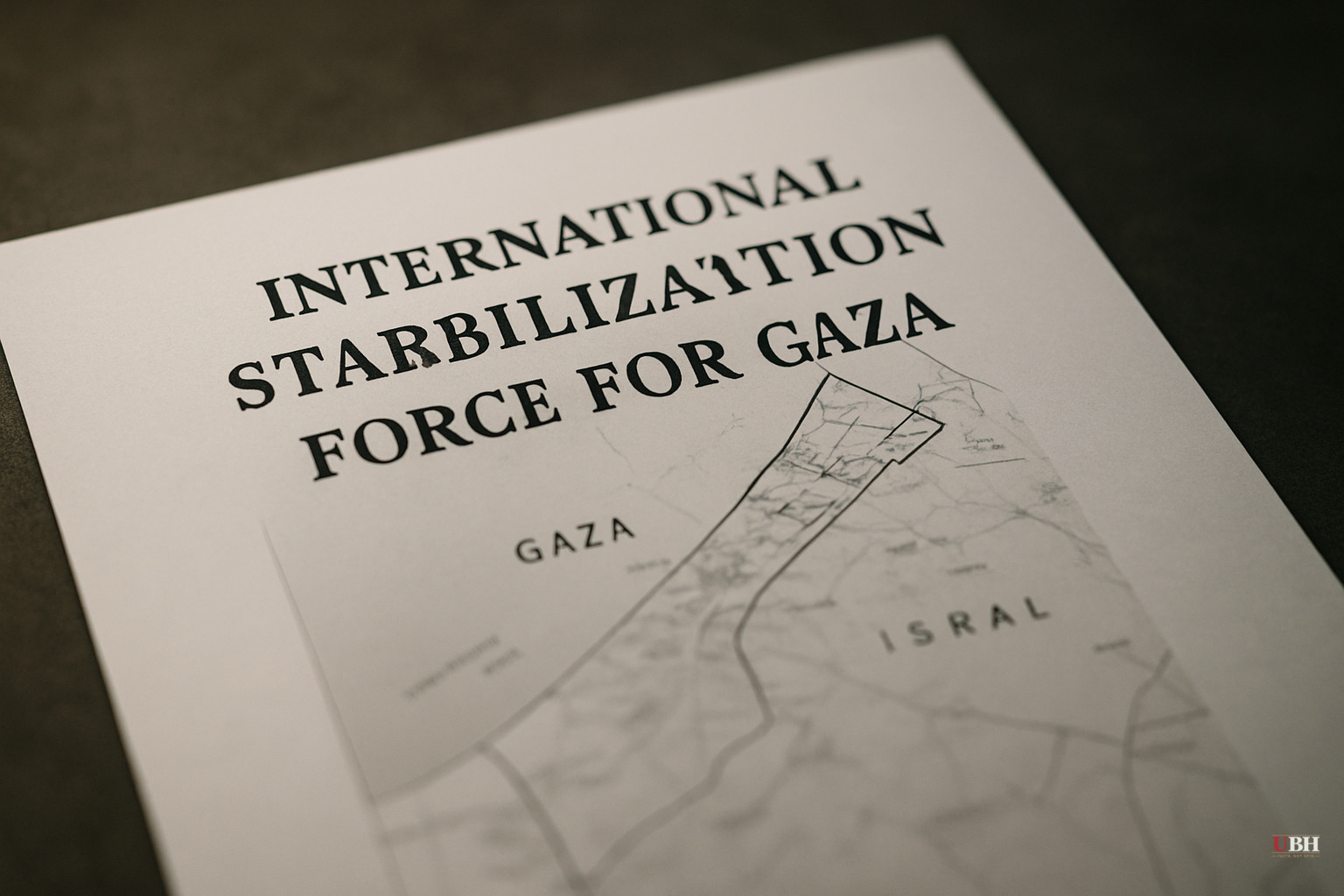
Trump's Gaza Stabilization Force Has Troop Pledges but No Boots on the Ground Yet
The Plan on Paper
On September 29, 2025, President Trump unveiled a 20-point Gaza framework linking a hostage-and-prisoner exchange to a full demilitarization of the territory and the installation of an internationally supervised interim government. The UN Security Council formally adopted the plan as Resolution 2803 on November 17, 2025, according to The Jerusalem Post.
The governance structure at the center of the plan is a technocratic body called the National Committee for the Administration of Gaza, a Palestinian-run entity that would handle services and reconstruction while operating under a Trump-chaired Board of Peace. Hamas is supposed to be stripped of governing authority and military capacity. Eventually, a reformed Palestinian Authority would inherit Gaza, but only after completing a prescribed reform program covering security, corruption, and governance.
Eight Arab and Islamic states — Egypt, Indonesia, Jordan, Pakistan, Qatar, Saudi Arabia, Turkey, and the UAE — issued a joint statement welcoming the plan and agreeing to help implement it, according to the Jerusalem Post.
Who Has Pledged Troops
The International Stabilization Force, as currently designed, targets 20,000 soldiers supported by 12,000 trained local police.
Five nations have formally committed troops: Indonesia, Morocco, Kazakhstan, Kosovo, and Albania. Indonesia's pledge is the largest. Army chief of staff Gen. Maruli Simanjuntak told The Guardian that he expects to send a full brigade of between 5,000 and 8,000 personnel, with training underway for engineering and health units. He was explicit that the mission remains in the planning stages. "It's all still being negotiated, not certain," Maruli said. "So there's no certainty on the number until now."
The inaugural Board of Peace meeting in February 2026 produced $7 billion in reconstruction funding commitments, according to Crypto Briefing.
The Gap Between Commitment and Deployment
As of July 10, 2026, no ISF units have actually deployed inside Gaza. The Jerusalem Post flags this plainly: troop pledges exist, but the territory remains unoccupied by international forces. The UAE's $100 million earmarked for Palestinian police training is frozen. Egypt and Jordan have agreed to train Palestinian police, but that process is ongoing without a clear timeline for completion.
Meanwhile, the military situation on the ground is moving in a different direction than the stabilization plan assumes. The IDF has reduced the area under Hamas control from 47% of the Gaza Strip to 40% or less since the ceasefire. In May 2026, Prime Minister Benjamin Netanyahu said he intends to expand Israeli territorial control to 70% of the Strip, according to the Jerusalem Post. This creates a direct structural tension: a stabilization force is being assembled for a territory whose borders of control are still actively shifting.
The Hamas Variable
Hamas agreed to some parts of Trump's proposal, including hostage releases and transferring administrative authority, but has maintained that its own disarmament requires further negotiation, according to the Jerusalem Post. That caveat is not minor. The entire architecture of the plan, from ISF deployment to eventual PA governance, depends on Hamas being defanged. If Hamas retains weapons and organizational capacity, international troops would be walking into an active threat environment with a mandate that outpaces the conditions on the ground.
Why Indonesia's Role Matters and Why It's Complicated
Gaza needs governance and reconstruction, and no one else is offering a credible alternative. Indonesia's participation is historically significant. As The Guardian noted, an Indonesian deployment would mark the first outside military force in Gaza since 1967. Indonesia is also the world's most populous Muslim-majority country, giving the force a degree of Islamic-world legitimacy that U.S. or European troops would not have.
The complication is that Indonesia and other contributing countries have made clear they do not want to be positioned as enforcing Israeli security objectives. Gen. Maruli's framing of the mission as engineering and health support, rather than disarmament operations, reflects that tension. Suggested contributors "have been reluctant to put their forces in the position of trying to disarm Hamas on Israel's behalf," The Guardian reported. That reluctance is not unreasonable, but it directly limits what the ISF can actually accomplish if disarmament is the prerequisite for everything else in the plan.
There is also domestic Israeli political pressure working against the deployment. The Jerusalem Post and The Guardian both note that the far-right wing of Netanyahu's coalition opposes any significant international force in Gaza, viewing it as a step toward Palestinian statehood.
What's Actually Unresolved
The plan's sequencing presents a central challenge. Phase one — ceasefire and hostage exchange — was completed. Phase two requires ISF deployment, Hamas disarmament, and the stand-up of a functional Palestinian police force before any reconstruction governance can begin. None of those phase-two conditions have been met nine months after UN authorization.
The Jerusalem Post also points out a demographic imbalance that complicates any governance framework: no more than 15% of Gaza's population remains in territory not under IDF influence. Stabilizing a territory that has been this thoroughly displaced is a different task than the plan's architects described in September 2025.
The unresolved question sitting at the center of all this: if the ISF cannot deploy until Hamas is disarmed, and Hamas will not disarm without guarantees the ISF cannot yet provide, which party moves first, and who compels them to?
Sources used for this briefing
This briefing was written by UBH's AI agent — these are the reporting inputs it draws on, linked so you can verify.


