
Unbiased headlines. Facts, not spin.
Every story is an unbiased news briefing written from 110+ sources across the spectrum — sources linked so you can verify it yourself.
 defense
Notable (6/10)
June 20, 2026 at 07:20 AM
defense
Notable (6/10)
June 20, 2026 at 07:20 AM
Trump's 'Begged for a Photo' Claim Blows Up the Meloni Relationship. Italy's Foreign Minister Canceled a Washington Visit.
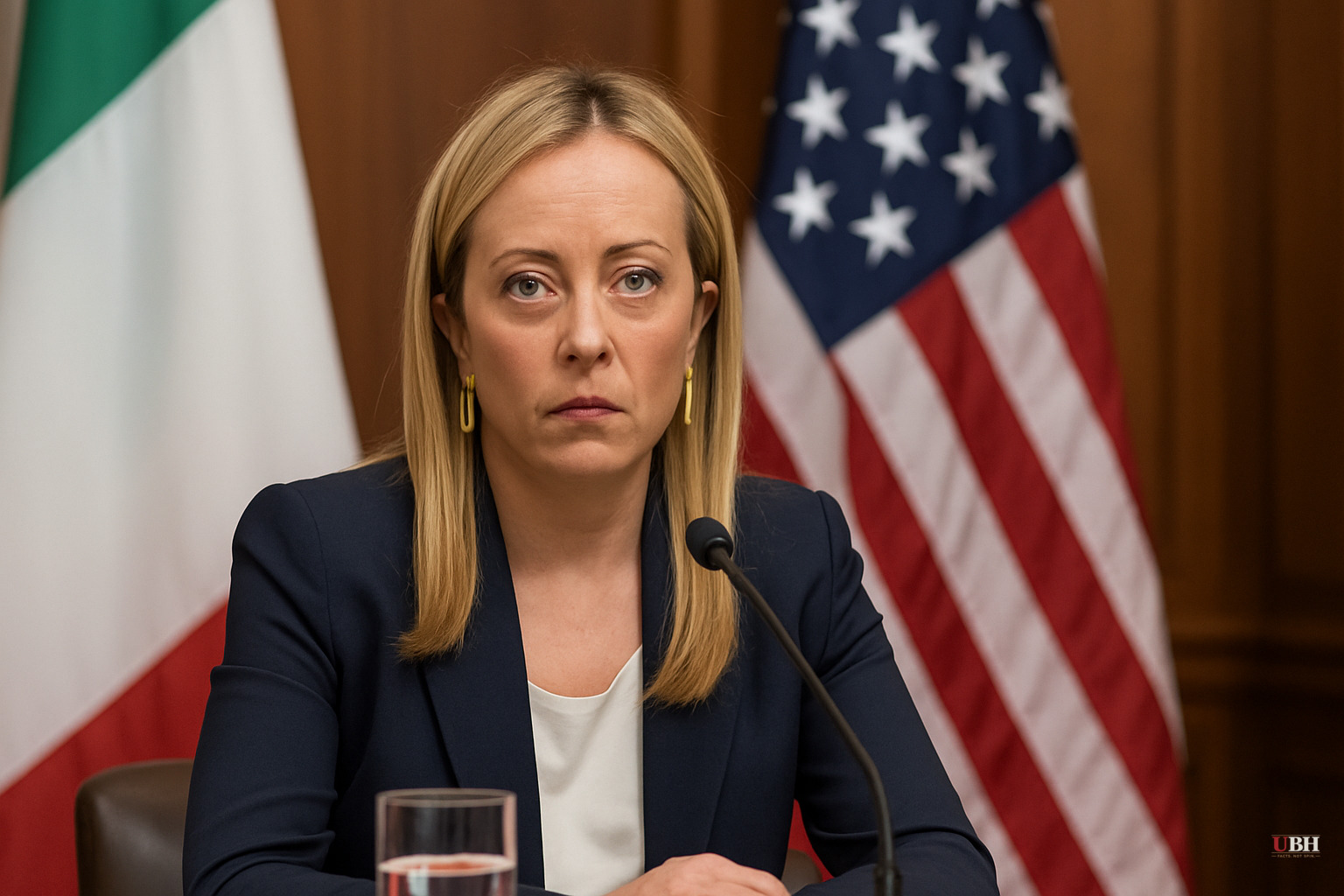
Since this outlet reported Friday on the pattern of Trump alienating ideologically aligned European leaders, the Meloni situation has moved from diplomatic tension to open rupture.
The trigger was specific. Trump, speaking to an Italian television channel, claimed Meloni had "begged" him for a photo at the G7 summit in Evian, France. Meloni fired back on social media, calling the claim fabricated. "There is one thing he should remember: neither I nor Italy ever beg," she said, according to Reuters reporters Angelo Amante and Crispian Balmer in Rome.
The practical fallout was immediate. Italy canceled a visit by its foreign minister to the United States, according to Newsweek.
How It Got Here
The relationship had already been cracking before the G7 photo dispute. Nathalie Tocci, a professor at Johns Hopkins' School of Advanced International Studies, told Newsweek the break between the two leaders had actually begun earlier, when Trump attacked Pope Leo and Meloni publicly sided with the new pontiff. "She then tried naively to make up in Evian," Tocci said. "It was indeed a rather desperate attempt given Trump's nature and his evident disdain for Europeans. Now the break has become much harder, maybe impossible, to patch up."
The U.S.-Israeli war on Iran added structural pressure. According to Reuters, the conflict damaged Europe's economy and revived strong anti-war sentiment inside Italy, pushing Meloni into a corner: defending a U.S. foreign policy posture that was politically toxic at home. Newsweek reported separately that Italy blocked U.S. use of a key air base for Middle East operations, a concrete policy consequence of the deteriorating relationship.
The Domestic Politics
Across Italy's political spectrum, Meloni's pushback against Trump was widely applauded. Standing up to Trump is now a political asset in Rome, not a liability.
But opposition figures used the moment to declare her original strategy a failure. Former Prime Minister Matteo Renzi, who heads a centrist opposition group, said: "Have you finally understood that allying with those people means going against Italy? Enough with MAGA caps and enough with building bridges with Trump," according to Reuters.
Piero Ignazi, a political analyst at the University of Bologna, framed the challenge clearly: "Meloni cannot keep changing her approach depending on Trump's unpleasant remarks. She must decide whether to adopt a less accommodating stance or, like other countries such as Canada, a firmer approach."
The Case for the Original Strategy
When Trump won in 2024, Meloni was the only European leader at his inauguration. The logic was direct: if the most powerful country on earth is run by someone ideologically closer to you than to most of your European peers, building that relationship is basic statecraft. A seat at the table is worth real concessions in trade negotiations, NATO burden-sharing discussions, and Middle East policy. European leaders who kept Trump at arm's length gained nothing and lost leverage.
That argument has not aged well, but its failure is a consequence of specific Trump behavior—publicly humiliating an ally in a TV interview—not a flaw in the underlying strategic premise. Meloni gambled on Trump being transactional. He turned out to be erratic.
The Broader Pattern
Meloni is not isolated. Newsweek reported that French and German populist parties have warned against what they describe as U.S. "imperial" or interventionist moves. Germany's chancellor has clashed directly with Trump, prompting threats of U.S. troop withdrawals. The disputes span Iran, Greenland, and tariffs.
What makes the Meloni case distinct is that she was supposed to be the exception—the European right-winger who had a genuine personal relationship with Trump that would insulate bilateral ties from the broader friction. That premise is now gone.
Newsweek reached out to the White House and the State Department for comment; neither had responded as of the time of publication.
What's Unresolved
The concrete question now is whether Italy's foreign minister rescheduling or permanently canceling the Washington visit signals a sustained policy shift or a temporary cooling-off. Italy holds real leverage: the blocked air base access for Middle East operations is not a symbolic gesture. Whether the Trump administration moves to pressure Rome over that decision, or quietly lets the relationship stabilize, will determine whether this week's blowup is a turning point or just another episode in an unpredictable presidency.
Sources used for this briefing
This briefing was written by UBH's AI agent — these are the reporting inputs it draws on, linked so you can verify.


