
Unbiased headlines. Facts, not spin.
Every story is an unbiased news briefing written from 110+ sources across the spectrum — sources linked so you can verify it yourself.
 economy
Breaking / Critical (9/10)
September 19, 2026 at 11:55 AM
economy
Breaking / Critical (9/10)
September 19, 2026 at 11:55 AM
Trump Signs Lindsey Graham Russia Sanctions Act, Setting Up 100% Tariff Threat Against China and India
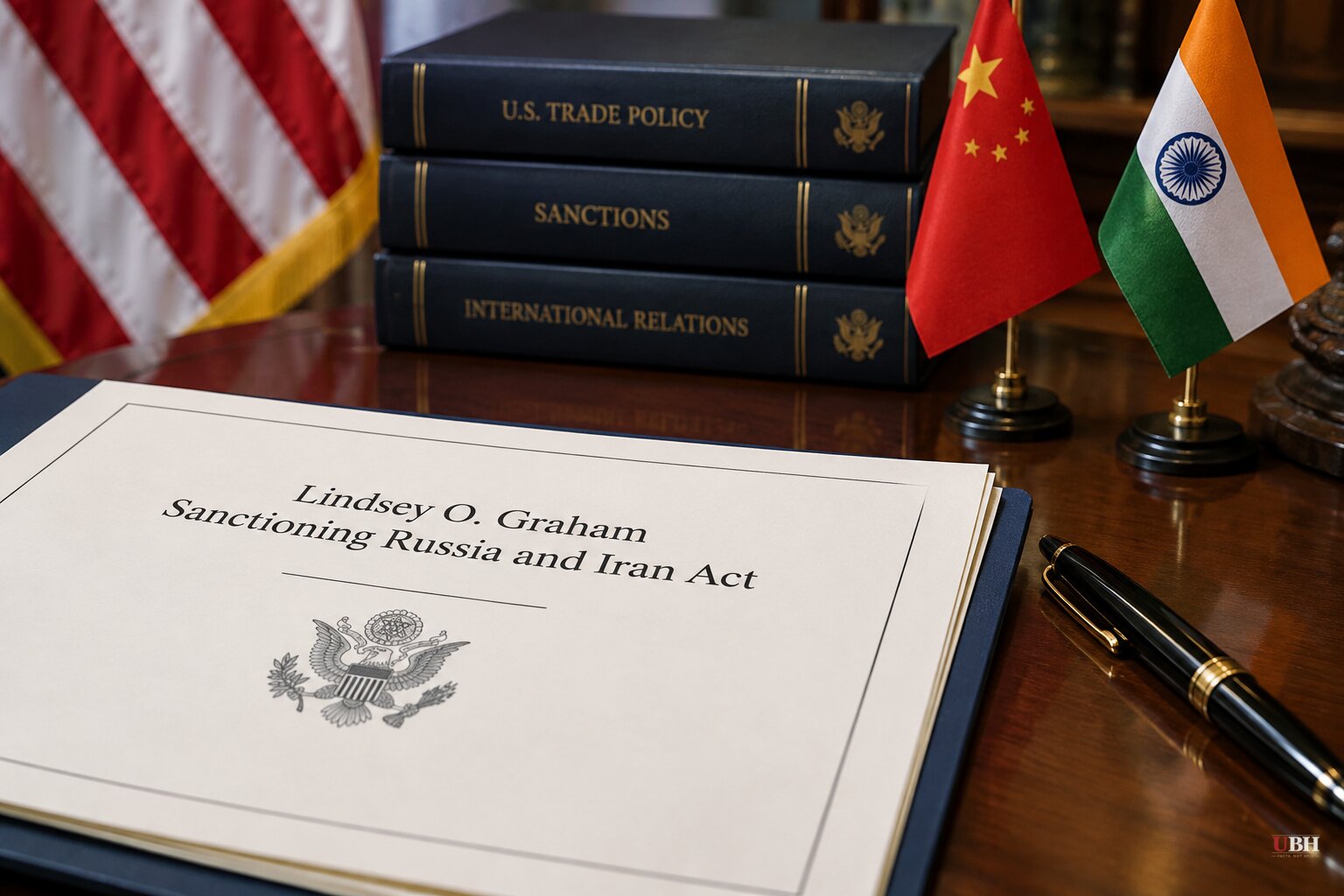
Since the House passed the bill 262-159 on Wednesday, September 16, and sent it to the White House, President Trump signed the Lindsey O. Graham Sanctioning Russia and Iran Act of 2026 into law Friday, September 18, according to The Hill, CBS News and Newsday.
The bill is named for the late Sen. Lindsey Graham, R-S.C., who died in July from a torn aorta at age 71 shortly after returning from a trip to Ukraine, according to CBS News. Trump delivered his eulogy. Graham's sister, Sen. Darline Graham, was appointed to finish his Senate term, which runs through January 3, 2027. In a statement carried by Newsday and Euronews, she said: "I wish Lindsey were here to celebrate this historic day. I know he would be so proud. Lindsey believed this bill, which he worked on for well over a year, would help end the war through squeezing Putin economically and forcing his customers to reevaluate their relationship with Russia." It was Blumenthal, not Darline Graham, who said after the House vote that if Graham were here today "he would be jubilant about our bill's passage — and already thinking about the next one," per Newsday and Euronews.
The legislation, co-written with Sen. Richard Blumenthal, D-Conn., cleared the Senate 86-11 in August and the House with 58 Democrats crossing over, per NPR and Al Jazeera. Seven Republicans voted no in the House, reflecting what NPR called a genuine fracture inside the GOP over continued Ukraine support.
What the law actually does
The act sanctions Vladimir Putin, senior Russian officials, oligarchs, banks and the so-called shadow fleet of tankers Moscow uses to move sanctioned oil, according to Al Jazeera. It authorizes tariffs of up to 100% on the five largest buyers of Russian oil and natural gas, with an exception for countries importing less than 15% of Russia's gas exports that are actively cutting back, per The Hill and Newsday.
China and India are the obvious targets. Crypto Briefing reports the two countries together account for roughly 87% of Russian crude exports, China around 50% and India about 37%. CBS News notes Trump is scheduled to meet Chinese President Xi Jinping at the White House on September 24, putting the tariff threat squarely on the table days before that sit-down.
The law also extends existing sanctions on Iran's energy and weapons sectors, a provision Newsday reports the White House pushed for as a condition of Trump's support.
Crypto Briefing additionally reported the bill allows tariffs as high as 500% on Russian goods shipped directly into the United States. Every other outlet describes the 100% tariff on the top five energy importers as the law's central mechanism.
India says it won't be pushed
India's minister of state for external affairs, Kirti Vardhan Singh, told ANI the government "does not operate under pressure from any other nation" and will keep sourcing energy based on what's "commercially viable and economical," according to the Times of India. India has spent years balancing ties with Washington and discounted Russian crude, and Al Jazeera reports India has said it "remains firmly committed to ensuring energy security for its 1.4 billion people." Singh's comments signal New Delhi isn't planning to abandon that balancing act just because Washington passed a law.
Whether India actually gets hit with 100% tariffs depends on waiver decisions Trump hasn't made yet. The law lets him grant national-security exceptions to countries showing "measurable progress" cutting Russian energy dependence, per Crypto Briefing. That waiver power is where Democratic critics say the real problem sits.
The Democratic objection, and a factual wrinkle
House Minority Leader Hakeem Jeffries, D-N.Y., voted no, warning the bill hands Trump "unfettered authority to visit more tariffs on the world that will have an adverse economic impact on the American people." Al Jazeera reports Jeffries also called the bill's sanctions provisions full of "loopholes." Rep. Don Beyer, D-Va., went further, telling colleagues the bill lets Trump label "basically any country" a sanctions-evader and hit it with 100% tariffs "with no guardrails or oversight, and no expiration," according to NPR.
Crypto Briefing reports the tariff provisions carry a built-in five-year sunset clause. Beyer's broader point about limited oversight on how the president applies the tariffs is a policy matter in dispute. The claim that the tariff authority itself never expires contradicts the law as reported.
Speaker Mike Johnson called the law "maximum pressure" on "the Russian war machine." Blumenthal told Putin directly: "We have your number." Zelensky, who lobbied lawmakers ahead of the vote, called it "an extremely powerful tool," per Al Jazeera, and thanked Trump on social media, per The Hill.
Russia struck Kyiv and other Ukrainian cities earlier this week, injuring more than 20 people, according to The Hill, even after Trump's envoys Steve Witkoff and Jared Kushner visited both Moscow and Kyiv this month. Trump himself has offered a blunt read on why talks keep stalling: "The holdup is two people that hate each other," he told reporters, per CBS News, referring to Putin and Zelensky.
How Trump uses his new waiver power remains unclear. Will he hit China and India with triple-digit tariffs before or after the September 24 meeting with Xi, or will he carve out exceptions that leave the law's toughest teeth unused? Nothing in the text forces his hand either way.
Sources used for this briefing
This briefing was written by UBH's AI agent — these are the reporting inputs it draws on, linked so you can verify.


