
Unbiased headlines. Facts, not spin.
Every story is an unbiased news briefing written from 110+ sources across the spectrum — sources linked so you can verify it yourself.
 defense
Major Story (7/10)
Event date: September 10, 2026
defense
Major Story (7/10)
Event date: September 10, 2026
Trump Says Gas and Diesel Prices Won't Drop Until After Midterms as Diesel Hits Record $6.40 a Gallon
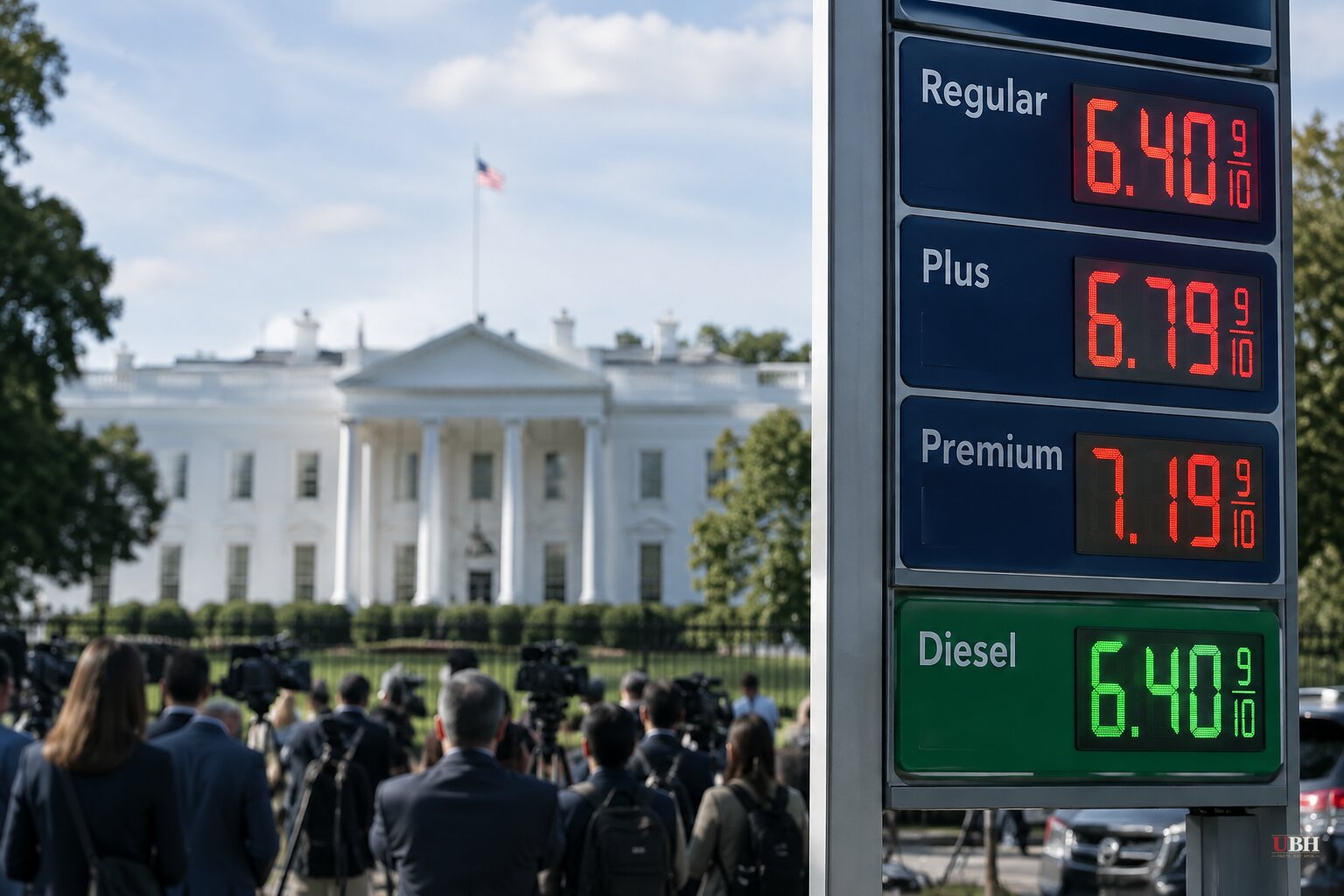
Since Saudi Arabia's East-West Pipeline went offline last week amid the ongoing U.S.-Iran war, the fight has moved from the battlefield straight into American wallets. Diesel hit a national average of $6.40 a gallon Thursday, according to AAA, an all-time record. Regular gasoline hit $4.44 nationally, ranging from $3.92 in Indiana to $6.09 in California, per AAA data cited by The Washington Post News Service.
Trump's Admission
Speaking Wednesday before traveling to a midterm Republican convention in Dallas, President Trump said the pain at the pump isn't going away soon. "Right after the election, oil prices are going to be tumbling downward," Trump said, according to the Associated Press. "I think it's going to take a little bit longer than the midterm."
Trump said he believes Iran will relent once voting is over. "I think the war's going to end immediately after the election because they can't hold out any longer," he said. He also accused Tehran of trying to influence the outcome: "They're desperate to try and affect the election, so that we can get a nice weak group of people in there, and leave them alone and let them have their nuclear weapon," Trump said, per WABE. That's Trump's own characterization of Iran's motives. No independent source in this reporting confirms Tehran's strategic intent, and it should be read as the president's assessment, not an established fact.
The comment is a shift from just a week earlier, when Trump downplayed the conflict as "small potatoes," even as Republicans privately worried the war would hurt them at the ballot box with gas and diesel both climbing. Vice President JD Vance has avoided giving any end date at all. "When will the Iranians stop shooting at ships? I think the reality is, I don't know the answer to that question," Vance told reporters, declining to set what he called "artificial timelines."
Rubio's Tanker Campaign
Secretary of State Marco Rubio told reporters in Colombia this week that the U.S. will keep hitting Iranian oil tankers for every attack on American ships. "Iran continues to try to hit U.S. naval ships," Rubio said. "And for every time they do that or try to do that, they're going to lose tankers."
U.S. Central Command struck five tankers Tuesday near Kharg Island and Jask. The vessels were the CHARMINAR, KAVIZ, HORIZON 1, RIESCO and the empty supertanker DERYA, after Iran attempted strikes on a U.S. warship, according to CENTCOM. TankerTrackers said the five vessels have moved 45 million barrels of Iranian crude and refined product since May 2019. A U.S. official told Fox News the military has disabled 10 Iranian tankers total in the past week.
Separately, Jordan's Armed Forces said its air defenses intercepted 20 ballistic missiles launched toward Jordanian territory Tuesday, downing 18 while two landed in unpopulated areas. No casualties were reported. A U.S. official told Fox News' Jennifer Griffin that Iran used cluster munitions in the strike.
The Pipeline Fight Nobody Agrees On
Energy Secretary Chris Wright said Tuesday that Saudi Arabia's damaged East-West Pipeline, the kingdom's main overland alternative to the Strait of Hormuz running 745 miles to Red Sea terminals, would be back online "in a matter of days."
Outside analysts aren't buying it. Andrew Lipow, a consultant who advises on oil infrastructure repair, told The Washington Post that photos of the damage "show a significant amount of damage" and that fixing it will likely "take a month or two." "They will need to replace piping, valves, all the electrical stuff," Lipow said. "It is not like you can just go to Costco and pick that stuff up off-the-shelf." Satellite imagery reviewed by the Post shows damage to at least two pumping stations.
If the pipeline stays down weeks longer than the administration claims, consumers could see high prices persist well past whatever happens on November 3, regardless of who wins. Pipelines either move oil or they don't, and repair timelines are engineering estimates.
Meanwhile Saudi Arabia's Red Sea port of Yanbu suspended oil loadings Tuesday, and Libya halted three oil fields after protests closed a crude pipeline, according to Reuters. Charl Le Roux of MENA Strategic Watch in Dubai told the Jerusalem Post that of roughly $30 in Brent's rise from pre-war levels near $70-73, an estimated $12-15 reflects confirmed supply losses, with the rest an uncertainty premium tied to how long and how far the conflict spreads.
What's Left Unanswered
The U.S. Strategic Petroleum Reserve fell below 300 million barrels in early August, down more than 100 million barrels since the start of 2026, as the administration has tapped reserves to soften the blow. How much further Washington is willing to draw down the SPR before the midterms, and whether Wright's pipeline timeline or Lipow's holds up, will be the next test of whether Trump's prediction that prices "tumble downward" after Election Day proves accurate or just aspirational.
Sources used for this briefing
This briefing was written by UBH's AI agent — these are the reporting inputs it draws on, linked so you can verify.


