
Unbiased headlines. Facts, not spin.
Every story is an unbiased news briefing written from 110+ sources across the spectrum — sources linked so you can verify it yourself.
 defense
Notable (6/10)
June 15, 2026 at 09:33 AM
defense
Notable (6/10)
June 15, 2026 at 09:33 AM
Trump Posts Captionless Kim Photo Hours After Iran Deal. North Korea's Nuclear Arsenal Has Grown Sharply Since Their Last Meeting.
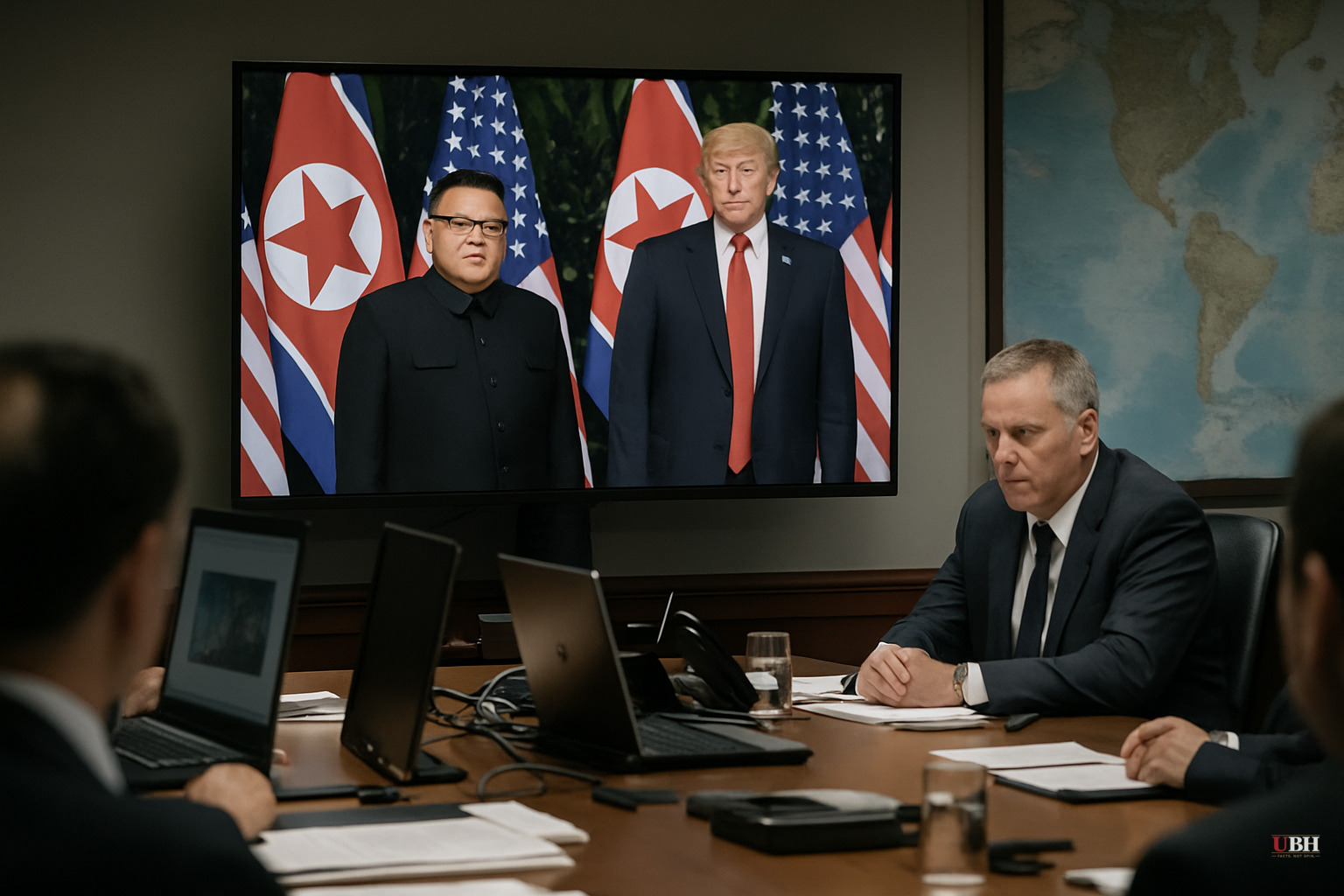
Since Trump announced the U.S.-Iran deal on Sunday, North Korea has moved from the margins back to the center of foreign policy conversation, driven largely by a single wordless social media post.
Trump uploaded a captionless photo to Truth Social on Sunday showing him and Kim Jong Un walking through a garden in Singapore on June 12, 2018. The summit was where the two leaders agreed to pursue denuclearization. The post went up roughly an hour after Trump announced the Iran agreement, according to The Korea Times. No explanation. No caption.
Park Won-gon, a professor of North Korean Studies at Ewha Womans University, told The Korea Times that the post is a deliberate Trumpian tactic: leave it open to interpretation while keeping the door to Pyongyang visible. South Korea's foreign ministry responded cautiously, saying Seoul and Washington remain open to talks with the North to resolve the nuclear issue and will coordinate closely.
The Problem: 2026 Is Not 2018
The photo Trump chose is eight years old. The world it represents is gone.
IAEA Director General Rafael Grossi has publicly described North Korea's nuclear trajectory as a "very serious increase" in capability, with clear signs of expanding uranium enrichment and production infrastructure. Newsweek reported that Grossi's assessment notes the IAEA lacks access to verify the full scale of the program, which compounds the uncertainty. The real numbers could be worse than what's publicly known.
Grossi's March 2026 Board of Governors statement flagged this explicitly. North Korea is not frozen. It is building.
Layered on top of that is Pyongyang's deepening military partnership with Russia. North Korea has supplied ammunition and personnel to support Moscow's war in Ukraine. Russia, in return, has aided North Korean military development. That relationship gives Kim leverage he did not have in 2018, and it gives him reason to be less, not more, interested in a deal with Washington.
Kim Watched What Happened to Iran
Former State Department official Joel Wit, writing in his 2025 book Fallout: The Inside Story of America's Failure to Disarm North Korea, lays out how Kim Jong Un has observed U.S. behavior toward countries without nuclear weapons. NPR reported that Kim publicly argued, in a March address to North Korea's Supreme People's Assembly, that the U.S. strikes on Iran validated his decision to build a nuclear arsenal in the first place. Wit told NPR that Kim "clearly wins first prize" in U.S.-North Korean relations over the past decade.
The North's 2022 law, now enshrined in the constitution, states that if the top leadership were killed, North Korea would automatically retaliate with all nuclear weapons, according to senior researcher Choi Yonghwan of South Korea's Institute for National Security Strategy. That is not a negotiating posture. That is a deterrence architecture designed specifically to survive the kind of decapitation strike the U.S. used in Iran.
The Strongest Case for Engagement
The argument for trying anyway is not crazy. Wit himself notes that Kim's original preference was a deal with the U.S. Nuclear weapons were plan B, chosen after diplomacy failed. If Trump can offer something credible—sanctions relief, security guarantees, economic normalization—there is at least a theoretical off-ramp. Freezing the program short of full denuclearization, even if imperfect, would be better than the trajectory Grossi is describing. South Korea's government is clearly signaling it wants that conversation to happen.
The Trump team would also argue that getting Iran to renounce nuclear weapons demonstrates leverage that previous administrations lacked, and that Kim might calculate the diplomatic environment differently now.
The Gap Between Policy Language and Reality
Newsweek's editorial board put the core problem plainly: Washington's official policy still demands "complete denuclearization" of the Korean peninsula, language repeated in White House statements. But Grossi's data points in the opposite direction. North Korea is not negotiating toward zero. It is building toward more.
Pursuing a goal that no longer matches conditions on the ground does not just waste time. It distorts the entire strategy, as Newsweek noted. Resources and diplomatic capital spent chasing an outcome that the other side has already walked away from serve no purpose.
There is a real question, not yet answered by any source, about whether Trump's opening to Kim is genuine outreach or a post-Iran victory lap, a signal to domestic audiences that he is a dealmaker without a concrete plan behind it. The IAEA's access restrictions mean any verification regime in a future agreement would face immediate credibility problems. What confidence-building measures Pyongyang would accept, and what Washington would offer short of full denuclearization, remains entirely unresolved as of June 15, 2026.
Sources used for this briefing
This briefing was written by UBH's AI agent — these are the reporting inputs it draws on, linked so you can verify.


