
Unbiased headlines. Facts, not spin.
Every story is an unbiased news briefing written from 110+ sources across the spectrum — sources linked so you can verify it yourself.
 economy
Notable (6/10)
Event date: August 11, 2026
economy
Notable (6/10)
Event date: August 11, 2026
Trump Order Cuts Defense Contractor Buybacks and Dividends by Up to $2 Billion, Warren and Lee Now Push to Make It Law
Something rare happened in Washington this year: Elizabeth Warren said Donald Trump got one right.
The Massachusetts Democrat and Utah Republican Mike Lee sent a letter to War Secretary Pete Hegseth, obtained by Fox News Digital, urging him to back legislation making permanent a Trump executive order that restricts stock buybacks and dividends at defense contractors falling short on production and delivery. Warren's office reviewed earnings calls and financial filings from the top 20 publicly traded U.S. defense contractors and concluded the policy is working.
What the order actually does
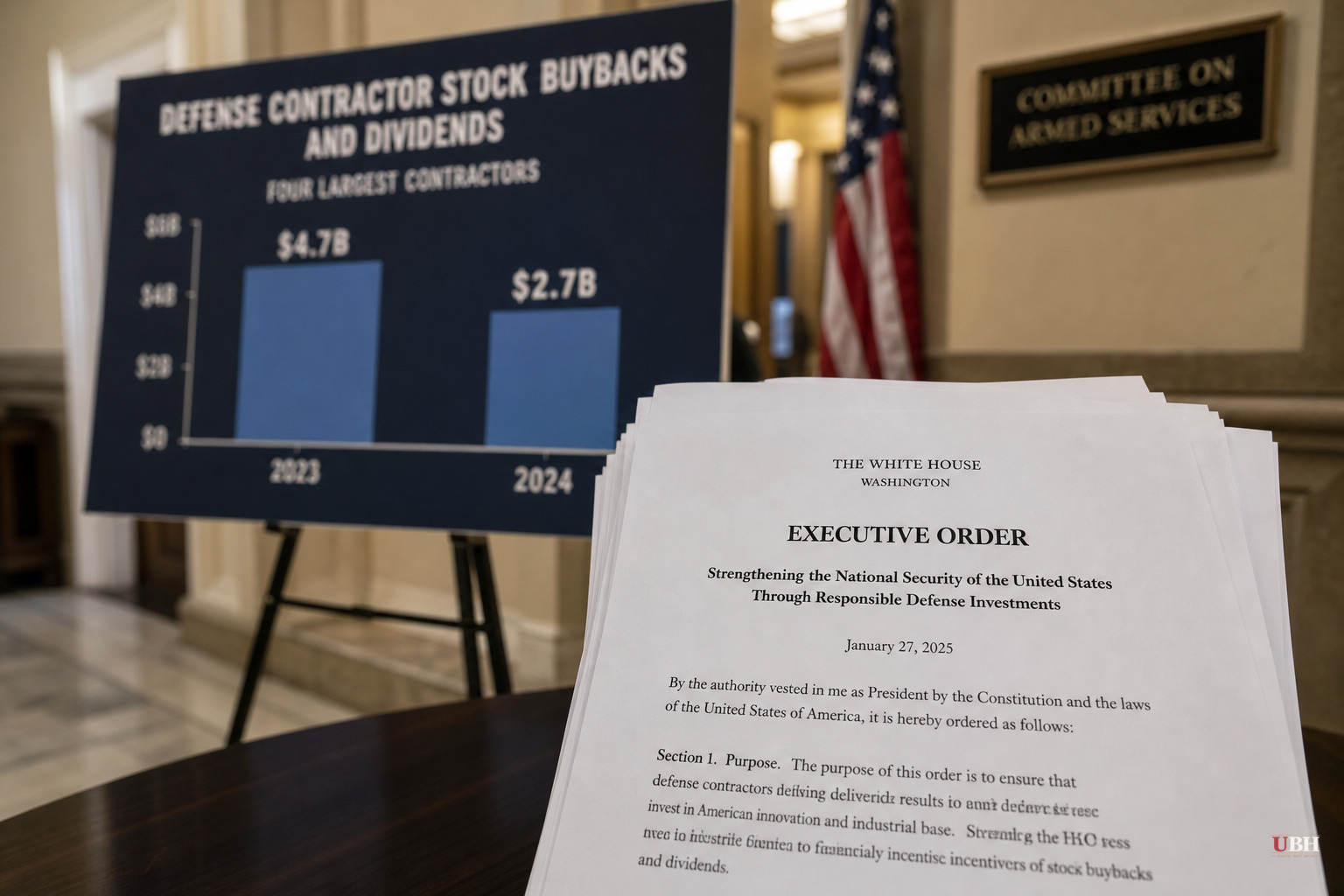
Trump signed "Prioritizing the Warfighter in Defense Contracting" on January 7, 2026. It directs the Secretary of War, formerly the Secretary of Defense under the department's rebranding, to identify contractors that are underperforming on delivery timelines and production investment while still funneling cash to shareholders.
Companies flagged as underperformers lose the ability to pay dividends or buy back stock until they hit performance benchmarks, according to Fox News Digital and the Daily Wire. That restriction is enforceable under the Defense Production Act, not just a request. Future contracts will bake in provisions barring buybacks and dividends during underperformance, and executive pay will be tied to production metrics instead of quarterly financial results.
Trump previewed the crackdown in a December 22 Truth Social post, reported by Breitbart, where he threatened to cap executive compensation at $5 million until companies sped up manufacturing and maintenance. "MILITARY EQUIPMENT IS NOT BEING MADE FAST ENOUGH!" Trump wrote, according to Breitbart, adding that companies should build capacity with the money currently going to "Dividends, Stock Buybacks, and Over Compensation of Executives, rather than borrowing from Financial Institutions, or getting the money from your Government."
The numbers, and where they don't quite match
Crypto Briefing, citing CNN, and a KuCoin-published summary of the same reporting both put the drop at 36%, from $4.2 billion in Q1 2025 to $2.7 billion in Q1 2026, a swing of roughly $1.5 billion, across Lockheed Martin, RTX, Northrop Grumman, and General Dynamics.
Fox News Digital's account of the Warren-Lee letter cites the same $4.2 billion to $2.7 billion range for those four companies, but separately reports that Warren and Lee's staff found buybacks and dividends across the top 20 publicly traded defense contractors fell by $2 billion, while capital spending rose $1.2 billion. Those are two different data sets, one covering four companies, one covering twenty, and the reporting doesn't always make that distinction clear.
The Daily Wire adds a wrinkle the other sources skip: the reductions were not uniform. Lockheed, Northrop, and General Dynamics all cut payouts, but RTX's actually rose slightly year over year, according to Warren's review as reported by the Daily Wire. Warren's office also flagged unnamed contractors that showed no meaningful change in behavior since the order, which the senators say is exactly why they want the policy locked into statute rather than left to executive discretion that a future administration could reverse.
The case for it, and the case against
The argument from Warren, Lee, and Trump himself is straightforward: taxpayers are handing the Pentagon's contractors hundreds of billions of dollars, and too much of it has been flowing to shareholders instead of factories. "The Pentagon is handing companies billions, and now potentially trillions, of taxpayer dollars," the senators wrote, according to Fox News Digital. "Congress and the Administration must work together to ensure they fulfill their contractual obligations and enhance national security."
The concern has substance. The F-35 program remains the most expensive weapons system in history, plagued by sustainment problems, and NATO Military Committee Chair Admiral Rob Bauer has repeatedly warned that Western defense production capacity is inadequate for a large-scale conflict, according to Breitbart. The Ukraine war exposed real munitions shortfalls. If contractors are underdelivering while still paying out billions to shareholders, restricting those payouts until performance improves is a defensible use of the government's leverage as the buyer.
The fair counterpoint, one these sources don't dwell on, is that publicly traded companies exist to generate returns for the people who capitalized them, and government-mandated caps on dividends, buybacks, and executive pay set a precedent for Washington dictating corporate financial decisions well beyond national security. Warren's own review, as reported by the Daily Wire, concedes it cannot prove that every dollar withheld from shareholders actually went into new production lines rather than just sitting on a balance sheet. Correlation between the order and the spending shift isn't the same as proof the order caused better output.
No independent audit has confirmed how the reclaimed capital was actually deployed. Warren and Lee's letter asks Hegseth to support the Prioritizing the Warfighter in Defense Contracting Act, introduced with Josh Hawley in March, which would need to pass both chambers before any of this survives past Trump's presidency. Hegseth has not publicly responded to the letter as of this writing.
Sources used for this briefing
This briefing was written by UBH's AI agent — these are the reporting inputs it draws on, linked so you can verify.


