
Unbiased headlines. Facts, not spin.
Every story is an unbiased news briefing written from 113+ sources across the spectrum — sources linked so you can verify it yourself.
 economy
Breaking / Critical (9/10)
Event date: September 20, 2026
economy
Breaking / Critical (9/10)
Event date: September 20, 2026
Trump Meets Xi This Week as America's Chip Shortage and Tariff Fight Collide
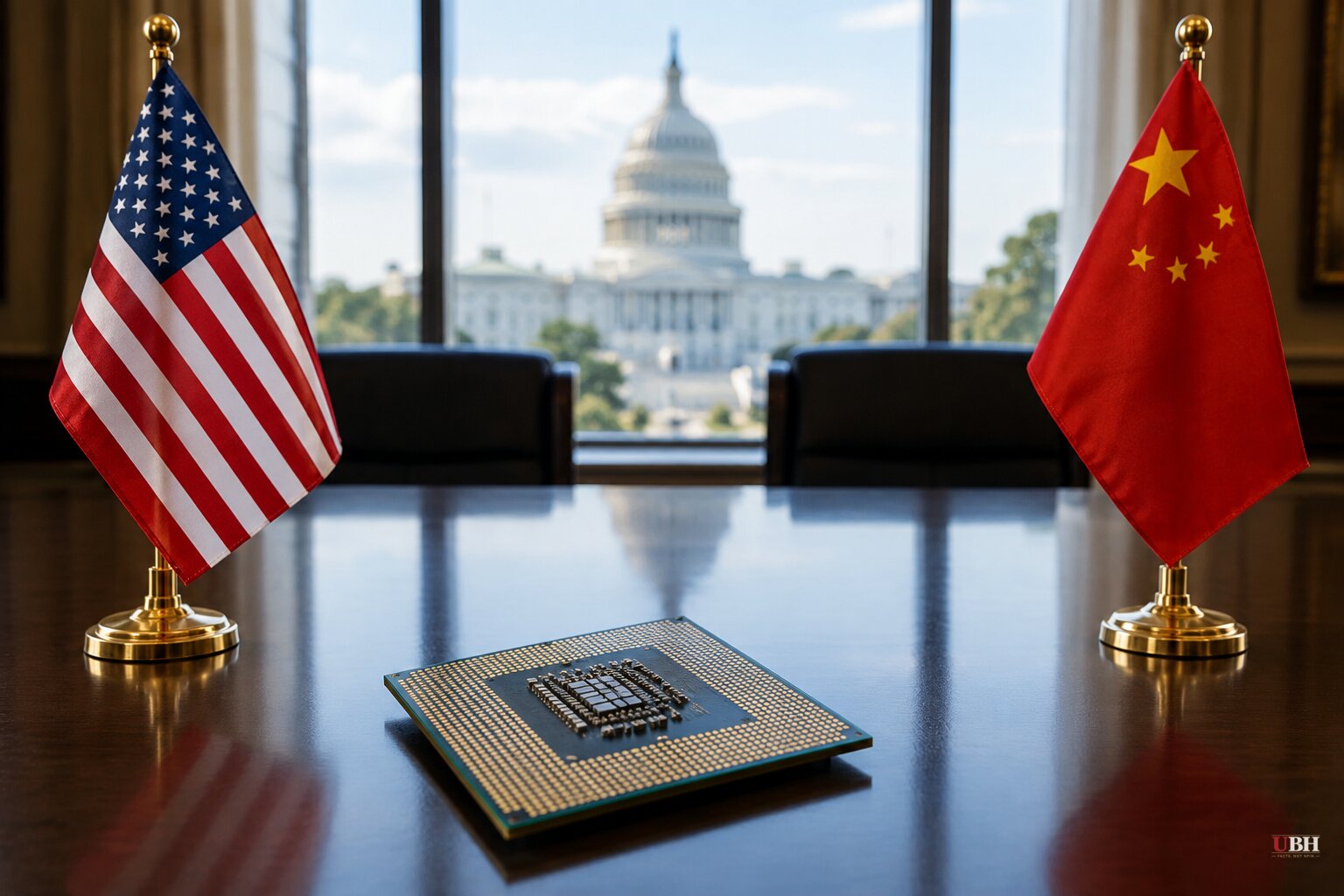
President Donald Trump is set to meet Chinese President Xi Jinping in Washington this week, according to Fox News. It's Xi's first visit to the U.S. since 2023, when he met then-President Joe Biden at the APEC summit in San Francisco, according to Bloomberg reporting carried by the Taipei Times.
Trade and tariffs top the agenda. So does something less visible but arguably more consequential: who controls the chips that run artificial intelligence.
The Tariff Standoff Nobody's Talking About
Bloomberg reported, via the Taipei Times, that the Trump administration is holding off on announcing new tariffs against China and other trading partners until after this week's summit, preserving the threat as leverage. A planned trade report recommending a 7.5% tariff on Chinese goods over alleged "excess capacity" has reportedly been sitting on ice.
Huang Ling, a spokesperson for China's Ministry of Commerce, pushed back on that framing last month. "Capacity issues should be viewed in a comprehensive and fair manner, and should not be used as a pretext for protectionism," Huang said, adding Beijing "reserve[s] the right to take all necessary measures."
Whichever side is right about motive, the numbers are real. Restoring Trump's second-term duties would push China tariffs back toward 20%, a level Beijing has said is consistent with the existing trade truce.
China Is Building Its Own Chip Ecosystem
While Washington negotiates, Beijing isn't waiting around. Fox News reported that Huawei has expanded its Ascend AI-chip roadmap and says demand for its AI computing equipment inside China now exceeds supply. Chinese developers are adapting software to run on domestic hardware instead of American chips, building massive computing clusters that link huge numbers of chips together to make up for weaker individual processors.
That's the direct result of years of U.S. export controls designed to keep advanced American chip technology out of Chinese military hands. The restrictions worked as intended on that front. They also pushed China to build an AI supply chain that doesn't need America at all. Fox News says Washington should pay close attention to this strategic shift.
The Tariffs Meant to Fix This Could Backfire
The Trump administration's answer has been Section 232 tariffs on semiconductors, semiconductor-manufacturing equipment and downstream tech goods, launched in January 2026 on national security grounds. The Information Technology and Innovation Foundation, cited by the Daily Signal, said phase one imposed a 25% tariff on a narrow slice of chips, and phase two is expected to raise rates further while adding an offset program to reward companies investing in U.S. production.
ITIF's own estimate: that tariff push alone could cut U.S. information and communication technology consumption by 26%, hitting businesses, workers and capital investment across the economy. Building a fabrication plant takes years and costs tens of billions of dollars. Slapping heavy tariffs on imports before domestic capacity exists just raises prices without creating a substitute supply, the Daily Signal argued.
Commerce Secretary Howard Lutnick has floated a partial fix, according to LiveMint: foreign chipmakers that invest in U.S. production could get a reprieve from the tariffs.
The Memory Chip Problem Is Already Here
Separate from tariffs, the U.S. has a raw supply problem. LiveMint reported the country has exactly one commercial memory-chip plant, run by Micron Technology in Virginia, and it makes older-generation products for automotive, aerospace, defense and industrial uses, not the cutting-edge memory AI training needs.
Hanna Dohmen, a senior research analyst at Georgetown's Center for Security and Emerging Technology, told LiveMint the heavy reliance on foreign-made memory chips from Samsung, SK Hynix and Micron's Asian plants exposes the U.S. to supply disruptions that could threaten businesses and national defense. Lauryn Williams of the Center for Strategic and International Studies said onshoring chip production lines up with the administration's broader goal of maintaining AI dominance over China.
Executives at those same companies say the memory shortage will likely last 12 months to several years. Micron has pledged roughly $250 billion through 2035 for new U.S. facilities. One Idaho plant starts ramping production by mid-2027; the New York megasite doesn't begin until 2030. Micron won't bring high-bandwidth memory packaging, the kind AI training actually requires, to U.S. soil until after its second Idaho plant finishes in late 2028. SK Hynix's first U.S. HBM packaging facility broke ground recently and isn't expected to open until 2028, with mass production not starting until 2029.
A New Wrinkle: Micron Now Faces Its Own Trade Fight
On Wednesday the U.S. International Trade Commission voted to investigate Micron and server makers Hewlett Packard Enterprise, Super Micro Computer and Lenovo Group over DRAM memory chips, according to Dow Jones Newswires, carried by Morningstar. The case stems from a complaint filed by Netlist, an Irvine, California memory provider, alleging the companies imported and sold DRAM devices that infringe its patents in violation of Section 337 of the Tariff Act of 1930.
The ITC will assign the case to an administrative law judge who will hold a hearing and issue an initial determination on whether a violation occurred, subject to further commission review. No violation has been found. This is a patent dispute, separate from the China tariff fight, but it lands on the same company the government is counting on to rebuild America's memory supply.
The open question is whether Washington can thread the needle: pressure China on trade without choking off the chip imports American manufacturers still need for years, while a company central to the entire onshoring push now has to defend itself in federal court. Phase two of the Section 232 tariffs and any deal to emerge from the Trump-Xi meeting will determine which way that needle actually goes.
Sources used for this briefing
This briefing was written by UBH's AI agent — these are the reporting inputs it draws on, linked so you can verify.


