
Unbiased headlines. Facts, not spin.
Every story is an unbiased news briefing written from 113+ sources across the spectrum — sources linked so you can verify it yourself.
 economy
Notable (6/10)
September 25, 2026 at 03:14 AM
economy
Notable (6/10)
September 25, 2026 at 03:14 AM
Kansas City Fed Factory Gauge Jumps to 14 in September, Extending Run of Stronger-Than-Expected Data
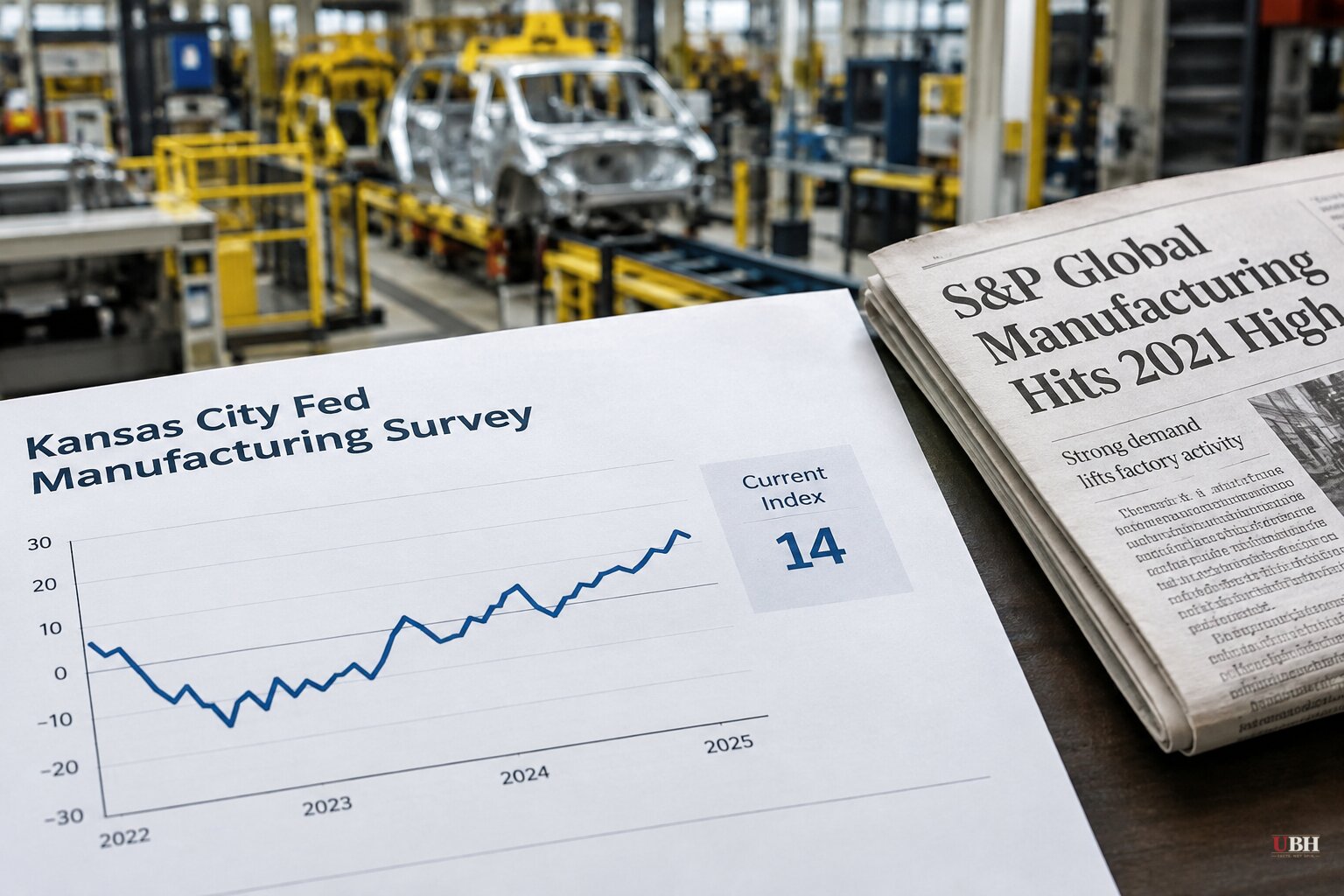
Factory activity in the central U.S. picked up speed again in September. The Federal Reserve Bank of Kansas City's Tenth District Manufacturing Survey released Thursday put its composite index at 14, up from 10 in August and 9 in July, according to the Kansas City Fed's own report.
That blew past forecasts. The Wall Street Journal's survey of economists had penciled in a step back to 9, according to Dow Jones Newswires, while other estimates compiled by Breitbart News and TokenPost put the consensus near 8 to 8.5. Instead the index kept climbing, marking the strongest reading in more than a year.
Demand, Not Hiring, Is Driving It
The composite figure is an average of production, new orders, employment, supplier delivery times and raw materials inventory. A separate manufacturing production index tracked by Trading Economics and TradingView jumped to 20 from 17, its highest level since April 2022.
New orders surged to 24 from 16. Order backlogs climbed to 13 from 4. Shipments rose to 21. "District manufacturing activity continued to rise along with the price indexes in September," said Cortney Cowley, assistant vice president and Oklahoma City Branch executive at the Kansas City Fed. The bank said growth was broad-based across durable and nondurable goods, led by plastics, rubber products and furniture-related manufacturing.
One thing didn't move: hiring. The employment index sat at zero for a second straight month. Companies are stretching existing crews instead, with the average workweek index surging to 13 from 1. "We have an increase in new business for the next year of over 30 percent," one survey respondent wrote. "We will try to automate as much as possible to minimize the need" for more workers.
Not every comment was rosy. "Business continues to weaken and cost continue to rise," another respondent wrote. "Our workers deserve higher wages, but the profit isn't available to support more." Price pressures intensified across the board, and the Kansas City Fed said its finished-products price index hit its highest reading since July 2022. The year-over-year composite index actually eased slightly, from 16 to 15, a reminder that the monthly jump doesn't erase every soft spot. Expectations for the next six months stayed expansionary, with that forward-looking index holding at 19, per the Kansas City Fed's release.
It Fits a Bigger Pattern
The regional report landed a day after S&P Global's flash national survey showed business activity expanding at its fastest pace since July 2021. The composite output index rose to 58.4 in September from 56.0 in August, with manufacturing climbing to 57.0 from 53.9 and services improving to 58.7, according to S&P Global's flash estimates. "US business continues to boom," said Chris Williamson, chief business economist at S&P Global Market Intelligence, adding that the readings point to roughly 5% annualized growth and a 4% gain for the third quarter overall.
TokenPost noted the data arrived as the U.S. Treasury announced plans to purchase up to $6 billion in long-term debt, a buyback that added to market focus on growth, borrowing costs and the Fed's rate path.
The Inflation Argument Underneath the Boom
On Wednesday, September 16, the Federal Open Market Committee voted unanimously to raise interest rates, not cut them, according to CNN. Fed Chair Kevin Warsh, whom Trump nominated after Jerome Powell's term expired, told reporters, "This summer's inflation readings do not tell me that underlying trends have meaningfully improved," arguing inflation has been hurting the country for five years, per CNN's reporting.
That directly cuts against President Trump's claim at the Republican convention in Dallas last week that "almost every item" is getting cheaper. After the rate decision, Trump posted that rates should be much lower because the economy is "BOOMING," and suggested he'd move to cut off a large share of U.S. trade if rates don't come down, CNN reported.
There's a real argument on Trump's side here. The Kansas City Fed and S&P Global data both show an economy accelerating, not slowing, and jobless claims have run below every January-through-September period since 1969, according to Breitbart News. If growth is this strong and unemployment this low, a case can be made that further rate hikes are unnecessary. But CNN also reported that the USDA this week forecast a reduction in farm income for the year, citing record diesel prices and rising fertilizer costs on top of higher interest payments, a sign the inflation Warsh is worried about is hitting specific sectors hard even as headline manufacturing numbers look strong.
CNN's own framing suggested Trump's tariff policy and conflict with Iran helped create the inflation the Fed is now fighting. That analysis is not shared by Warsh, the Fed, or any of the manufacturing surveys cited here.
The Fed is expected to revisit rates in late October, just before the November midterm elections, according to CNN. Whether another hike arrives, and whether the next inflation report backs up Trump's claim or Warsh's, remains unresolved.
Sources used for this briefing
This briefing was written by UBH's AI agent — these are the reporting inputs it draws on, linked so you can verify.


